Best Benefits Administration Software in 2026: 8 Picks
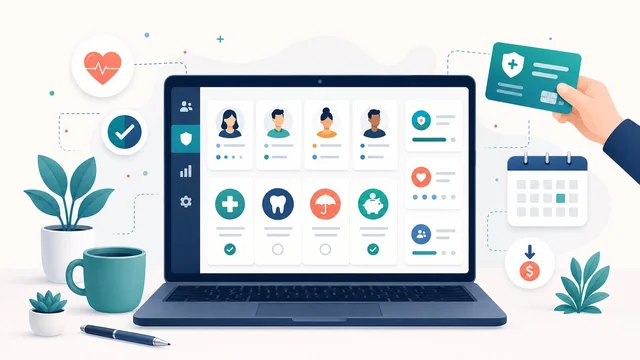
Benefits administration software is the layer between your employees and their health insurance, dental, vision, life, disability, 401(k), HSA / FSA, commuter benefits and any other employer-sponsored benefit. It runs open enrollment, manages mid-year qualifying-life-event changes, syncs payroll deductions, files ACA reports, and connects to dozens of carriers' systems through EDI feeds. In 2026 the category has consolidated heavily — most SMB customers buy benefits admin as part of an all-in-one HRIS rather than a standalone tool, and a few enterprise specialists remain at the high end. Here are the platforms worth a trial today.
Best benefits administration software in 2026 (at a glance)
| Platform | Starting price | Best for | Region |
|---|---|---|---|
| Gusto | From $40 / mo + $6 / employee | SMBs 1–100 employees | US |
| Rippling | From $8 / employee / mo | Tech SMBs that want HRIS + IT + Finance in one | US, global expansion |
| Paylocity | Custom quote (~$20 / employee / mo) | Mid-market 100–5,000 employees | US |
| BambooHR | Custom quote (~$8 / employee / mo) | SMBs that prioritise HR experience over payroll | US, CA |
| Justworks (PEO) | From $59 / employee / mo (PEO) | SMBs that want a PEO to handle compliance | US |
| TriNet (absorbed Zenefits) | From $130 / employee / mo (PEO) | Mid-market PEO clients | US |
| ADP Workforce Now | Custom quote | Enterprise + global multi-country | Global |
| Ease | Free for brokers; broker passes cost | Companies that buy benefits through a broker | US |
1. Gusto — the SMB default
Gusto is the most-used payroll + benefits platform for US SMBs in 2026. The Plus tier ($80 / month + $12 per employee) and Premium tier (custom) include full benefits administration: medical / dental / vision through Gusto’s broker, 401(k) through Guideline integration, HSA / FSA, commuter, life, disability, and pet insurance through partners. Open enrollment is self-service for employees through a polished mobile app, payroll deductions sync automatically, and ACA 1095-C filings are handled in-product. Best for: US-based companies 1–100 employees that want one tool for payroll + benefits + onboarding.
2. Rippling — the tech-SMB favourite
Rippling is the modern multi-product platform that bundles HRIS + payroll + benefits administration + IT provisioning (laptop, SaaS app provisioning) + corporate cards into one system. Strong for tech and SaaS companies that want one workflow to onboard new hires through HR, IT and benefits enrolment at once. Per-product modular pricing typically lands at $8–$15 / employee / month for the HRIS + benefits combination. Global hire-and-pay capability through Rippling EOR for international employees.
3. Paylocity — the mid-market HCM pick
Paylocity targets the mid-market (100–5,000 employees) with a full human capital management suite — payroll, benefits administration, talent management, recruiting, learning, performance, and employee engagement under one roof. Strong benefits-admin workflows with deeper carrier-connection options than the SMB-focused tools. Custom-quoted pricing typically lands at $15–$25 per employee per month. Best for: mid-market US companies that have outgrown Gusto and want a full HCM.
4. BambooHR — for HR-led organisations
BambooHR is the HRIS that consistently rates highest on user experience surveys. Benefits administration is included via the Benefits Advantage module which connects to carriers through Maxwell Health (now PlanSource) for plan setup and enrolment. Payroll is offered separately (via Trax) or via deep integration with Gusto, ADP, Paylocity etc. Best for: SMBs 25–200 employees where the HR team values UX and people-data over having one tool for everything.
5. Justworks — the SMB PEO option
Justworks is a Professional Employer Organisation (PEO). When you sign up, your employees become co-employed with Justworks for payroll, benefits and compliance purposes. The trade-off: Justworks negotiates large-group health insurance rates that small companies couldn’t access on their own (often 10–25% cheaper than direct-purchase), handles all payroll-tax filing across 50 states, and absorbs the HR-compliance burden. Cost: $59–$109 / employee / month all-in. Best for: US SMBs 5–50 employees that want big-company benefits without an HR team.
6. TriNet — mid-market PEO with deep absorption history
TriNet is the mid-market PEO that acquired Zenefits in 2022 and absorbed its core benefits tech. Today TriNet sells as a full-service PEO (full co-employment, benefits, payroll, compliance) and TriNet Zenefits (HR platform, less PEO-heavy). Pricing starts around $130 / employee / month for the full PEO; the Zenefits HR platform tier is meaningfully cheaper. Best for: scale-ups 50–500 employees that need PEO-level benefits negotiation power.
7. ADP Workforce Now — for enterprise + global
ADP Workforce Now is the enterprise standard, particularly for companies with international operations or multi-state US headcount. Strongest for organisations that need carrier-EDI connections at scale, ACA / state-specific compliance, and integrations with workforce-management tools like Kronos / UKG. Custom-quoted pricing; realistic deployments for mid-market start around $20–$30 / employee / month plus implementation. Best for: 500+ employee organisations, particularly those with multi-country payroll requirements.
8. Ease — the broker-driven option
Ease is unique: it’s a benefits administration platform sold primarily through insurance brokers rather than directly to employers. Your broker provides Ease to you (often at no direct cost to the company) and uses it to administer the policies they sold you. Strong electronic-enrollment and EDI connection library, polished employee app. Best for: companies that already buy benefits through a traditional broker and want a modern admin experience without paying separately.
What to look for when buying
- Carrier EDI feeds. The benefits-admin platform needs to push enrolment data electronically to each insurance carrier. Coverage of major carriers (Aetna, Cigna, BCBS, UHC, Anthem, Guardian, Principal, Lincoln, MetLife, Sun Life) is table-stakes; coverage of smaller regional carriers varies.
- ACA reporting (1094-C and 1095-C) included. Critical for US companies with 50+ FTEs. Gusto, Rippling, Paylocity and ADP all generate and e-file these.
- Open enrollment workflow. Modern platforms guide each employee through plan selection with cost-comparison side-by-side, recommended-plan logic (HSA-eligible HDHP vs PPO), and dependent enrollment.
- Mid-year qualifying-life-event (QLE) handling. Marriage, divorce, new child, loss of coverage. The platform should self-serve these to the employee with proper documentation collection.
- HSA / FSA / commuter benefits administration. Often a separate third-party administrator (TPA) like HealthEquity, Optum, WageWorks — verify the integration is automatic, not a manual file upload.
- COBRA administration. Continuation coverage for terminated employees. Some platforms include this; others require a separate vendor (WEX, BASIC, Tasc).
- Payroll deduction sync. Benefits enrolments automatically create payroll deductions, including pre-tax vs post-tax handling for HSA, FSA, 401(k), commuter, etc.
- State-by-state insurance compliance. Some states (California, New York, Massachusetts, Hawaii) have additional benefits-compliance requirements. Check coverage for the specific states where you employ people.
What changed in 2025–2026
- Zenefits is now TriNet Zenefits / TriNet HR Platform. If older comparison posts still mention Zenefits standalone, it’s been part of TriNet since the 2022 acquisition.
- Maxwell Health became PlanSource. If you see Maxwell referenced as a BambooHR or broker partner, that’s the same underlying tech.
- ICHRA adoption. Individual Coverage Health Reimbursement Arrangements have grown rapidly through 2024–2026 as an alternative to traditional group health plans. Most major benefits-admin platforms now support ICHRA workflows (Gusto via Take Command, Rippling natively, ADP via partners).
- AI-driven plan recommendations. Gusto, Rippling and Paylocity all rolled out AI plan-recommendation engines in 2024–2025 — based on the employee’s health-spending history (if available), family size and risk tolerance, the system recommends the optimal medical plan during open enrollment.
Frequently asked questions
What is the best benefits administration software for small businesses?
For most US SMBs 1–100 employees, Gusto Plus or Premium ($80 / mo + $12 per employee) covers payroll, benefits administration, onboarding, time-off and ACA reporting in one tool. For tech-leaning SMBs that also want IT and laptop provisioning bundled in, Rippling is the modern alternative. For SMBs that prefer the HR-led BambooHR experience and don’t mind having a separate payroll system, BambooHR + Gusto-or-Trax payroll is also strong.
PEO vs traditional benefits administration — which is better?
A PEO (Justworks, TriNet, Insperity) co-employs your workforce and lets you access large-group insurance rates plus offloads payroll-tax and HR-compliance complexity. The trade-off: less control over plan selection (you pick from the PEO’s plan menu), higher per-employee cost ($60–$150 / employee / month), and you swap PEO for direct-purchase if you outgrow them. A traditional benefits-admin platform (Gusto, Rippling, BambooHR) lets you keep your own broker and plan selection, costs less per employee, and scales better past 100 employees. Most SMBs under 50 with no HR team save money via PEO; companies with an HR team or 100+ employees usually do better direct.
Does benefits administration software include the actual insurance?
No — benefits-admin software is the technology layer. The insurance itself comes from carriers (UnitedHealthcare, Cigna, Aetna, BCBS, Guardian, etc.) and is sold by a broker (Gusto Benefits, Rippling Insurance Services, your existing broker, or a PEO’s in-house broker). The software handles enrolment, payroll deductions, ACA reporting and life-event changes; the underlying policies live with the carrier.
How much does benefits administration software cost in 2026?
For SMBs: $6–$15 / employee / month bundled with payroll (Gusto, Rippling, BambooHR, Paylocity Lite). For mid-market HCM: $15–$30 / employee / month (Paylocity, ADP Workforce Now). For full-service PEOs: $59–$150 / employee / month all-in (Justworks, TriNet, Insperity). For broker-distributed platforms (Ease, Employee Navigator) the cost is often absorbed by the broker and not directly billed to the employer.
What is the difference between an HRIS and benefits administration software?
An HRIS (Human Resources Information System) manages the full employee record — personal info, job history, compensation, performance reviews, time-off, documents. Benefits administration is one module of an HRIS that specifically handles enrolment and management of employee benefits (health, dental, vision, retirement, etc.). In 2026 almost no SMB buys a standalone benefits-admin tool — it’s purchased as a feature of an all-in-one HRIS / payroll platform like Gusto, Rippling, BambooHR or Paylocity.
For more workplace-software guides, see our top 10 expense report software roundup and the best digital signature software picks.