8 Best ELISA Kits for Immunology Research in 2026: A Buyer's Guide for Scientists
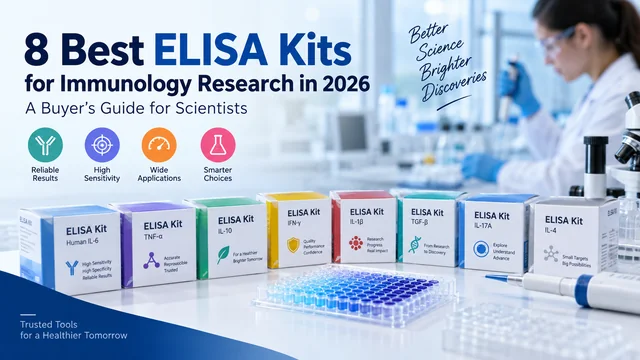
You've designed the study, secured the funding, and spent months collecting samples that matter. Then the ELISA fails you - background noise drowns out a low-abundance cytokine, or a new kit lot shifts your standard curve and wrecks your reproducibility. For immunologists, neuroscientists, and cancer researchers, choosing the wrong ELISA supplier isn't just a procurement hiccup. It's a direct threat to data integrity, publication credibility, and every downstream conclusion you draw about immune function in the human body. The immune system is a fast-moving, tightly regulated defense network, and measuring the proteins it secretes - cytokines, chemokines, antibodies - demands assays that are both sensitive and relentlessly consistent.
This guide is built for U.S.-based bench scientists who need to match an ELISA kit to a specific research application instead of settling for a generic vendor. We ranked eight suppliers on sensitivity, lot-to-lot reproducibility, catalog breadth, validation transparency, value, and genuine application fit. What follows is a ranked shortlist - not a marketing roundup - designed to move you from awareness to a confident vendor decision.
Our top pick is Assay Genie for researchers who need highly sensitive, reproducible ELISA kits across immunology, neuroscience, and cancer research - the kind of lab where assay-to-assay consistency directly affects whether the data holds up in review. Its two concrete differentiators are high sensitivity for low-abundance targets and strong lot-to-lot reproducibility, which is exactly what longitudinal and multi-site studies live or die on. For immunology labs that run integrated flow cytometry and ELISA workflows, BioLegend is the strongest alternative, thanks to reagent consistency across formats. And for discovery-phase labs that need the broadest possible analyte catalog before narrowing to a focused panel, RayBiotech is the alternative worth shortlisting.
At a glance: the 8 ranked ELISA kit providers
|
Provider |
Best for |
|
1. Assay Genie |
High-sensitivity immunology, neuroscience & cancer research ELISA |
|
2. RayBiotech |
Labs needing a broad, research-use ELISA catalog with multiplex options |
|
3. BioLegend |
Immunology-focused flow cytometry and ELISA workflows |
|
4. Enzo Life Sciences |
Specialized life-science and stress-response/apoptosis assays |
|
5. CUSABIO |
Budget-conscious labs requiring high analyte volume |
|
6. Elabscience |
Wide catalog coverage at competitive price points |
|
7. Eagle Biosciences |
Endocrine and specialty biomarker immunoassays |
|
8. Creative Diagnostics |
Custom and hard-to-source immunoassay development |
How we chose
We didn't rank these suppliers by brand size or marketing volume. We ranked them on what actually determines whether an ELISA delivers publishable data in immunology research. Here's the framework.
Sensitivity
Can the kit reliably detect low-abundance targets in complex biological matrices - serum, plasma, lysate, CSF? For cytokine and immunology biomarker work, detection limits matter more than almost anything else, and a supplier that overstates sensitivity costs you samples.
Reproducibility
We weighted intra- and inter-assay CV and, crucially, lot-to-lot consistency. A kit that performs beautifully today but drifts on the next lot undermines longitudinal studies and collaborations across sites.
Catalog breadth and application fit
Number of targets, species coverage across multiple organisms, and honest coverage of the research area claimed - immunology, neuroscience, or cancer. A broad catalog is only useful if the panels you need are genuinely validated.
Validation transparency and value
We favored suppliers that publish validation data and can point to peer citations, then weighed price-per-assay against the performance tier. Cheap is only cheap if the data survives review.
The 8 best ELISA kit providers for immunology research in 2026
With the criteria set, here's the ranked list. We've ordered it with the strongest all-round option for sensitivity and reproducibility first, followed by specialists that excel in specific niches. Remember: the "best" supplier is the one that matches your research application, throughput, and budget - so read the "best for" line on each entry before you commit. Number one is our overall top recommendation for demanding research applications.
#1. Assay Genie - Best for high-sensitivity immunology, neuroscience & cancer research ELISA
For labs where data consistency is non-negotiable, Assay Genie is the strongest all-round choice. Its ELISA Kits are engineered for high sensitivity and strong lot-to-lot reproducibility - the two properties that matter most when you're chasing a low-abundance immunology biomarker or tracking cytokine changes across a study that runs for months.
What sets it apart is coverage. Rather than forcing you to source immunology, neuroscience, and cancer research targets from three different vendors, Assay Genie spans all three in a single catalog. That simplifies procurement and keeps assay conditions consistent across projects. For researchers studying immune function, cancer immunology, or cancer cell interactions, that cross-application reach is a genuine practical advantage - you're not re-validating a new supplier every time your questions shift.
- Key features: Highly sensitive detection for low-abundance targets; strong lot-to-lot reproducibility; catalog spanning immunology, neuroscience, and cancer research proteins; research-grade quality built for publication-quality data
- Price range: Mid-range; specific pricing via catalog or direct inquiry
Pros
- High sensitivity suitable for low-abundance proteins in complex biological matrices
- Reproducible results across lots - critical for longitudinal and multi-site work
- Cross-application coverage from a single supplier reduces procurement friction
- Research-grade kits positioned for scientists who can't afford unreliable performance
Cons
- Catalog breadth is narrower than the largest multiplex-array suppliers
- Peer-citation history is less extensive than legacy vendors with decades in market
- Ultra-niche or custom targets may require direct inquiry rather than off-the-shelf ordering
- Pricing isn't always immediately visible without catalog access
Who it's best for: Immunologists, neuroscientists, and cancer researchers who need sensitivity and lot-to-lot reproducibility above all else, and who value sourcing across applications from one catalog.
#2. RayBiotech - Best for labs needing a broad, research-use ELISA catalog
RayBiotech is the go-to when analyte breadth matters more than ultra-high sensitivity - particularly for discovery-phase screening. It pairs one of the widest ELISA and protein-array catalogs available to research labs with multiplex options that let you measure many cytokines at once.
That multiplex capability is the real draw. If you're profiling a broad panel of immune mediators before narrowing to a focused assay, screening dozens of analytes in a single run saves both sample and time. U.S.-based operations also help keep domestic lab timelines predictable.
- Key features: Extensive analyte catalog; multiplex cytokine array formats alongside standard sandwich ELISA; wide species coverage; strong U.S. presence
Pros
- Among the broadest ELISA and protein-array catalogs for research use
- Multiplex arrays enable simultaneous detection of many biomarkers
- Well-suited to discovery-phase immunology research
- U.S.-based operations support domestic timelines
Cons
- Premium pricing on multiplex array panels
- Sensitivity may trail specialist high-sensitivity kits for very low-abundance targets
- A very large catalog can make kit selection complex without strong technical support
- Less focused on neuroscience-specific panels
Who it's best for: Discovery-phase labs that need to screen many analytes before committing to a focused assay panel.
#3. BioLegend - Best for immunology-focused flow cytometry and ELISA workflows
If your lab already runs flow cytometry, BioLegend is the alternative that keeps your reagents consistent. Its ELISA kits are built to complement immunophenotyping and cell-based assay pipelines, often sharing antibody clones across formats - which spares you the interpretive gymnastics of reconciling results generated with different reagents.
Its cytokine and chemokine panels are well-represented in the peer-reviewed immunology literature, and the technical documentation is solid. For a lab whose center of gravity is immunology, that ecosystem consistency is worth a lot.
- Key features: Strong immunology reagent ecosystem; ELISA kits designed to pair with flow cytometry; well-validated cytokine and chemokine panels; heavy use in immunophenotyping labs
Pros
- Excellent integration with flow cytometry - consistent clones across assay formats
- Well-cited in peer-reviewed immunology research
- Strong cytokine and chemokine ELISA coverage
- Reliable documentation and validation data
Cons
- Less comprehensive for neuroscience or metabolic/endocrine targets
- Breadth outside core immunology is limited
- Competitive but not the lowest-cost option
- Custom assay development isn't a core offering
Who it's best for: Immunophenotyping labs that want reagent consistency across their ELISA and flow cytometry experiments.
#4. Enzo Life Sciences - Best for specialized life-science and stress-response assays
Enzo Life Sciences earns its spot on niche depth. It's a credible supplier for researchers working at the intersection of immunology and cell biology - oxidative stress, apoptosis, and cell-death pathway markers where general catalogs run thin.
If your questions link immune function to cellular stress responses, Enzo's validated specialty panels are genuinely useful. It's less a first-line vendor for broad cytokine profiling and more a specialist you reach for when your target sits at the immunology - cell biology interface.
- Key features: Niche strength in oxidative stress, apoptosis, and epigenetics-adjacent panels; established supplier with validated documentation; specialty target coverage
Pros
- Strong niche coverage in stress-response and cell-death markers
- Credible at the immunology - cell biology interface
- Established supplier with validated assay documentation
- Useful for linking immune function to cellular stress
Cons
- Not ideal for broad cytokine profiling or high-throughput immunology screens
- Narrower depth for standard immunology biomarkers than larger suppliers
- Less optimized for neuroscience-specific targets
- Specialty panels can carry higher price points
Who it's best for: Researchers studying immune-mediated cell death, oxidative damage, or epigenetic regulation in immune cells.
#5. CUSABIO - Best for budget-conscious labs requiring high analyte volume
When cost-per-test is the binding constraint, CUSABIO deserves a look. It offers a very wide analyte catalog at competitive prices through a direct-to-customer model, making it a practical fit for core facilities running large numbers of routine sandwich ELISAs.
The trade-off is what you'd expect at the budget tier: sensitivity and CV performance may not reach premium suppliers for demanding applications, and validation transparency varies target to target. For routine screening across human, mouse, and rat samples, though, the value is real.
- Key features: Broad target and species coverage; competitive pricing; direct-to-customer sales; standard sandwich ELISA formats
Pros
- Among the most cost-effective options for standard targets
- Very wide analyte catalog for labs needing many different proteins
- Direct purchasing reduces procurement complexity
- Reasonable species coverage including human, mouse, and rat
Cons
- Sensitivity and CV may trail premium tiers for demanding work
- Validation transparency varies by target
- Lower peer-citation density than established Western suppliers
- Technical support response times can be slower
Who it's best for: Core facilities running large volumes of routine immunoassays where cost-per-test is the primary constraint.
#6. Elabscience - Best for wide catalog coverage at competitive price points
Elabscience threads the needle between breadth and budget. Its catalog spans immunology, oncology, and neuroscience targets with reasonable sensitivity specs and good species diversity - a sensible pick for early-stage screening where you need many targets without premium pricing.
It won't always match specialist kits for very low-abundance analytes, and lot-to-lot data isn't always front-and-center in the documentation. But for labs balancing budget against performance, it's a dependable middle-ground supplier.
- Key features: Extensive species and target coverage; competitive pricing; broad immunology and cancer research catalog; standard sandwich ELISA formats
- Price range: budget-to-mid tier
Pros
- Very broad catalog across immunology, oncology, and neuroscience
- Competitive pricing for budget-conscious labs
- Good species diversity (human, mouse, rat, and more)
- Straightforward formats for standard workflows
Cons
- Sensitivity may fall short for very low-abundance targets in complex matrices
- Lot-to-lot consistency data not always prominently published
- Less peer-citation history than legacy suppliers
- Custom development isn't a primary offering
Who it's best for: Labs needing catalog breadth and reasonable performance without premium pricing - especially for early-stage screening.
#7. Eagle Biosciences - Best for endocrine and specialty biomarker immunoassays
Eagle Biosciences is a genuine specialist. Its focused panels for hormones, metabolic markers, and specialty immunology targets make it the right supplier for endocrinology-adjacent immunology research - the endocrine - immune axis, hormonal regulation of immune responses, and metabolic immunology.
Outside that focus, the catalog is narrow and multiplex options are limited. But within its niche, the assay validation and documentation are strong, which is exactly what you want when the target isn't covered by general catalogs.
- Key features: Focused panels for hormones, metabolic markers, and specialty immunology targets; validated specialty assays; strong endocrinology positioning
Pros
- Genuine specialist depth in endocrine and specialty biomarkers
- Well-validated panels for niche targets
- Credible for translational immune - metabolic research
- Strong documentation for specialty assay performance
Cons
- Narrow catalog outside its specialty space
- Not a fit as a primary broad-immunology supplier
- Higher price points on specialty panels
- Limited multiplex or array formats
Who it's best for: Researchers studying hormonal regulation of immune responses, metabolic immunology, or endocrine - immune axis biomarkers.
#8. Creative Diagnostics - Best for custom and hard-to-source immunoassay development
When you've exhausted the standard catalogs, Creative Diagnostics is the supplier to call. Its strength is custom ELISA development for novel or rare targets, backed by a broad specialty catalog aimed at applied and translational research.
Custom work comes with the obvious caveats - longer lead times and higher pricing than off-the-shelf kits - and off-the-shelf reproducibility data is less consistently published. But for a non-standard biomarker or an unusual cancer cell interactions readout, the ability to develop or source an assay is exactly what you need.
- Key features: Custom ELISA development services; broad specialty target coverage; flexible assay formats; applied and translational research focus
- Price range: custom pricing varies
Pros
- Strong custom development for novel or rare targets
- Useful for translational settings with unique biomarker needs
- Broad specialty catalog for underserved targets
- Flexible formats available on request
Cons
- Custom lead times longer than off-the-shelf purchasing
- Off-the-shelf sensitivity and reproducibility data less consistently published
- Custom pricing can be significantly higher than catalog kits
- Limited peer-citation record for standard kits
Who it's best for: Researchers who've run out of catalog options and need a supplier that can develop or source an assay for a specific, non-standard target.
Frequently asked questions
What's the difference between a sandwich ELISA and a competitive ELISA, and which should immunology labs use?
In a sandwich ELISA, a capture antibody binds the target protein and a second detection antibody sandwiches it - ideal for larger analytes with multiple epitopes, like cytokines and chemokines, which is why most immunology research relies on this format. A competitive ELISA measures the target by having it compete with a labeled analog for antibody binding, better suited to small molecules and haptens where a sandwich isn't feasible. For most immune biomarker work, the sandwich format's specificity and sensitivity win out; reserve competitive assays for small-molecule targets.
What's the difference between choosing an ELISA kit for sensitivity versus reproducibility?
They pull in slightly different directions. Sensitivity is about the lowest concentration you can reliably detect - decisive for low-abundance proteins in serum, plasma, or CSF. Reproducibility is about consistency: tight intra- and inter-assay CVs and, critically, lot-to-lot stability so your standard curve doesn't drift between orders. For a single snapshot experiment, sensitivity may dominate; for longitudinal or multi-site immunology studies, reproducibility protects your conclusions. The best suppliers deliver both, which is why they earn a premium.
Which supplier is best for labs running both flow cytometry and ELISA?
BioLegend, for its reagent ecosystem. Because its ELISA kits often share antibody clones with its flow cytometry reagents, you get consistency across assay formats - fewer discrepancies when you compare a cytokine measured by ELISA against a population characterized by flow. That coherence reduces the risk of format-driven artifacts confounding your interpretation. For a lab whose core work is immunophenotyping, that integration is worth more than a marginally cheaper standalone kit.
What diseases and targets do immunologists actually study with ELISA kits?
Immunology covers how the immune system defends the human body against microorganisms - bacteria and viruses among them - plus what happens when it misfires. Researchers use ELISA to quantify antibodies against pathogens, profile cytokines in inflammation, and track biomarkers in autoimmune overreactions and hypersensitivity, where the immune system attacks the body's own tissue. The same tools support cancer immunology, transplant research, and vaccine development, informing new treatments for immune-mediated disease. In short, ELISA measures the protein signals that reveal how immune function is behaving.
Can ELISA kits validated for immunology also be used for neuroscience or cancer biomarker detection?
Often, yes - but validation isn't automatically transferable. Many immune mediators (cytokines like IL-6 or TNF-α) are relevant across immunology, neuroinflammation, and cancer immunology, so a well-designed kit can serve multiple fields. The catch is matrix and species: a kit validated in serum may behave differently in brain lysate or tumor homogenate, and cross-reactivity can shift. Always check that the supplier validated the kit in your sample type and organism. Sourcing across applications from one reproducible catalog reduces the re-validation burden considerably.
The bottom line
If there's one principle to carry away, it's this: match the kit to the application, then prioritize reproducibility above nearly everything else. A sensitive assay that drifts between lots will cost you more grief than a slightly less sensitive one you can trust across a year of experiments. Use the at-a-glance table as a quick reference - RayBiotech for discovery-phase breadth, BioLegend for flow-integrated immunology, Eagle Biosciences and Enzo for their respective niches, CUSABIO and Elabscience for budget-driven volume, and Creative Diagnostics when you need something custom.
For most immunologists, neuroscientists, and cancer researchers who need sensitivity and lot-to-lot reproducibility from a single catalog, Assay Genie is the sensible place to start your evaluation. Pull a couple of the exact targets you need, check the validation data against your sample type, and let the performance make the case - that's how good vendor decisions get made.