The Top Universities in China for International Students 2026
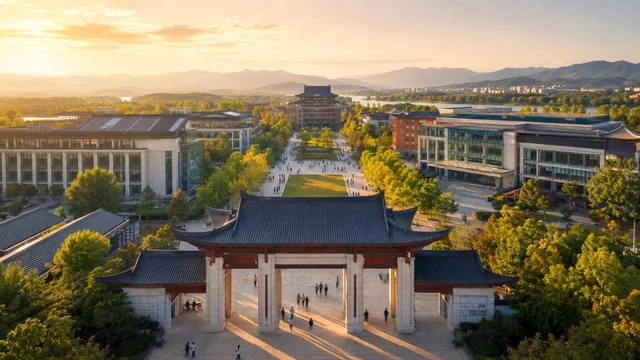
China has quietly become one of the world's most ambitious higher-education destinations, with five mainland universities now sitting inside the QS Top 100 and dozens of fully English-taught degrees aimed at international students. The combination of world-class research, comparatively modest tuition, and the generous Chinese Government (CSC) Scholarship has drawn hundreds of thousands of overseas students each year since the early 2010s. This 2026 guide covers the seven universities most worth applying to, plus the application, visa, and scholarship steps you'll actually need.
Key takeaways:
- Five mainland Chinese universities now sit inside the QS Top 50 in 2026, led by Peking (#14) and Tsinghua (#17).
- Most top universities offer English-taught programs in business, engineering, public policy, and medicine, so fluent Mandarin is not required.
- Tuition is far cheaper than in the US or UK, and the CSC scholarship can cover tuition, housing, insurance, and a monthly stipend.
- Type A CSC applications go through the Chinese embassy; Type B applications go directly to the university and often have earlier deadlines.
- International students need an X1 visa for programs over 180 days, converted to a residence permit within 30 days of arrival.
Why study in China in 2026?
China's top universities have closed much of the gap with their Western peers over the past decade. In the QS World University Rankings 2026, Peking University holds steady at #14 and Tsinghua University climbs to #17 — both ahead of Cornell and most of continental Europe. Fudan (#30), Shanghai Jiao Tong (#47), and Zhejiang (#49) round out a remarkable five-in-the-top-50 showing for mainland China.
For international students, the appeal is practical. Tuition at flagship universities typically runs between USD 4,000 and USD 13,000 a year — a fraction of comparable US or UK programs — and living costs in most cities sit well below Western capitals. English-taught bachelor's, master's, and PhD programs have multiplied since 2015, so you no longer need fluent Mandarin to study engineering, business, public policy, or medicine. And the Chinese Government Scholarship (CSC), administered by the China Scholarship Council, covers tuition, accommodation, health insurance, and a monthly stipend for thousands of students each year.
The trade-offs are real too: visa policy, internet restrictions, and shifting geopolitics can affect long-term plans. But for a degree that opens doors across Asia and at a manageable cost, the case for China in 2026 is stronger than at any point since universities first began recruiting overseas students in the early 2010s.
1. Tsinghua University (Beijing)
Tsinghua is China's engineering, computer science, and AI powerhouse, ranked #17 in the QS World University Rankings 2026 and consistently #1 or #2 in Asia. Founded in 1911 on the grounds of a former imperial garden in northwest Beijing, it produces a disproportionate share of China's tech founders, Politburo members, and top researchers.
For international students, two flagship programs stand out. The Schwarzman Scholars program — launched in 2016 and modelled on the Rhodes — offers a fully funded one-year master's in Global Affairs to roughly 150 students a year, taught entirely in English. Tsinghua-MIT Global MBA and the School of Economics and Management's English-track programs draw strong international cohorts. Undergraduate international admission is competitive but increasingly open, with English-taught tracks in economics, environmental engineering, and computer science.
2. Peking University (Beijing)
Peking University (PKU, or "Beida") is Tsinghua's traditional rival and China's leading humanities, social sciences, and basic sciences institution. It sits at #14 in the QS World University Rankings 2026 — the highest-placed mainland Chinese university and third in Asia behind only the National University of Singapore and the University of Hong Kong.
PKU's Yenching Academy, established in 2014, offers a fully funded English-taught master's in China Studies with around 125 international students per cohort. The National School of Development runs the well-regarded BiMBA program in partnership with international business schools. PKU also hosts a strong international PhD pipeline in physics, chemistry, and economics, and accepts CSC Type A and Type B scholarship students across most departments.
3. Fudan University (Shanghai)
Fudan made one of the biggest 2026 jumps among Chinese universities, climbing to #30 in the QS World Rankings. Based in Shanghai's Yangpu district, it is China's strongest all-rounder in humanities, journalism, medicine, and business, with a particularly international flavour thanks to Shanghai's expat community.
The Fudan International School of Finance (FISF) runs an English-taught MBA and Master of Finance that are now genuinely competitive with regional peers like HKUST and NUS. Fudan's medical school (the former Shanghai Medical University) offers an MBBS program for international students in English, and the School of International Relations and Public Affairs hosts well-regarded English-taught master's programs. Fudan is a popular CSC Type B host and partners with dozens of overseas universities for exchange.
4. Shanghai Jiao Tong University
Shanghai Jiao Tong University (SJTU) ranks #47 globally in QS 2026 and is consistently considered the strongest engineering school in eastern China. Founded in 1896, it has a particularly powerful presence in mechanical engineering, naval architecture, materials science, and biomedical engineering, plus a fast-rising AI institute.
The Antai College of Economics and Management runs accredited English-taught MBA and master's programs, and the SJTU-ParisTech Elite Institute of Technology (SPEIT) offers a six-year French/English engineering track that is unusual in China. SJTU Medical School, formed from a 2005 merger with the former Shanghai Second Medical University, runs an English-taught MBBS aimed at international students. SJTU is also a major CSC scholarship host.
5. Zhejiang University (Hangzhou)
Zhejiang University (ZJU) sits at #49 in QS 2026 and is China's largest top-tier comprehensive university, with seven campuses in and around Hangzhou. Its core strengths are engineering, computer science, agriculture, and biomedical sciences, and it has a deep relationship with the tech ecosystem built around Alibaba, NetEase, and Hikvision — all headquartered in the same city.
ZJU's International College runs English-taught undergraduate and graduate programs in business, engineering, and biomedical sciences, and the International Campus in Haining hosts joint programs with the University of Edinburgh and the University of Illinois Urbana-Champaign. For students interested in tech entrepreneurship or applied AI, ZJU's proximity to Hangzhou's startup scene is a genuine advantage.
6. University of Science and Technology of China (USTC, Hefei)
USTC, based in Hefei in Anhui province, is China's most research-intensive university per capita and a quiet giant in physics, quantum information, materials science, and computer science. It's the home base of the team behind the Jiuzhang quantum computer and a long string of breakthroughs in cold-atom physics.
USTC is smaller and more academically focused than the Beijing and Shanghai giants — undergraduate cohorts are tight, and the culture leans heavily toward research from year one. For international PhD students in the physical sciences, USTC is one of the most rewarding choices in Asia, with strong CSC scholarship support and an English-taught Master of Physics program. Hefei itself is more affordable than the tier-1 cities, which helps stretch a stipend.
7. Nanjing University
Nanjing University rounds out the list as one of China's oldest and most respected comprehensive universities, with particular strength in astronomy, atmospheric sciences, geology, chemistry, and Chinese literature. It has been a fixture of the QS Top 150 for several years and has invested heavily in English-taught graduate programs through its Kuang Yaming Honors School and the Hopkins-Nanjing Center, a long-running joint program with Johns Hopkins SAIS.
For students who want a serious academic environment in a historic city — Nanjing was China's capital several times over and has a calmer pace than Beijing or Shanghai — it's an under-rated option, and CSC funding is widely available.
How to apply as an international student
The process for international applicants is more standardised than it used to be, but still varies by university and program. The core steps:
- Pick programs and check the language of instruction. Chinese-taught programs typically require HSK Level 4 for undergraduate admission and HSK 5 for master's and PhD; the top humanities programs at Peking and Fudan often want HSK 6. English-taught programs require IELTS 6.0–6.5 or TOEFL iBT 80–90.
- Apply directly to the university's international office, usually through an online portal, between roughly December and April for the September intake. Required documents typically include transcripts, two recommendation letters, a study plan, passport copy, physical examination form, and a non-criminal record certificate.
- Apply for the CSC scholarship in parallel if you want full funding (see next section).
- Receive your admission letter and JW202 form (issued by the Ministry of Education for scholarship students; self-funded students get a JW201). Both are needed for the visa.
- Apply for an X1 visa at a Chinese embassy or consulate for studies longer than 180 days. Within 30 days of arrival, you convert the X1 into a residence permit at the local Public Security Bureau.
Costs and scholarships
Tuition at top Chinese universities for international students typically runs:
- Undergraduate: USD 4,000–8,000 per year
- Master's (taught): USD 5,000–13,000 per year (MBA programs higher)
- PhD: USD 5,000–10,000 per year
- MBBS (English-taught medicine): USD 6,000–9,000 per year
Living costs vary sharply by city. Budget roughly USD 600–900 per month in Beijing or Shanghai, USD 400–600 in Hangzhou, Nanjing, or Hefei.
The Chinese Government Scholarship (CSC), administered by the China Scholarship Council, is the main funding route. There are two main paths:
- Type A — Bilateral Program: a full scholarship covering tuition, on-campus accommodation, comprehensive medical insurance, and a monthly stipend (around CNY 2,500 for undergraduates, CNY 3,000 for master's, CNY 3,500 for PhD). You apply through the Chinese embassy or the dispatching authority in your home country. The 2026 application window runs roughly December 15, 2025 to April 30, 2026, depending on country.
- Type B — University Program: a similar full package, but you apply directly to the university (which nominates you to CSC). University deadlines are usually earlier — often January or February — and competition varies a lot by department.
Most universities also offer their own scholarships: the Tsinghua Schwarzman, Peking Yenching, Shanghai Government Scholarship, and Zhejiang ZJU Scholarship are all worth looking at if CSC doesn't come through. Age limits broadly apply: under 25 for undergraduates, 35 for master's, 40 for doctoral applicants.
How to Pick a Chinese University as an International Student
Rankings are a useful starting point, but for international students they shouldn't be the deciding factor. The right question is usually: does this university actually run my program in a language I can study in, in a city I can live in, with funding I can get? A CSC-funded master's at USTC in Hefei may be a far better outcome than a self-funded place at Peking that drains your savings.
Three filters tend to matter most. First, language of instruction: confirm in writing that your specific program is English-taught (or that your HSK level is sufficient), because department websites are often out of date. Second, city fit: Beijing and Shanghai give you the biggest expat communities and job markets but cost more; Hangzhou, Nanjing, and Hefei are cheaper and more academically focused. Third, funding path: decide early whether you'll go Type A (through your home-country embassy) or Type B (direct to the university), and align your application calendar accordingly.
Finally, talk to current international students. Every top Chinese university has active WeChat and Discord groups, and a 20-minute chat with someone already in the program will tell you more about housing, visa renewals, and supervisor relationships than any brochure.
Sources & Further Reading
- China Scholarship Council (CSC)
- Study in China Ministry of Education
- QS World University Rankings
- Times Higher Education World Rankings
Frequently Asked Questions
What are the top universities in China for international students in 2026?
In the QS World University Rankings 2026, the top mainland Chinese universities are Peking University (#14), Tsinghua University (#17), Fudan University (#30), Shanghai Jiao Tong University (#47), and Zhejiang University (#49). USTC and Nanjing University round out the strongest options for international applicants. All seven host English-taught programs and accept CSC scholarship students.
Do I need to speak Mandarin to study at a Chinese university?
Not necessarily. Most top universities now offer English-taught bachelor's, master's, and PhD programs in fields like business, engineering, public policy, and medicine. For Chinese-taught programs, you typically need HSK Level 4 for undergraduate admission and HSK 5 for master's or PhD. Even if you study in English, basic Mandarin will make daily life significantly easier.
What is the CSC scholarship and how does it work?
The Chinese Government Scholarship (CSC), administered by the China Scholarship Council, is the main funding route for international students in China. Type A is a fully funded scholarship you apply for through the Chinese embassy or your home-country dispatching authority, while Type B is a similar package you apply for directly to the university. Both cover tuition, on-campus accommodation, health insurance, and a monthly stipend.
How much does it cost to study in China?
Tuition at top Chinese universities for international students typically ranges from USD 4,000 to USD 13,000 per year, depending on the program — MBAs and some specialist master's programs cost more. Living costs are roughly USD 600–900 per month in Beijing or Shanghai and USD 400–600 in smaller cities like Hangzhou, Nanjing, or Hefei. CSC scholarships can cover all of this.
What visa do I need to study in China?
For programs longer than 180 days you need an X1 student visa, which you apply for at a Chinese embassy or consulate using your admission letter and JW201 or JW202 form. Within 30 days of arrival in China, you convert the X1 visa into a residence permit at the local Public Security Bureau. Programs shorter than 180 days use the X2 visa, which does not need conversion.
When are the application deadlines for Chinese universities and the CSC scholarship?
Most international applications for the September intake open between December and February and close between March and April. CSC Type A deadlines through embassies typically fall between December 15 and April 30, while Type B deadlines set by individual universities are often earlier — sometimes as early as January. Always verify the exact dates with the university's international office for the current year.
University rankings, scholarship terms, and admission requirements change yearly — always verify with each institution's international office and the China Scholarship Council. Information is based on public sources and vendor pages current as of June 2026. Details, prices and plans change frequently — verify on the official site before relying on them.