Composition and Benefits of Anthracite Coal (2026 Guide)
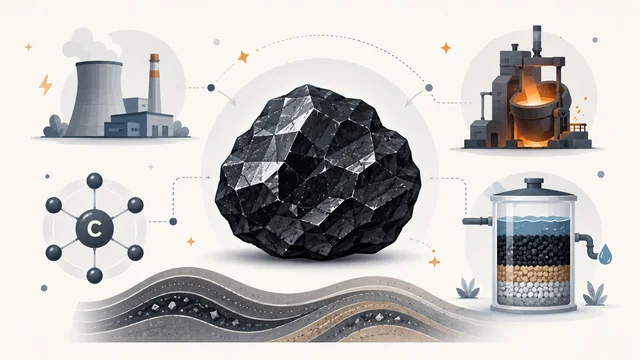
Anthracite coal is the highest-rank, hardest and cleanest-burning form of coal — the result of millions of years of pressure and heat converting plant matter into nearly pure carbon. While the broader coal industry has shrunk dramatically through the 2020s as power generation shifts to renewables and gas, anthracite still occupies a niche role in metallurgy, water filtration, specialty heating and a handful of industrial processes where its specific properties matter. Here is what anthracite actually consists of, why those properties matter, and where it still makes sense in 2026.
What anthracite coal is
Coal is ranked by the degree of coalification — how much the original plant matter has been transformed by heat and pressure over geological time. The ranks from lowest to highest are:
- Peat — barely-coal, ~50–60% carbon, still recognisable plant fibres.
- Lignite (brown coal) — 60–75% carbon, used mostly for electricity in mine-mouth power plants.
- Sub-bituminous — 75–80% carbon, the main coal in US electric power.
- Bituminous — 76–86% carbon, the workhorse of steelmaking metallurgical coal.
- Anthracite — 86–97% carbon, the highest-rank ordinary coal.
Anthracite is hard, brittle, lustrous black with a near-metallic sheen, and has the highest energy density of any coal — roughly 30–35 megajoules per kilogram (MJ/kg) compared to ~20 MJ/kg for sub-bituminous and ~15 MJ/kg for lignite. It also burns the cleanest of any coal, with the lowest sulphur, lowest volatile matter and lowest visible smoke. The trade-off: it ignites at much higher temperatures than other coals, so you need a hotter starter fire to get it going.
Composition of anthracite
| Component | Typical range | Why it matters |
|---|---|---|
| Fixed carbon | 86–97% | The combustible solid — drives heat output |
| Volatile matter | 2–14% | Low value = less smoke, less flame visibility |
| Ash | 5–15% | The non-combustible residue — lower is better |
| Moisture | < 5% | Lower than any other coal — very high net energy |
| Sulphur | 0.6–1.0% | Lower than bituminous — less SO₂ in emissions |
| Hydrogen | 2–4% | Lower than younger coals — contributes minor heat |
| Oxygen | 1–3% | Very low — sign of full coalification |
Benefits of anthracite
1. High heat output per kilogram
At 30–35 MJ/kg (roughly 12,500–15,000 BTU/lb), anthracite produces more heat per kilogram than any other coal and roughly twice that of lignite. For applications where storage space or transport weight matters — home stoves, marine bunker fuel historically, locomotive water-tube boilers — the energy density is a real advantage.
2. Clean burn (relatively)
Compared to other coals, anthracite’s low volatile matter and low sulphur content mean it produces less smoke, less soot and less SO₂. The flame is short and nearly invisible, the residue is mostly fine grey ash. That said, "clean compared to other coal" is a low bar — anthracite still releases ~94 kg of CO₂ per gigajoule of heat, vs. ~55 kg/GJ for natural gas and zero for solar / wind / nuclear.
3. Long burn time
Anthracite burns slowly compared to wood or softer coals — a single stove load can burn for 12+ hours. Useful for overnight heating in regions where it’s still legal and practical (parts of Pennsylvania, UK conservation areas, Eastern Europe).
4. Lower ash + lower clinkering
Anthracite’s ash content (5–15%) is lower than bituminous (8–25%) and dramatically lower than lignite (20–40%). The ash that does form tends to be loose and powdery rather than fused clinker, which means easier cleanup and longer time between grate scrapings.
5. Dense, hard, dust-resistant
Anthracite is the hardest coal — it doesn’t crumble in transport or storage, doesn’t generate the fine dust that bituminous and lignite do, and is much less prone to spontaneous combustion in stockpiles.
Where anthracite is still used in 2026
- Water filtration. Anthracite’s low silica content and angular grain shape make it an excellent filter medium for municipal water treatment plants. A common multi-media filter consists of anthracite over sand over garnet — the anthracite layer catches larger particles, the finer media below catch smaller ones. This is still the largest non-fuel industrial use of anthracite globally.
- Sintering iron ore. Anthracite is used as a reductant and heat source in iron-ore sintering — the step that turns ore fines into furnace-ready agglomerated lumps before they enter the blast furnace.
- Ferro-alloys. Producing ferro-silicon, ferro-manganese and silicon metal requires a high-purity carbon reductant in the electric-arc furnace. Anthracite’s low ash and low volatiles make it well-suited.
- Carbon electrodes. Calcined anthracite is used as a feedstock for carbon electrodes in steelmaking and aluminium smelting.
- Activated carbon. Anthracite can be activated (heated in steam at high temperature) to produce activated carbon for air filtration, gas masks, and high-end industrial gas scrubbers.
- Specialty heating. A small market remains in residential and small-commercial stoves in regions with strong anthracite traditions (Pennsylvania, Ukraine, Wales). Modern anthracite stoves can hit 80%+ efficiency.
- Carburising and case-hardening steel. Anthracite is one of the carbon sources used in pack-carburising to harden steel surfaces.
Anthracite vs. other coal grades
| Property | Anthracite | Bituminous | Sub-bituminous | Lignite |
|---|---|---|---|---|
| Carbon content | 86–97% | 76–86% | 75–80% | 60–75% |
| Heating value | 30–35 MJ/kg | 24–33 MJ/kg | 18–24 MJ/kg | 10–19 MJ/kg |
| Sulphur | 0.6–1.0% | 0.5–5% | < 1.5% | 0.5–5% |
| Smoke / volatiles | Very low | High | Moderate | High |
| Ignition temp. | ~480 °C | ~400 °C | ~370 °C | ~250 °C |
| Hardness | Hard, lustrous | Medium | Soft to medium | Soft, crumbly |
| Geological age | 300+ million yrs | 100–300 million yrs | 100–300 million yrs | < 100 million yrs |
Environmental footprint and current outlook
Anthracite is cleaner than other coals at the point of combustion but it’s still a fossil fuel: roughly 94 kg of CO₂ per gigajoule of heat compared to 56 kg/GJ for natural gas and zero for renewables. As global power generation shifts to gas, wind, solar and nuclear, anthracite’s residential and industrial heating market continues to shrink — particularly in the UK, where the 2023 Smoke Control Areas regulations effectively phased out most household solid-fuel burning, and in the EU under the European Green Deal carbon-price escalator.
Where anthracite continues to make economic sense in 2026 is mostly in non-combustion uses: water filtration, sintering, ferro-alloys and carbon electrodes — all applications where the carbon content and physical properties matter and there’s no current alternative material at the same cost.
Major producers in 2026
- China — by far the largest producer (~70% of global anthracite output), driven by metallurgy demand.
- Russia — second-largest producer; exports complicated by sanctions since 2022.
- Vietnam — major producer for Asian sintering and ferro-alloy markets.
- Ukraine — historically a major producer; output disrupted since 2022.
- South Africa — medium producer for export to European water-treatment markets.
- United States (Pennsylvania) — small but persistent producer for water filtration and a remnant residential heating market.
Frequently asked questions
Why does anthracite burn cleaner than other coals?
Anthracite has the lowest volatile matter (2–14%) of any coal, the lowest moisture content (under 5%), and relatively low sulphur (0.6–1%). Volatile matter is what produces visible smoke and soot when coal burns — less of it means a cleaner, near-smokeless flame. Lower sulphur means less SO₂ in the exhaust. The result is the cleanest-burning coal at the point of combustion, although it’s still significantly dirtier per unit of heat than natural gas or renewables.
Is anthracite still used for home heating in 2026?
In a few places, yes — parts of rural Pennsylvania, eastern Ukraine, Wales and parts of Eastern Europe still have household anthracite stoves and boilers. The market is shrinking quickly under air-quality regulations (the UK’s Smoke Control Areas effectively phased out most solid-fuel home heating in 2023, the EU Green Deal pushes the same way), and most new household heating installations are heat pumps, gas or biomass instead. Modern anthracite stoves can hit 80%+ efficiency but the installed base is in decline.
Why is anthracite used in water filtration?
Anthracite’s low silica content, angular grain shape and acid-resistance make it an excellent top-layer filter medium in multi-media water filters. The standard configuration in a municipal water-treatment plant uses anthracite over sand over garnet — the anthracite layer catches larger suspended particles while the finer media below catch smaller ones. Anthracite is preferred over sand at the top because its lower density allows for a deeper, more open filter bed that doesn’t clog as quickly.
What is the difference between anthracite and bituminous coal?
Anthracite has higher carbon (86–97% vs 76–86%), higher heating value (30–35 MJ/kg vs 24–33 MJ/kg), lower volatile matter, lower sulphur, lower moisture, harder texture and a higher ignition temperature. Bituminous coal is the more abundant grade globally and is the workhorse of metallurgical coal for steelmaking. Anthracite is rarer, more expensive, and used mostly for water filtration, ferro-alloys and specialty applications rather than bulk fuel.
Is anthracite renewable or sustainable?
No. Anthracite is a fossil fuel formed over 300+ million years and is finite. Burning it releases approximately 94 kg of CO₂ per gigajoule of heat — lower than burning lignite or bituminous but still meaningfully higher than natural gas, and dramatically higher than renewables (wind / solar / nuclear) which approach zero. For applications that simply need heat, renewables and gas are the more sustainable choice; for non-combustion uses like water filtration or carbon electrodes, anthracite’s physical properties have no current renewable substitute.