TDEE Calculator

Most people trying to lose weight in India make one very common mistake — they focus only on cutting food, without knowing how much energy their body actually burns every day. This is where TDEE comes in.
TDEE stands for Total Daily Energy Expenditure. It is the total number of calories your body burns in a complete 24 hours — including sleep, digestion, work, commute, household chores, gym, and everything in between.
Without knowing your TDEE, you are essentially guessing. You might eat 1,500 calories thinking it is a good deficit — but if your body only burns 1,600, your results will be painfully slow. Or you might eat 2,200 calories and wonder why the scale is not moving when your TDEE is actually only 1,900.
Your TDEE is your personal calorie budget. Know it, and weight management becomes simple math.
This guide will show you exactly how to calculate your TDEE step by step — with real examples based on common Indian lifestyles, from office workers in Mumbai to homemakers in smaller towns.
Use our free TDEE Calculator at savedelete.com/calorie-calculator to get your number instantly.
What Is TDEE and Why Does It Matter?
TDEE is the grand total of everything your body burns in a day. It has four components:
|
Component |
What It Means |
% of TDEE |
|
BMR (Basal Metabolic Rate) |
Calories burned at complete rest — just to stay alive |
60–70% |
|
TEF (Thermic Effect of Food) |
Calories burned digesting and processing food |
8–10% |
|
NEAT (Non-Exercise Activity) |
Walking, household work, fidgeting, standing |
15–20% |
|
EAT (Exercise Activity) |
Intentional workouts — gym, yoga, running |
5–15% |
The reason TDEE matters more than BMR is simple: your BMR only tells you the calories you burn lying still. But you are not lying still all day. You are commuting, cooking, working, walking — all of that burns extra calories.
Important: Two people with the same BMR can have very different TDEEs based on how active their daily lives are. A construction worker in Pune and a software engineer in Hyderabad may weigh the same and have similar BMRs — but wildly different TDEEs.
Step 1 — Calculate Your BMR First
Before calculating TDEE, you need your BMR. BMR is the number of calories your body burns doing absolutely nothing — the energy cost of just existing.
Our Calorie Calculator uses the Mifflin-St Jeor equation, which research shows is the most accurate formula for most healthy adults:
|
Gender |
BMR Formula |
|
Men |
BMR = (10 × weight in kg) + (6.25 × height in cm) − (5 × age) + 5 |
|
Women |
BMR = (10 × weight in kg) + (6.25 × height in cm) − (5 × age) − 161 |
Example 1 — Rahul, 28-year-old male, Delhi
Weight: 78 kg | Height: 175 cm | Age: 28
BMR = (10 × 78) + (6.25 × 175) − (5 × 28) + 5
BMR = 780 + 1,093.75 − 140 + 5 = 1,738 calories/day
Example 2 — Priya, 32-year-old female, Bengaluru
Weight: 62 kg | Height: 163 cm | Age: 32
BMR = (10 × 62) + (6.25 × 163) − (5 × 32) − 161
BMR = 620 + 1,018.75 − 160 − 161 = 1,317 calories/day
BMR is your floor, not your target. Never eat at or below your BMR without medical supervision.
Step 2 — Apply Your Activity Multiplier to Get TDEE
Once you have your BMR, you multiply it by an activity multiplier that reflects how active your actual daily life is. This is where most people go wrong — they overestimate their activity level, which leads to eating more than they should.
Here is the standard activity multiplier table — but we have added Indian lifestyle context so you can pick the right one honestly:
|
Activity Level |
Multiplier |
Who This Really Fits — Indian Context |
|
Sedentary |
× 1.2 |
WFH job, no exercise, mostly sitting 10+ hrs/day, occasional evening walk |
|
Lightly Active |
× 1.375 |
Office job + 2–3 light walks per week OR light household chores daily |
|
Moderately Active |
× 1.55 |
Office job + gym/yoga 3–4x per week OR physically moderate daily work |
|
Very Active |
× 1.725 |
Gym 5–6x per week intensely OR physically demanding job (teacher, nurse, field sales) |
|
Extremely Active |
× 1.9 |
Manual labour job (construction, farming) + daily hard training |
TDEE Calculation for Rahul (Sedentary — IT job, no exercise)
TDEE = 1,738 × 1.2 = 2,085 calories/day
This means Rahul needs about 2,085 calories per day to maintain his current weight with his sedentary lifestyle.
TDEE Calculation for Priya (Moderately Active — WFH + gym 3x/week)
TDEE = 1,317 × 1.55 = 2,041 calories/day
Priya needs about 2,041 calories per day to maintain her current weight.
Skip the gym to spare multiplier. If you work out at the gym 3x a week but sit all remaining hours, you are moderately active — not very active.
Real Indian Lifestyle Examples — Which Activity Level Are You?
The biggest challenge with activity multipliers is that they were designed with Western lifestyles in mind. Indian daily life looks very different. Here is a practical guide:
|
Your Daily Reality |
Honest Activity Level |
|
IT professional, WFH, no exercise, cook/clean at home |
Sedentary to Lightly Active |
|
Office job in city, 30 min commute by auto/metro, no gym |
Sedentary |
|
Office job + evening walk 30 min daily |
Lightly Active |
|
Homemaker — cooking, cleaning, school runs, light errands all day |
Lightly to Moderately Active |
|
Homemaker with no domestic help + gym 2x week |
Moderately Active |
|
School/college teacher, standing + walking most of the day |
Moderately to Very Active |
|
Field sales person — on feet most of the day, travelling |
Very Active |
|
Construction worker, farmer, factory floor worker |
Extremely Active |
|
Gym 5x week (weight training) + desk job |
Moderately to Very Active |
Special Note for Indian Homemakers
Homemakers are often mislabelled as sedentary. If your day involves cooking 3 meals from scratch, cleaning, school pickups, grocery runs, and childcare — you are at minimum lightly active, and often moderately active.
However, if you have domestic help and spend a significant portion of your day sitting (watching TV, resting, phone use), lean toward lightly active.
How to Calculate Calories Needed Per Day for Weight Loss, Gain, and Maintenance
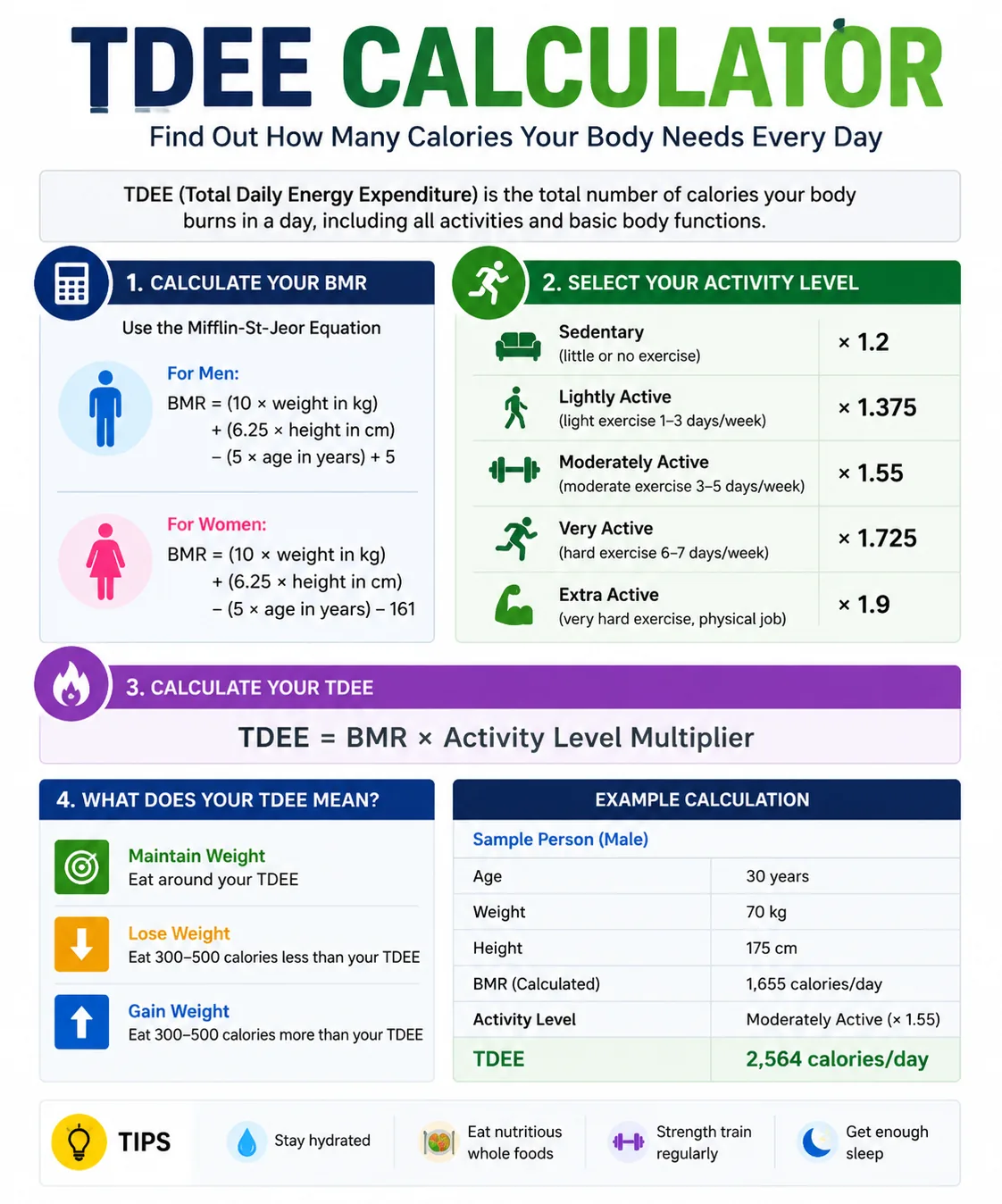
Once you know your TDEE, you have a powerful number. Here is how to use it:
|
Goal |
Calorie Target |
Expected Result |
|
Weight Loss (Slow & Sustainable) |
TDEE minus 300–400 calories |
0.25–0.35 kg loss per week |
|
Weight Loss (Standard) |
TDEE minus 500 calories |
~0.5 kg loss per week |
|
Weight Loss (Aggressive — short term) |
TDEE minus 750–1000 calories |
0.7–1 kg loss per week |
|
Weight Maintenance |
Eat at TDEE |
Weight stays stable |
|
Muscle Gain (Lean Bulk) |
TDEE plus 200–300 calories |
Gradual muscle gain, minimal fat |
Example for Rahul (TDEE 2,085):
• Maintenance: 2,085 calories/day
• Standard deficit (500 cal): 1,585 calories/day → ~0.5 kg/week loss
• Minimum floor (never go below): ~1,500 calories for men
Example for Priya (TDEE 2,041):
• Maintenance: 2,041 calories/day
• Standard deficit (500 cal): 1,541 calories/day → ~0.5 kg/week loss
• Minimum floor (never go below): ~1,200 calories for women
1 kg of fat = approximately 7,700 calories. A 500-Calorie Daily Deficit = 3,500 calories/week = roughly 0.45 kg of fat loss per week. This is the math behind the numbers.
TDEE vs BMR — The Key Difference Explained Simply
People often confuse BMR and TDEE. Here is the clearest way to think about it:
|
|
BMR |
TDEE |
|
What it measures |
Calories burned at complete rest |
Calories burned in a full active day |
|
Includes daily activity? |
No |
Yes |
|
Includes exercise? |
No |
Yes |
|
Should you eat at this number? |
No — too low |
Yes — this is your maintenance target |
|
Used for |
Starting point for calculations |
Actual diet planning |
Think of BMR as the fuel your car needs just to idle. TDEE is the fuel it needs to actually drive to work and back every day.
Common Mistakes Indians Make When Calculating TDEE
Mistake 1: Choosing 'Very Active' Because You Go to the Gym
Going to the gym 4 times a week for 1 hour does not make you very active if you sit at a desk for 9 hours otherwise. Activity level is about your entire day — not just your workout. Most gym-going professionals with desk jobs are moderately active at best.
Mistake 2: Not Accounting for NEAT
NEAT (Non-Exercise Activity Thermogenesis) is all the movement you do outside the gym — walking to the office, taking stairs, household work, standing while talking on the phone. Indians who live in cities and have active commutes have higher NEATs than those who work from home and order everything online.
Mistake 3: Using TDEE as a Set-and-Forget Number
Your TDEE changes as your weight changes. If you lose 5 kg, your BMR drops slightly, and your TDEE adjusts. Recalculate every 4–6 weeks or whenever your weight changes by more than 3–4 kg.
Mistake 4: Overestimating Activity for Housework
While housework counts as activity, it is not as calorie-intensive as many people think. Cooking one meal might burn 50–80 calories. Mopping a medium-sized home burns about 100–150 calories. This is why even active homemakers cannot always eat as freely as they might expect.
Mistake 5: Not Recalculating After a Major Lifestyle Change
Started working from home? Switched from a field job to a desk job? Your TDEE can drop by 300–500 calories overnight and you might not notice until you have gained 3–4 kg over a few months. Any lifestyle change should trigger a TDEE recalculation.
TDEE for Different Indian Lifestyles — Quick Reference
|
Profile |
Approx. BMR |
Activity Level |
Approx. TDEE |
|
Female, 28, 58 kg, 160 cm — WFH software job, no exercise |
1,283 cal |
Sedentary (×1.2) |
1,540 cal |
|
Male, 30, 80 kg, 178 cm — WFH job, gym 3x/week |
1,793 cal |
Moderately Active (×1.55) |
2,779 cal |
|
Female, 35, 65 kg, 162 cm — Homemaker, no help, 2 kids |
1,337 cal |
Lightly Active (×1.375) |
1,838 cal |
|
Male, 25, 70 kg, 172 cm — College student, active campus life |
1,723 cal |
Lightly Active (×1.375) |
2,369 cal |
|
Female, 40, 72 kg, 158 cm — School teacher |
1,385 cal |
Moderately Active (×1.55) |
2,146 cal |
|
Male, 32, 85 kg, 175 cm — Construction worker |
1,830 cal |
Extremely Active (×1.9) |
3,477 cal |
Note: These are approximations. Use our TDEE calculator at savedelete.com/calorie-calculator for a precise number based on your exact inputs.
How to Track Your TDEE Progress and Know If It Is Working
Calculating your TDEE is step one. But the real question is: how do you know if your calculated number is actually correct for your body? The only honest answer is your body’s response over the first 2–3 weeks.
Most people calculate their TDEE, set a calorie target, and then panic after 4–5 days because the scale has not moved. That is too soon. Weight fluctuates daily due to water, salt, digestion, and hormones. You need at least 14 days of consistent eating to see a real signal.
The 2-Week Reality Test
After setting your calorie target based on your TDEE, eat at that number consistently for 14 days while tracking your food honestly. Then check the scale — not day to day, but as a weekly average. Weigh yourself every morning and average the 7 readings for each week. Compare Week 1 average to Week 2 average.
Here is how to read your results:
- Weight dropped as expected — Your TDEE estimate is accurate. Continue at the same target.
- Weight dropped faster than expected — Your actual TDEE is higher than calculated. You can add back 100–150 calories and still lose weight comfortably.
- Weight did not change at all — Your real TDEE is likely 200–300 calories lower than calculated. Reduce daily intake by 150–200 calories and track for another 2 weeks.
- Weight went up despite eating at a deficit — First check your food tracking. Are you logging cooking oil, chai, sauces, and snacks? If tracking is accurate, drop to the next lower activity multiplier and recalculate.
The Biggest Hidden Calorie Problem in Indian Kitchens
The single biggest reason Indians eat ‘at their TDEE’ but do not lose weight is undercounted cooking oil. Indian cooking uses significant amounts of ghee, mustard oil, coconut oil, or refined oil. Just 2 tablespoons adds around 240 calories — calories most people never log because they think of it as ‘just cooking.’
Other commonly missed calories in Indian daily eating:
● Chai with milk and sugar — 2–3 cups per day adds 150–200 calories easily
● Ghee on roti or dal — 1 teaspoon is 45 calories; many people use 3–4 helpings without thinking
● Namkeen, biscuits, or murmura while watching TV — a small bowl can be 200–300 calories
● Fresh fruit juice — a glass of orange or mosambi juice is 110–130 calories with very little fibre
● Tasting while cooking — licking the spoon and nibbling before serving adds 50–100 calories most days
These hidden calories can easily add 400–600 extra calories per day — completely wiping out your deficit without you realising it. This is one of the most common reasons people feel stuck despite doing ‘everything right.’
A Simple 4-Week TDEE Tracking Plan for Beginners
Follow this plan immediately after calculating your TDEE at savedelete.com/calorie-calculator:
|
Week |
What To Do |
What To Check |
|
Week 1 |
Calculate TDEE. Set calorie target. Download a food tracking app — MyFitnessPal or Healthify Me work well for Indian foods. Log everything including oil, chai, and small snacks. |
Weigh yourself daily at the same time each morning. Note it down but do not react yet. |
|
Week 2 |
Continue tracking. Be especially careful on weekends — social eating is where most Indian deficits break. Weddings, family dinners, and chai with biscuits all add up quickly. |
Calculate your Week 1 and Week 2 weight averages. Compare them. This is your first real data point. |
|
Week 3–4 |
Adjust calorie target based on your 2-week result using the guide above. Do not make dramatic cuts — 100–200 calories is enough to adjust. |
If losing 0.3–0.5 kg per week on average — your system is working. Stay the course. |
|
Month 2+ |
Recalculate your TDEE every time you lose 4–5 kg, since a lighter body burns fewer calories. Also recalculate if your routine changes significantly. |
Consistent 0.3–0.5 kg per week loss is the target. Faster than that risks muscle loss. Slower, reduce by another 100 cal. |
How Often Should You Recalculate Your TDEE?
Your TDEE is not a permanent number. It changes with:
- Weight change (every 4–5 kg lost or gained)
- Age (TDEE typically drops 1–2% per decade after 30)
- Job or lifestyle changes (WFH vs office, new exercise routine)
- Pregnancy or postpartum
- Medical conditions (thyroid disorders, PCOS can affect BMR)
A good rule: recalculate every 4–6 weeks if you are actively trying to lose or gain weight. If you are in maintenance mode, once every 3 months is fine.
Frequently Asked Questions
Is TDEE the same as maintenance calories?
Yes. Your TDEE and your maintenance calories refer to the same number — the total calories your body burns in a day, including all activity. Eating at your TDEE means your weight stays stable.
What is a good TDEE for an Indian woman trying to lose weight?
This depends on your height, weight, age, and activity level. Most Indian women have TDEEs between 1,600 and 2,200 calories. To lose weight, you would typically eat 300–500 calories below that. Never go below 1,200 calories per day without medical supervision.
My TDEE seems very low. Is something wrong?
If your TDEE calculation seems surprisingly low, first check: did you choose the correct activity level? Many people overestimate their activity. Also, shorter or lighter individuals naturally have lower TDEEs. If you have a thyroid condition or PCOS, your real TDEE might be 10–15% lower than calculated — consult your doctor.
Does TDEE change in summer vs winter in India?
Slightly. In extreme heat, your body uses a small amount of extra energy to regulate temperature. In cold months, the body can also burn slightly more. However, the difference is small enough (50–100 calories) that most people do not need to adjust their TDEE seasonally unless they are in very extreme climates.
How accurate are online TDEE calculators?
They are accurate to within 10–15% for most people. The main source of error is the activity multiplier — which you self-report. The Mifflin-St Jeor formula used in our calculator is the most validated formula for healthy adults. Treat your TDEE as a starting estimate and adjust after 2–3 weeks based on real results.
Should I eat at my TDEE on rest days and less on workout days?
You can, but it is not necessary for most people. A simpler approach: eat the same number of calories every day (at your maintenance or deficit target). The body averages things out over a week. Cycling calories is a more advanced strategy and not required for beginners.
Conclusion: Your TDEE Is Your Starting Point — Not the Finish Line
Calculating your TDEE is one of the most important steps you can take toward managing your weight successfully. It removes the guesswork and gives you a concrete calorie target based on your real body and real life.
But a number alone does not change anything. What matters is using that number consistently — tracking your food, adjusting after a few weeks, and staying patient.
Here is a simple action plan:
- Use our TDEE Calculator at savedelete.com/calorie-calculator to get your number
- Set your calorie goal (TDEE minus 300–500 for weight loss)
- Track your food using an app for 2–3 weeks
- Check your results — if weight is not moving, reduce calories by 100–150 more
- Recalculate your TDEE every 4–6 weeks
Weight loss is not about eating as little as possible. It is about eating a little less than your body burns — consistently, every day. Your TDEE tells you exactly where that line is.