Stop Face Drift: The Practical Guide to Keeping One Character Identical Across Every Scene
For comic artists, short drama teams, and character IP creators, one problem keeps showing up at the worst possible moment: the lead looks right in one image, then turns into someone else in the next. In one scene, the heroine looks perfect in a café. In the next, she still feels recognizable while running. But once the setting changes dramatically—say, from the street to outer space—the face often falls apart, and the “same character” starts to look like someone else entirely.
That kind of inconsistency does more than ruin a single image. It weakens story flow, damages audience trust, and makes a character harder to remember. Kimg AI offers a much more practical way to solve this problem, especially for creators who need one heroine to stay visually stable across many scenes, moods, and visual styles.
I. Why Face Drift Ruins Character-Driven Content
-
A character stops feeling real when the face keeps changing
A creator may spend hours refining one heroine’s look, only to watch her features change from scene to scene. The hair may stay similar, and the clothes may remain close, but the face no longer feels like the same person. That breaks immersion almost immediately.
-
Comics and short dramas rely on instant recognition
Serialized content depends on visual continuity. Readers and viewers should not need extra effort to confirm who is on screen. When the lead appears again, recognition should happen in a second.
-
Character IP depends on stable visual identity
For creators building an original IP, facial consistency is not a small technical detail. It directly affects posters, thumbnails, covers, promo art, and social visuals. If the face drifts too often, the character loses brand strength before the story can build momentum.
II. Why Single-Reference Tools Usually Fail
-
One image cannot describe a full identity
A single reference image may look beautiful, but it does not fully explain a face. It may show one flattering angle, one expression, and one lighting setup. That is not enough to preserve identity when the character turns, moves, or enters a completely different scene.
-
Outfit consistency can hide facial inconsistency
Some tools can keep the same hairstyle, earrings, or clothing details across images. At first glance, that looks like success. But once the costume changes or the camera angle shifts, the weak point appears: the face was never really locked.
-
Good luck is not the same as a repeatable workflow
Many creators are not searching for one lucky result. They want a method they can trust again and again. That is one reason search interest around Nano Banana Pro free unlimited keeps appearing. The real need behind that phrase is simple: a reliable process for building stable characters, not a random one-off image.
III. What Actually Improves Character Consistency
-
Multiple reference angles create a stronger identity base
A face is not flat. It changes with angle, pose, lighting, and expression. When more views are available, the model has more useful information to work with. That leads to stronger consistency across new scenes.
-
A simple homepage workflow saves time for working creators
Creators do not need extra complexity when testing a character. A direct workflow matters because image generation often involves repeated prompt tuning, scene testing, and selection. Fewer steps make that process easier to manage.
-
Image creation and motion work should connect naturally
A stable still image is only the first half of the job for many creators. Short drama teams, comic marketers, and IP builders often need the same character to move later. When the image stage and the motion stage connect well, the overall workflow becomes far more useful.
IV. How to Lock a Character with Kimg AI
-
Start from the homepage and choose the right model
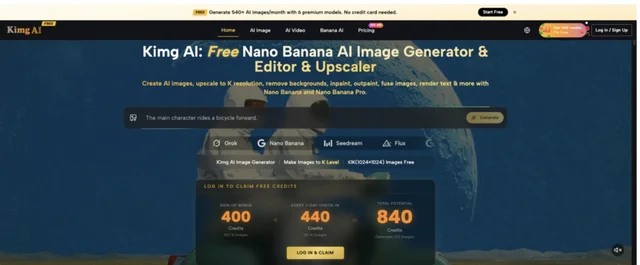
On Kimg AI, the practical choice for this task is Nano Banana Pro. For creators trying to lock a heroine’s face across multiple situations, this matters because it supports up to 8 reference images. That gives much better identity coverage than a single-image setup.
-
Upload references that show the same heroine from different angles
The best results usually come from variety with purpose. Instead of uploading near-identical portraits, it helps to include a front view, side profile, three-quarter angles, and a few natural expression changes. This gives the model a fuller understanding of the heroine’s face structure.
-
Test the same character in very different scenes
A useful consistency test should not stay in one safe setting. Try generating the heroine drinking coffee in a café, then place her in a running scene with motion and body tension, and then move her into an outer space setting with very different styling and lighting. If the face still reads as the same person, the workflow is doing real work.
That is the key difference between a flashy sample and a practical production method. A creator does not need one beautiful image. A creator needs one believable character who can survive scene changes.
Images can also be generated at up to 4K quality, which helps when the final outputs are meant for posters, covers, thumbnails, or campaign visuals rather than quick casual drafts.
V. Three Tips That Make Results More Stable
-
Keep the reference images clean and readable
The face should be clearly visible in the uploaded references. Heavy filters, strong shadows, oversized accessories, or blocked facial features can weaken identity control. Clear inputs usually lead to better consistency.
-
Separate identity from styling
Hair clips, dresses, uniforms, and makeup details can support recognition, but they are not the core identity. The face structure matters more: eyes, brow shape, nose line, lip shape, jaw contour, and the overall look of the expression. Styling can change between scenes, but the person should still feel the same.
-
Keep the character description steady across prompts
When scene prompts become too focused on background details, the character can start drifting. It helps to keep the heroine’s core description stable while changing only the environment, action, or mood. That gives the model a stronger anchor.
This is also why Kimg AI feels practical for creator workflows. It supports a more deliberate way of building a character, instead of treating every new image like an isolated experiment.
VI. From Still Images to Motion: The Real Finishing Move
-
Select the most consistent image set first
Before moving into motion, it helps to confirm which outputs preserve the character best. A strong still image is more than a nice visual. It becomes the base for future storytelling, promotion, and extension.
-
Use Veo 3 on the homepage to make the character move
This is where the process becomes much more complete. After generating consistent images, creators can use Veo 3 directly from the homepage of Kimg AI to animate the character further. That means the heroine does not need to be reinvented in a disconnected workflow.
-
This creates a cleaner loop for creators
For short drama creators, that can mean moving from key visuals to moving promo content more smoothly. For comic and manga-style IP teams, it means a stable character can move from still art into animated snippets and campaign assets without losing identity halfway through.
That full loop is the real advantage. First, the character is locked visually. Then, the same character can continue into motion. The process feels complete rather than fragmented.
VII. Why This Matters for Self-Media, Short Drama, and Comic IP Creators
-
Self-media creators need repeatable character output
A creator who posts often cannot afford to rebuild the heroine from zero for every new image. Consistency saves time and makes the content stream feel more professional and more memorable.
-
Short drama projects need visual trust across scenes
Even when the story format is fast and episodic, the audience still expects the lead to remain recognizable. If the face changes too much between scenes, emotional investment drops.
-
Comic and manga-style IP needs long-term stability
A single good poster is not enough for IP work. The same character may need to appear on covers, vertical panels, promo banners, teaser motion clips, and social media cards. A workflow built around consistency is far more valuable than a workflow built around occasional surprises.

VIII. Conclusion
For creators working on self-media stories, short dramas, or original comic IP, face drift is not a minor flaw. It is one of the fastest ways to weaken character trust. When the café scene looks right but the space scene introduces what feels like a stranger, the audience notices.
Kimg AI offers a more useful answer to that problem. By selecting the right model, uploading multiple reference angles, and testing the same heroine across very different settings, creators can hold onto the one thing that matters most: identity. And once that identity is stable, Veo 3 helps carry it into motion, creating a much stronger creative loop from still image to animated output.
The real value is not just generating attractive pictures. It is making sure one character stays one character, no matter where the story takes her.