How to Use AI to Decode the Science Behind Viral Content in 2026

Some creators seem to crack the content code effortlessly. They post, people engage, and the cycle repeats like clockwork. Meanwhile, most of us are left wondering what we're missing. The truth is, viral content isn't random — and AI can now help you dissect exactly why certain posts explode while others vanish into the void.
Here's a practical framework for using AI to reverse-engineer viral content, extract the underlying patterns, and build your own content strategy that compounds over time.
Step 1: Stop Looking at What They Said — Look at Why It Landed
The biggest mistake content creators make is copying the surface. They see a viral post, mimic the format — maybe the hook style, the emoji placement, the post length — and expect similar results. It rarely works.
The real question isn't what someone posted. It's why it resonated at that specific moment with that specific audience.
When you feed AI a piece of viral content, don't just paste the text. Give it the full context: the platform it appeared on, the audience demographics, the top comments and reactions, the timing. Then ask questions like:
- "What emotional trigger does this content activate?"
- "Why would someone feel compelled to share this with their network?"
- "What cultural moment or shared frustration does this tap into?"
AI excels at identifying these deeper patterns because it can cross-reference thousands of similar content pieces and surface the invisible thread connecting them all.

Step 2: Extract the Worldview, Not Just the Words
Every piece of content that generates massive engagement carries an implicit worldview — a set of assumptions about how things work, what matters, and what most people get wrong.
When you analyze a consistently successful creator, ask AI:
- "What does this creator believe to be true that most people haven't realized yet?"
- "What idea feels obvious after you read their post but wasn't obvious before?"
- "What are people really reacting to beneath the surface-level content?"
For recurring creators, these answers reveal a pattern — a consistent philosophical stance that audiences learn to expect and trust. For one-off viral moments, it usually comes down to a shared emotion: collective frustration, unexpected honesty, humor that hits a nerve, or outrage at something people have been silently thinking.
Either way, the engagement isn't about the writing. It's about the resonance.
Step 3: Build for Recognition, Not Just Reach
There's an important distinction between content that goes viral once and a creator who builds lasting influence. The people who sustain engagement over months and years aren't optimizing for reach — they're training their audience to recognize a signature.

That signature is a combination of:
- A consistent stance — a point of view they're known for
- A recognizable rhythm — how they structure their ideas
- A distinctive way of framing problems — making the familiar feel new
You can use AI to identify these elements in any creator you admire. Try prompts like: "What makes this person's voice recognizable even without seeing their name?" or "If this creator commented on a completely new topic, what would people expect them to say?"
This is how influence compounds. People don't just engage with individual posts — they develop expectations for what you'll say next. That anticipation is the engine of sustained virality.
Step 4: Don't Ignore Style — Just Don't Obsess Over It
While the underlying worldview and emotional resonance matter most, presentation still plays a supporting role. There are genuine stylistic patterns in successful content that are worth understanding:
- Hook structure — how the first line grabs attention
- Post length — whether brevity or depth performs better for the topic
- Pacing and formatting — use of white space, line breaks, paragraph rhythm
- Visual elements — strategic use of images, emojis, or formatting
- Word economy — how many words it takes to land the point
Ask AI to analyze a batch of successful posts with a focused prompt: "Analyze these posts for stylistic patterns only — hooks, length, pacing, formatting, and tone. What tends to repeat, and what actually seems to matter versus what's just personal habit?"
This gives you a style layer to apply on top of your core message — the polish that makes good ideas land even better.
Step 5: Turn Insights Into a Repeatable Playbook
Here's where most people stop too early. They analyze a few viral posts, maybe learn something interesting, and then go back to creating content the same way they always did.
The real leverage comes from turning your analysis into a structured playbook — a documented system you can reference every time you create. Instead of asking AI to write posts for you, ask it to build you a strategy framework:
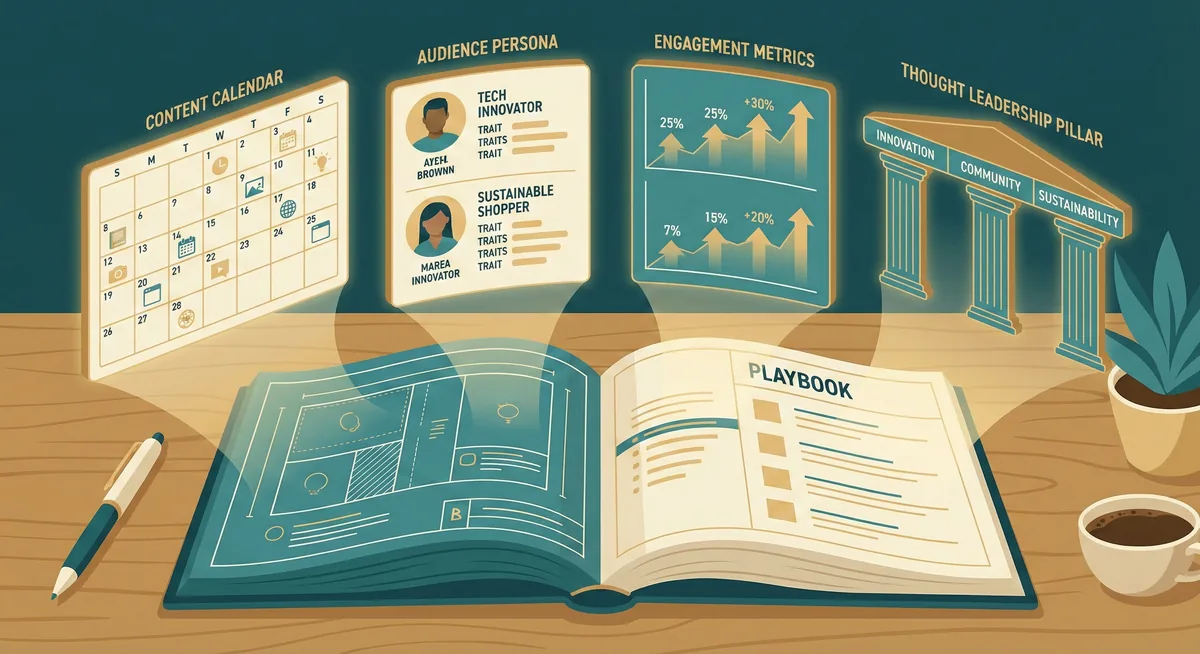
"Based on these successful content examples, generate a thought-leadership playbook that includes: core beliefs and values, recurring themes worth revisiting, contrarian angles that generate discussion, tone and voice guidelines, and engagement patterns — so I can write original posts in my own authentic voice."
This playbook becomes your creative compass. It doesn't replace your voice — it sharpens it. You're not copying what worked for someone else. You're building a framework informed by what works in general, filtered through your unique perspective.
Step 6: Use AI as Your Editorial Board
Once you have your playbook, the most powerful way to use AI isn't for content creation — it's for content evaluation. Feed your playbook into an AI tool along with a few examples of content you admire, and use it as an editor-in-chief that can:
- Score your drafts against your established criteria
- Flag takes that feel generic or derivative
- Identify which of your ideas has the highest potential for engagement
- Stress-test your content across different audience segments
- Track what's actually working over time and adjust the playbook accordingly
This transforms AI from a writing tool into a thinking partner — one that helps you maintain consistency while continuously improving your content strategy.
The Bottom Line
Going viral in 2026 isn't about luck, and it's not about following a template. It's about understanding the invisible mechanics behind content that resonates — the emotional triggers, the worldviews, the recognition patterns — and systematically building your own approach based on those insights.
AI is uniquely suited for this kind of pattern recognition. It can process hundreds of examples, identify the common threads, and help you build a framework that's both data-informed and authentically yours. The creators who will dominate the next era of content aren't the ones with the best writing — they're the ones who understand why certain ideas spread, and who build systems to consistently produce content that connects.
Quick Reference:
- Analyze context and timing, not just format
- Extract beliefs and worldviews, not just wording
- Optimize for audience recognition over one-time reach
- Build a documented thought-leadership playbook
- Use AI as an editorial board, not a ghostwriter
- Stress-test ideas across formats and audiences