10 Best Music Apps for iPhone in 2026 (Free & Paid)
The music app on your iPhone in 2026 is almost certainly Apple Music or Spotify — the two have dominated the streaming category for years. But the category around them is more interesting than it looks: there’s an Apple Music Classical app most subscribers don’t know they already have access to, a high-resolution alternative (Tidal) that’s now the cheapest of the major services on its student tier, a free option (YouTube Music) that nobody talks about because of the name, and a thriving long-tail of niche apps for podcasts, live radio, song identification and AI-curated playlists. Here are the music apps actually worth installing on iPhone in 2026.
Best music apps for iPhone (2026)
| App | Best for | Pricing | Free tier? |
|---|---|---|---|
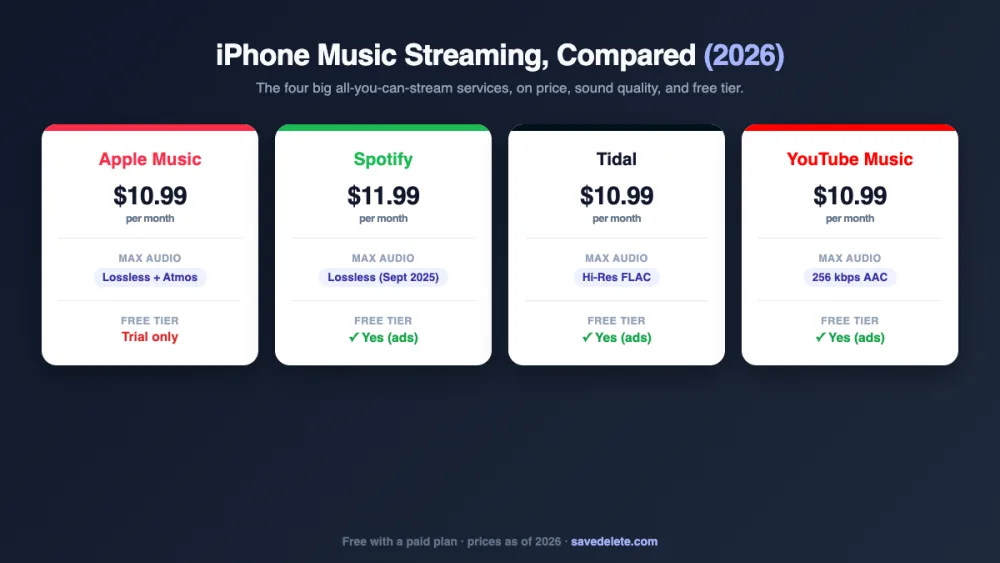
| Apple Music | iPhone-first integration, lossless & Dolby Atmos included | $10.99 / month | 1-month trial |
| Spotify | Discovery, podcasts, social features | $11.99 / month | Free tier with ads |
| Apple Music Classical | Classical music done properly | Free with Apple Music sub | Same as Apple Music |
| Tidal | Hi-Res audio, artist payouts | $10.99 / month | Free tier (ads) |
| YouTube Music | Massive catalogue + music videos | $10.99 / month (free with YT Premium) | Free tier (ads) |
| SoundCloud | Indie, remixes, unsigned artists | $4.99–$10.99 / month | Free tier |
| Shazam | Identifying what’s playing | Free | Yes |
| TuneIn Radio | Live radio worldwide | Free / $9.99 Premium | Yes |
| Pocket Casts | Podcast listening | Free / $40 a year Plus | Yes |
| Endel | AI-generated focus / sleep soundscapes | $5.99 / month | Yes (3 sessions / day) |
1. Apple Music — the iPhone default
Apple Music is the natural pick on iPhone in 2026. Lossless audio (up to 24-bit / 192 kHz) and spatial audio with Dolby Atmos are included at no extra cost on the standard $10.99 / month plan — both Spotify and Tidal charge more for the equivalent. The library tops 100 million tracks, AirPlay routing across HomePods, Apple TVs and CarPlay is seamless, and the deep iOS integration (Siri, Lock Screen, Now Playing widget, Apple Watch sync) genuinely matters in daily use. The Apple One bundle ($19.95 / month) includes Music, TV+, Arcade and 50 GB iCloud storage and is usually better value if you already pay for any two of those.
2. Spotify — still the best for discovery
Spotify remains the leader on the discovery and social side: Discover Weekly, Daily Mixes, Wrapped, collaborative playlists, and the Blend feature that automatically creates a shared playlist with a friend are all things Apple Music doesn’t do as well. The free tier with ads is the only true freemium offering among major services. Audio quality used to be the trade-off, but Spotify finally added lossless streaming (24-bit / 44.1 kHz FLAC) to Premium at no extra cost in September 2025, closing most of the gap with Apple Music and Tidal. For pure listening on iPhone, Spotify is roughly tied with Apple Music; for finding new music you wouldn’t have found yourself, it’s still ahead.
3. Apple Music Classical — free if you already subscribe
Apple Music Classical is a separate iPhone app you might not know exists. It launched in 2023 and is built on the catalogue and indexing model Apple acquired from Primephonic. The point: regular streaming apps file classical music by “artist” (meaning the performer) and “album”, which makes finding a specific Beethoven symphony interpretation almost impossible. Apple Music Classical lets you search by composer, work, performer, conductor, ensemble, opus number and recording. If you ever listen to classical, install it — it’s free with any Apple Music subscription.
4. Tidal — for hi-fi listeners and indie-artist supporters
Tidal pioneered hi-res audio streaming and still has the strongest catalogue of master-quality (MQA / FLAC up to 24-bit / 192 kHz) tracks. After major pricing reforms in 2024–2025, Tidal HiFi sits at $10.99 / month for individuals — same as Apple Music — and the student / family discounts undercut Spotify. Tidal also still pays a higher per-stream royalty to artists than the majors, which matters if you care about that. The interface is the weakest of the major services, but for audiophiles with a wired-DAC setup, it’s worth choosing.
5. YouTube Music — the dark-horse free option
YouTube Music shares the same catalogue + recommendation engine as YouTube proper, which makes its library effectively unmatched — live concerts, demos, remixes, fan covers, B-sides that no other platform carries. Paid YouTube Music is $10.99 / month, but if you already pay $13.99 / month for YouTube Premium (no-ads YouTube), Music is included free. The free tier is ad-supported but works in the background on iOS in 2026, unlike when it launched. Best for: listeners who want music videos and rare cuts as well as the standard discography.
6. SoundCloud — for indie, remixes and DJ mixes
SoundCloud is the home of unsigned, indie and remix culture — a deep cut of music you cannot find on Spotify or Apple Music because the artist self-publishes here first (or only). The free tier is ad-supported; SoundCloud Go ($4.99 / month) gives unlimited skips and offline; SoundCloud Go+ ($10.99 / month) adds the full SoundCloud catalogue (some labels reserve their major-label tracks for the higher tier). Install if you listen to underground hip-hop, electronic, DJ mixes, demo cuts, or want to follow unsigned artists.
7. Shazam — what is this song?
Shazam identifies the song playing around you in about two seconds. Apple acquired Shazam in 2018 and integrated the tech directly into iOS — you can ask Siri “What song is this?” without installing anything, and Control Center has a dedicated Shazam toggle (Settings > Control Center > Music Recognition). The app itself adds offline song matching, history, charts and a tighter integration with Apple Music. Free, unlimited, no ads.
8. TuneIn Radio — live radio from everywhere
TuneIn Radio streams live FM, AM and internet radio stations from more than 100,000 sources worldwide. The free tier covers most music and news stations; TuneIn Premium ($9.99 / month) unlocks live sports (NFL, MLB, NHL, NBA in the US) and ad-free music stations. Best for: listeners who want a specific local station from another country, sports talk radio, BBC Radio outside the UK, and people who’ve never quite given up the radio listening pattern.
9. Pocket Casts — the best podcast player
Pocket Casts is the strongest third-party podcast app on iOS — smarter sync between devices, better playback-speed controls (trim silence, voice boost), better library management than Apple Podcasts. The core app is free; Pocket Casts Plus ($40 / year) adds desktop apps, themes and folders. Worth installing even if podcasts aren’t your main listening — both Apple Music and Spotify offer podcasts but neither is as good at managing a serious podcast library.
10. Endel — AI-generated focus and sleep audio
Endel generates personalised soundscapes for focus, relaxation, sleep and movement using a soft-AI model that reacts to your time of day, weather and heart rate (if you allow it). It’s deliberately not music in the Spotify sense — there are no recognisable songs — but it’s become the default focus-audio app for a lot of people. Free with three sessions a day; the unlock is $5.99 / month.
Apps to drop from your shortlist
Several apps that appeared on older “best music apps for iPhone” lists are gone or no longer worth installing in 2026:
- MixRadio — shut down in 2016.
- 8tracks — entered receivership in 2019; the site has come back under different ownership but is a shadow of its former self.
- Hype Machine — the original music-blog aggregator pivoted into NFT territory and is no longer a useful music-discovery tool.
- Discovr — discontinued years ago.
- Songkick — still exists as a concert-listings site but the standalone Songkick Concerts app has been retired in favour of integrations with Spotify and Apple Music.
- SongPop — the music trivia game is still on the App Store but doesn’t count as a music-listening app.
Frequently asked questions
Apple Music or Spotify on iPhone in 2026?
Apple Music is the cleaner default on iPhone — lossless and Atmos included, deeper iOS integration, smoother CarPlay handoff. Spotify is the better choice if discovery, social features (Blend, collaborative playlists) and podcasts matter more than audio quality or platform integration. Most people will be happy with either; switching is friction-free since both let you import library data.
Is Apple Music Classical worth installing?
If you listen to any classical music at all, yes — it’s included free with any Apple Music subscription and the metadata indexing (composer, work, opus number, conductor) makes finding specific recordings actually possible, which is impossible inside regular Apple Music or Spotify. Even if you don’t listen to classical often, the app is free with your existing sub.
What is the best free music app for iPhone?
Spotify’s free tier is the most generous — the full library is available with ad interruptions and shuffle restrictions on phone. YouTube Music’s free tier is the runner-up and is the only free tier that handles music videos as well as audio. SoundCloud’s free tier is the pick if you want indie / underground / DJ-mix listening.
Can I get lossless / hi-res audio on iPhone?
Yes — Apple Music delivers lossless and Dolby Atmos at no extra cost. Tidal HiFi gives master-quality FLAC at the same price ($10.99 / month). Spotify added lossless (24-bit / 44.1 kHz FLAC) to Premium at no extra cost in September 2025. Note that wireless AirPods and most Bluetooth headphones still don’t play back true lossless — the codec on Bluetooth caps quality. You need wired headphones with a Lightning / USB-C DAC adapter, or AirPlay to a wired DAC, to actually hear the difference.
Can I share an Apple Music subscription with my family?
Yes. Apple Music Family ($16.99 / month) covers up to six people with separate libraries and recommendations under Apple Family Sharing. Spotify Premium Family is $19.99 / month for the same six-person allowance. YouTube Premium Family is $22.99 / month. All three require everyone to be at the same residential address according to the platform’s terms; enforcement varies.
For more app guides, see our roundup of portable tech gadgets and the best AI tools for YouTube thumbnails.