
Content creation has evolved dramatically in 2025, with AI-powered workflows now capable of handling everything from ideation to publishing. This comprehensive guide will teach you how to build automated content creation systems that can research topics, generate high-quality articles, optimize for SEO, and even schedule publications—all with minimal human intervention.
By the end of this tutorial, you'll have a complete understanding of how to leverage cutting-edge AI tools to create a semi-autonomous blog that produces consistent, engaging content while you focus on strategy and growth. We'll cover the entire pipeline from content planning to distribution, including the latest AI models, automation platforms, and optimization techniques that are transforming the industry in 2025.
Prerequisites
Before diving into AI-powered content automation, ensure you have the following foundation in place:
- Basic understanding of content marketing: Familiarity with SEO principles, target audience identification, and content strategy fundamentals
- WordPress or similar CMS: A functioning blog or website with admin access for publishing automation
- API knowledge: Basic understanding of how APIs work and ability to follow API documentation
- Budget allocation: $50-200 monthly budget for AI tools and automation platforms (costs vary based on content volume)
- Time investment: 10-15 hours for initial setup, then 2-3 hours weekly for monitoring and optimization
- Content guidelines: Clear brand voice documentation and content quality standards
Step 1: Choose Your AI Content Generation Stack
The foundation of any automated content workflow starts with selecting the right AI tools. In 2025, several platforms have emerged as leaders in different aspects of content creation. Here are the top options for each component of your stack:
Claude 3.5 Sonnet
Advanced AI writing with superior reasoning
Anthropic's Claude 3.5 Sonnet leads the pack for long-form content generation in 2025, offering exceptional coherence and factual accuracy across complex topics.
- 200,000 token context window for comprehensive articles
- Superior fact-checking and source integration
- Natural writing style that requires minimal editing
- Built-in safety measures for brand-appropriate content
GPT-4 Turbo
Versatile content creation with plugin ecosystem
OpenAI's GPT-4 Turbo remains a solid choice for content automation, especially when integrated with custom GPTs and automation workflows.
- Extensive plugin ecosystem for specialized tasks
- Strong API integration capabilities
- Custom GPT creation for brand-specific writing
- Real-time web browsing for current information
Perplexity Pro
AI research assistant with real-time data
Essential for research-heavy content, Perplexity Pro excels at gathering current information and citing sources automatically.
- Real-time web search integration
- Automatic source citation
- Academic and news database access
- Multi-source fact verification
For most users, I recommend starting with Claude 3.5 Sonnet as your primary content generator, supplemented by Perplexity Pro for research. This combination provides the best balance of quality, accuracy, and cost-effectiveness for automated content workflows.
Step 2: Set Up Content Planning and Research Automation
Effective content automation begins with systematic planning. Instead of generating random articles, create a research-driven approach that identifies trending topics, analyzes competitor content, and maintains a consistent publishing schedule.
Automated Topic Research
Create a research workflow that runs weekly to identify content opportunities:
- Set up Google Trends monitoring: Use Google Trends API to track rising search terms in your niche. Create a spreadsheet that automatically updates with trending keywords and their search volume trajectories.
- Implement competitor analysis: Use tools like Ahrefs or SEMrush APIs to monitor competitor content performance. Set up automated reports that highlight their top-performing articles from the past month.
- Configure social media listening: Integrate with platforms like Brandwatch or Mention to identify trending discussions and questions in your industry.
- Create content gap analysis: Use AI to analyze your existing content against competitor coverage, identifying topics you haven't addressed that are performing well for others.
Ahrefs API
Comprehensive SEO data for content planning
Essential for keyword research automation and competitor analysis, providing the data foundation for strategic content planning.
- Keyword difficulty and search volume data
- Competitor content gap analysis
- Backlink opportunity identification
- SERP feature tracking
Content Calendar Automation
Once you have topic data, automate your content calendar creation:
- Priority scoring system: Create a formula that weighs search volume, keyword difficulty, trend momentum, and relevance to your audience. This helps prioritize which topics to tackle first.
- Seasonal content planning: Use historical data to identify seasonal trends and automatically schedule relevant content 2-3 months in advance.
- Content cluster mapping: Group related topics into content clusters that can link to each other, improving SEO performance through topical authority.
- Publishing schedule optimization: Analyze your audience engagement patterns to determine optimal publishing times and frequencies.
Step 3: Build Your Content Generation Workflow
With research and planning automated, it's time to create the core content generation system. This involves setting up prompts, templates, and quality control measures that ensure consistent output.
Master Prompt Engineering
The quality of your automated content depends heavily on prompt engineering. Here's a framework for creating effective content generation prompts:
| Prompt Component | Purpose | Example |
|---|---|---|
| Role Definition | Establishes AI perspective | "You are an expert technology journalist with 10 years of experience..." |
| Context Setting | Provides background information | "Writing for SaveDelete.com, a tech blog focused on practical tutorials..." |
| Task Specification | Clearly defines the output | "Create a 2000-word comprehensive guide on..." |
| Style Guidelines | Maintains brand consistency | "Use conversational tone, include practical examples, avoid jargon..." |
| Structure Requirements | Ensures proper formatting | "Include H2 headings, bullet points, numbered lists, and conclusion..." |
| Quality Criteria | Sets output standards | "Ensure factual accuracy, include current 2025 data, cite sources..." |
Here's a complete example of a master content generation prompt:
Master Content Prompt Template:
"You are a senior technology writer specializing in practical tutorials and software reviews. You're writing for SaveDelete.com, a technology blog that helps users solve everyday tech problems with clear, actionable advice.
Create a comprehensive [WORD_COUNT]-word article on [TOPIC] that includes:
- Engaging introduction that clearly states what readers will learn
- Step-by-step instructions with screenshots (indicate where images should go)
- Practical tips and best practices
- Common troubleshooting issues and solutions
- Conclusion with next steps or related topics
Writing style: Conversational but professional, accessible to intermediate users, include relevant examples, avoid unnecessary jargon. Use current 2025 information and tools. Structure with clear H2 and H3 headings, bullet points, and numbered lists where appropriate."
Content Generation Pipeline
Create a multi-stage pipeline that ensures quality and consistency:
- Research compilation: Automatically gather relevant information from multiple sources using Perplexity Pro or similar tools
- Outline generation: Create detailed article outlines based on research and SEO requirements
- Content drafting: Generate the full article using your primary AI tool (Claude 3.5 Sonnet recommended)
- Fact-checking pass: Use a secondary AI model to verify claims and identify potential inaccuracies
- SEO optimization: Automatically optimize for target keywords, meta descriptions, and heading structure
- Quality review: Implement automated checks for readability, tone consistency, and completeness
Step 4: Implement SEO Optimization Automation
SEO optimization is crucial for content success, and many aspects can be automated to ensure consistency across all your content.
Surfer SEO
AI-powered content optimization
Surfer SEO's Content Editor provides real-time optimization suggestions and can be integrated into automated workflows for consistent SEO performance.
- Real-time content scoring and optimization
- Keyword density and semantic keyword suggestions
- Content structure recommendations
- SERP analysis integration
Automated SEO Checklist
Create automated checks for these essential SEO elements:
- Title optimization: Ensure titles are 50-60 characters, include target keywords, and follow proven formulas
- Meta description generation: Automatically create compelling 150-160 character descriptions
- Header structure: Verify proper H1, H2, H3 hierarchy with keyword distribution
- Internal linking: Automatically suggest and insert relevant internal links to existing content
- Image optimization: Generate SEO-friendly alt text and file names for images
- Schema markup: Add appropriate structured data for better search visibility
Step 5: Set Up Publishing Automation
The final step in your content workflow is automated publishing and distribution. This ensures your content reaches your audience consistently without manual intervention.
Zapier
Workflow automation platform
Zapier connects your AI tools with your CMS and social media platforms, enabling seamless content publishing automation.
- 5000+ app integrations
- Multi-step workflow automation
- Conditional logic and filters
- Error handling and notifications
WordPress Publishing Automation
Set up automated WordPress publishing with these steps:
- Install necessary plugins: Use plugins like WP Scheduled Posts and Yoast SEO for enhanced automation capabilities
- Configure API access: Set up WordPress REST API access for external tools to publish content
- Create publishing templates: Standardize post formats, categories, and tags for consistency
- Set up approval workflows: Implement a system where content is saved as drafts for final human review before publishing
- Configure backup systems: Ensure all generated content is backed up before publishing
Social Media Distribution
Extend your automation to social media promotion:
- Auto-generate social posts: Create platform-specific promotional content for each article
- Schedule optimal posting times: Use analytics data to determine when your audience is most active
- Create content variations: Generate multiple social media posts per article for extended promotion
- Track engagement: Monitor social media performance to refine your promotion strategy
Step 6: Quality Control and Monitoring
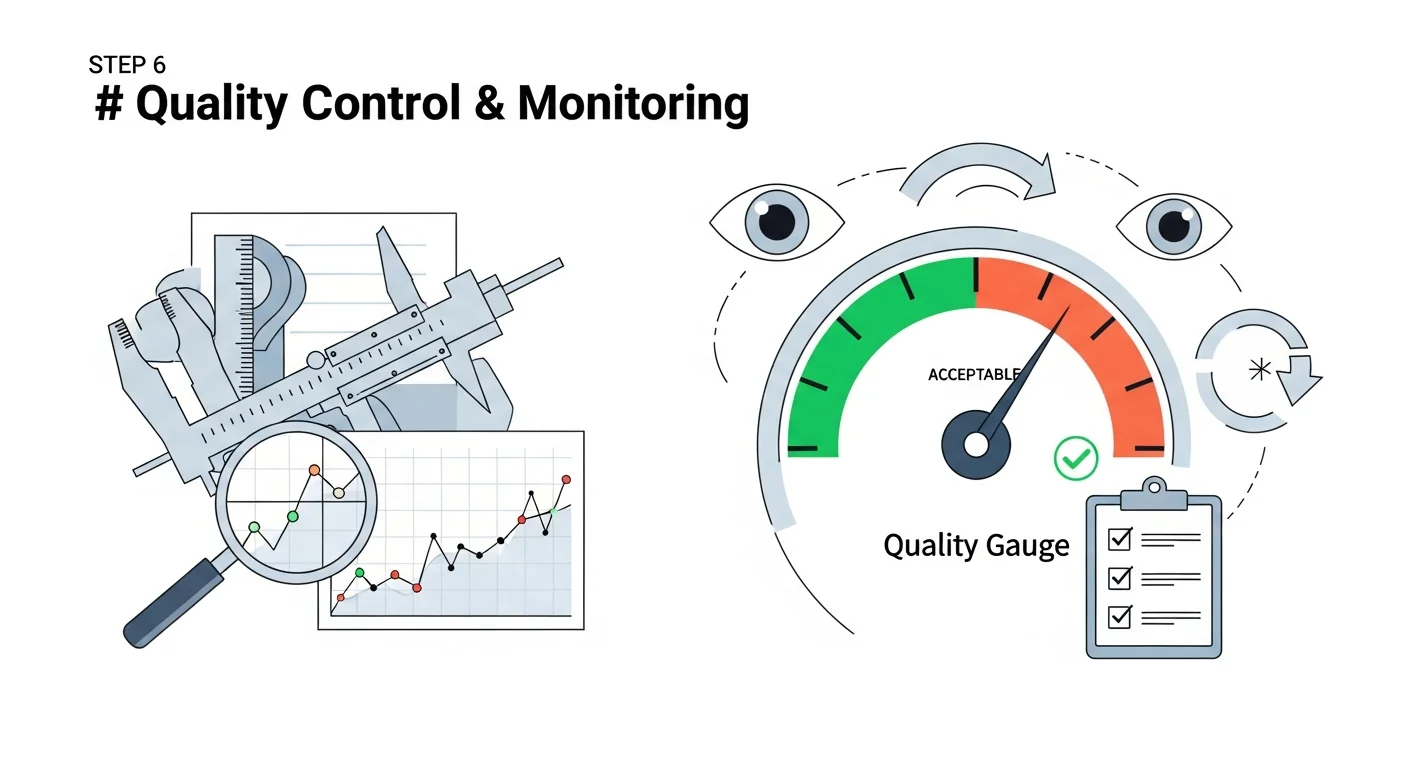
Automation doesn't mean abandoning quality control. Implement systems to monitor and maintain content standards:
Automated Quality Checks
- Plagiarism detection: Use tools like Copyscape API to check for duplicate content
- Readability scoring: Implement Flesch-Kincaid and other readability metrics
- Fact-checking alerts: Set up systems to flag potentially inaccurate claims for human review
- Brand voice consistency: Use AI to analyze tone and style consistency across content
- Technical accuracy: For technical content, implement specialized checking for code examples and procedures
Performance Monitoring
Track the success of your automated content:
- SEO performance: Monitor rankings, organic traffic, and click-through rates
- Engagement metrics: Track time on page, bounce rate, and social shares
- Conversion tracking: Measure how automated content contributes to business goals
- Content velocity: Monitor publishing frequency and consistency
Step 7: Advanced Optimization Techniques
Once your basic automation is running smoothly, implement these advanced techniques to maximize effectiveness:
Dynamic Content Personalization
Use AI to create personalized content variations:
- Audience segmentation: Generate different versions of articles for different reader personas
- Geographic customization: Adapt content for different regions or markets
- Skill level adaptation: Create beginner and advanced versions of technical content
- Industry-specific variations: Tailor examples and case studies for different industries
Continuous Learning and Improvement
Implement feedback loops to improve your automation over time:
- Performance-based prompt optimization: Adjust prompts based on content performance data
- A/B testing automation: Test different headlines, structures, and approaches automatically
- Reader feedback integration: Use comments and feedback to improve future content generation
- Competitive analysis updates: Regularly update your strategy based on competitor performance
Best Practices for AI Content Automation
Follow these proven practices to maximize the effectiveness of your automated content system:
Content Quality Standards
- Maintain human oversight: Always have human editors review content before publication, even if just for final approval
- Implement version control: Keep track of prompt changes and their impact on content quality
- Regular prompt auditing: Review and update your prompts monthly based on performance data
- Diverse source integration: Don't rely on a single AI model; use multiple sources for research and generation
- Brand voice documentation: Maintain detailed style guides and update them regularly
Technical Implementation
- Robust error handling: Build systems that can handle API failures and unexpected responses
- Rate limit management: Respect API rate limits and implement proper queuing systems
- Data security: Ensure all content and data is properly secured and backed up
- Scalability planning: Design systems that can handle increased content volume
- Cost monitoring: Track AI usage costs and optimize for efficiency
Content Strategy Integration
- Editorial calendar alignment: Ensure automated content supports your overall content strategy
- Seasonal content planning: Build awareness of holidays, events, and industry cycles into your automation
- Content cluster development: Create interconnected content that builds topical authority
- Audience feedback integration: Use reader comments and engagement data to guide content direction
Common Mistakes to Avoid
Learn from common pitfalls that can derail your content automation efforts:
Over-Automation Errors
- Publishing without human review: Never publish AI-generated content without at least a quick human check for accuracy and appropriateness
- Ignoring brand voice: Automated content that doesn't match your brand voice will confuse and alienate readers
- Neglecting fact-checking: AI can generate convincing but incorrect information; always verify factual claims
- Keyword stuffing: Don't let SEO automation tools create unnatural keyword density
- Generic content creation: Avoid prompts that generate generic, non-differentiated content
Technical Implementation Mistakes
- Insufficient error handling: Systems that break when APIs are unavailable or return unexpected results
- Poor prompt versioning: Not tracking which prompts generate the best results makes optimization impossible
- Inadequate testing: Launching automation without thorough testing in a staging environment
- Ignoring rate limits: Overwhelming APIs with too many requests can result in temporary bans
- Lack of monitoring: Not setting up alerts for system failures or quality issues
Strategic Missteps
- Focusing only on volume: Prioritizing quantity over quality will hurt your brand reputation
- Ignoring audience feedback: Not adapting your automation based on reader engagement and comments
- Neglecting competitor analysis: Failing to stay current with industry trends and competitor strategies
- Poor content distribution: Creating great content but failing to promote it effectively
- Inadequate performance tracking: Not measuring the ROI of your automation efforts
Frequently Asked Questions
How much does it cost to set up AI content automation?
Initial setup costs typically range from $150-500 monthly, including AI tools ($40-60), SEO tools ($89-200), automation platforms ($20-100), and miscellaneous services. Costs scale with content volume and complexity. Most businesses see ROI within 3-6 months through reduced content creation time and improved SEO performance.
Can AI-generated content rank well in search engines?
Yes, AI-generated content can rank excellently when properly optimized and fact-checked. Google's focus is on content quality and user value, not the creation method. Key factors include accuracy, depth, originality, and proper SEO optimization. Many successful blogs use AI assistance while maintaining high search rankings.
How do I maintain my brand voice with automated content?
Develop detailed style guides and incorporate them into your AI prompts. Include specific examples of your brand voice, tone preferences, and writing style. Regularly review and refine prompts based on output quality. Consider creating custom GPTs trained on your existing content for better brand consistency.
What's the recommended publishing frequency for automated content?
Start with 2-3 articles per week and scale based on quality maintenance and audience engagement. Publishing too frequently can overwhelm readers and dilute quality. Focus on consistency rather than volume. Monitor engagement metrics to find your optimal frequency.
How do I handle fact-checking in automated workflows?
Implement multi-layer fact-checking: use research-focused AI tools like Perplexity Pro for source verification, cross-reference claims with authoritative sources, set up automated plagiarism detection, and maintain human oversight for final review. Never publish without some form of fact verification.
Should I disclose that content is AI-generated?
Disclosure requirements vary by jurisdiction and platform, but transparency is generally recommended. Many successful blogs note "AI-assisted" content creation while emphasizing human oversight and editing. Focus on providing value to readers rather than the creation method.
How do I scale content automation without losing quality?
Implement robust quality control systems, maintain detailed prompt libraries, use performance-based optimization, invest in better AI tools as you scale, and consider hiring editors for high-volume workflows. Quality should never be sacrificed for quantity.
What metrics should I track for automated content performance?
Monitor organic traffic growth, search rankings, engagement metrics (time on page, bounce rate), social shares, conversion rates, content velocity, and cost per article. Set up automated reporting dashboards to track these metrics consistently.
Conclusion and Next Steps
AI-powered content automation represents a significant opportunity for bloggers and content creators in 2025. By following this comprehensive guide, you've learned how to build a sophisticated system that can research, create, optimize, and publish high-quality content with minimal manual intervention.
The key to success lies in balancing automation with human oversight, maintaining quality standards, and continuously optimizing your processes based on performance data. Remember that automation should enhance your content strategy, not replace strategic thinking and brand development.
Immediate Action Items
- Start small: Begin with one AI tool (recommend Claude 3.5 Sonnet) and automate a single part of your workflow
- Document everything: Keep detailed records of prompts, processes, and performance metrics
- Set up monitoring: Implement basic performance tracking before scaling your automation
- Plan your content strategy: Define your target audience, content goals, and quality standards
- Budget appropriately: Allocate resources for tools, testing, and potential iterations
Long-term Development
As your automation matures, focus on these advanced developments:
- Custom model training: Consider training custom models on your specific content and audience data
- Advanced personalization: Implement dynamic content that adapts to individual reader preferences
- Multi-format automation: Expand beyond blog posts to podcasts, videos, and interactive content
- International expansion: Automate content translation and localization for global audiences
- Community integration: Use AI to engage with reader comments and foster community discussion
The content creation landscape will continue evolving rapidly throughout 2025 and beyond. Stay informed about new AI developments, regularly update your tools and processes, and always prioritize providing genuine value to your audience. With proper implementation and ongoing optimization, AI content automation can significantly accelerate your blog's growth while maintaining the quality and authenticity your readers expect.
Remember that the most successful automated content systems are those that enhance human creativity rather than replace it entirely. Use these tools to handle routine tasks and research, freeing yourself to focus on strategy, relationship building, and the unique insights that only human experience can provide.