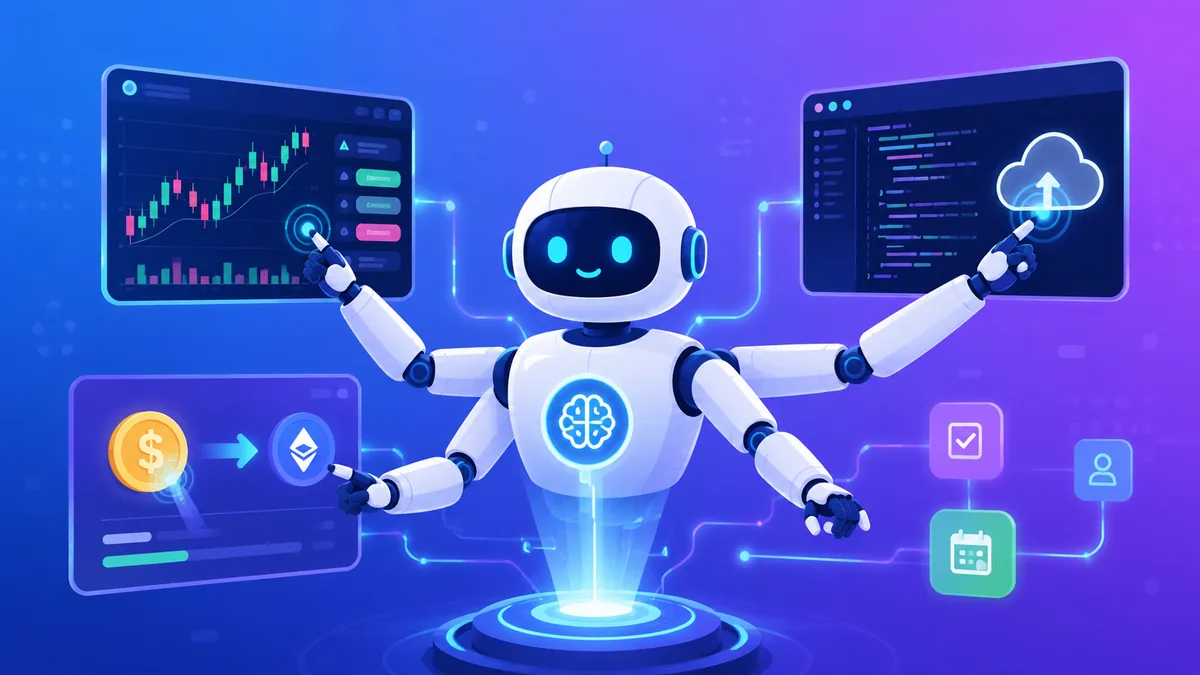
For three years, "using AI" mostly meant chatting with it. You asked, it answered, and you did the actual work. That's now changing fast. On June 11, 2026, two separate announcements drew the same line in the sand: AI agents are being handed the ability to act in the real world — to execute trades, move money, and run software on their own.
Coinbase launched a tool that lets AI agents trade crypto and pay for services from your account. The same day, OpenAI agreed to buy a company whose entire purpose is giving agents a secure place to run for hours at a time. Individually, each is notable. Together, they mark the moment "agentic AI" stopped being a buzzword and started being a product.
The News in Brief
- Coinbase for Agents: a new tool that lets AI agents pull market data, execute crypto trades, and pay for services within user-set limits.
- OpenAI acquires Ona: OpenAI is buying Ona, which provides secure cloud environments for AI agents, to let its Codex assistant run long, persistent tasks.
- The theme: AI is shifting from generating answers to taking actions — the core of "agentic AI."
- The plumbing: open standards like MCP and the x402 payment protocol are what make it possible.
What "Agentic AI" Actually Means
An AI agent is software that uses an AI model not just to respond, but to pursue a goal — planning steps, calling external tools, and acting until the task is done. The difference is simple but profound:
| Aspect | Chatbot (2023–24) | AI agent (2026) |
|---|---|---|
| What it does | Answers your question | Completes the task for you |
| Tools | None — text in, text out | Calls apps, APIs, code, payments |
| Steps | One reply | Many chained steps, self-checking |
| Human role | Does the work | Sets goals and limits, supervises |
That jump — from "tell me how to rebalance my portfolio" to "rebalance my portfolio" — is exactly what the day's two announcements enable, one for money and one for code.
Coinbase: Agents That Trade and Pay
Coinbase's new "Coinbase for Agents" gives AI agents direct, permissioned access to a user's account. An agent can pull live market data, analyze it, and execute crypto trades — using Coinbase Advanced, the company's professional trading platform with tools like TradingView charts. You might ask an agent to rebalance your portfolio, to follow an investment thesis and trade on your behalf, or simply to advise on a one-off trade.
It ships with two ways to connect: MCP for web-based agents like ChatGPT and Claude, and a CLI for terminal-based setups. Crucially, it can also pay for things — using the open x402 protocol, an agent can buy premium research data or on-demand compute without a login or subscription.
"Instead of asking an AI how to trade, you can now ask it to trade — within the limits you set."
Coinbase clearly anticipated the obvious worry. If you'd rather not hand an autonomous agent your main balance, you can confine it to a sandbox account, separate from your real funds.
OpenAI + Ona: Agents That Run for Hours
The Coinbase news is about agents that act; the OpenAI news is about giving agents somewhere to live while they do. OpenAI agreed to acquire Ona, a startup that provides secure, persistent cloud environments for AI agents. The goal: let OpenAI's coding assistant, Codex, take on long-running tasks instead of short bursts.
What makes Ona interesting is its customer-controlled execution model. Agents run inside an organization's own cloud environment, while OpenAI provides the intelligence and orchestration on top. For enterprises nervous about handing autonomous code-writing agents the keys to their systems, that separation matters. Ona brings real scale to the table, too — it has helped 2 million developers work in secure, reproducible cloud environments.
Terms weren't disclosed, and the deal is subject to regulatory approval. After it closes, the Ona team will join the Codex group. The strategic message is clear: the race is no longer just about the smartest model, but about the infrastructure that lets agents work reliably for hours.
The Plumbing: MCP and x402
None of this works without shared standards, and two open protocols are quietly doing the heavy lifting.
| Standard | What it does | Why it matters |
|---|---|---|
| MCP (Model Context Protocol) | Lets agents connect to tools and services in a consistent way | One standard plug for every app — how an agent reaches Coinbase, your files, or an API |
| x402 | Open payment protocol for agents (by Coinbase with AWS, Anthropic, Circle, Near) | Lets agents pay for data or compute on demand, no login or subscription needed |
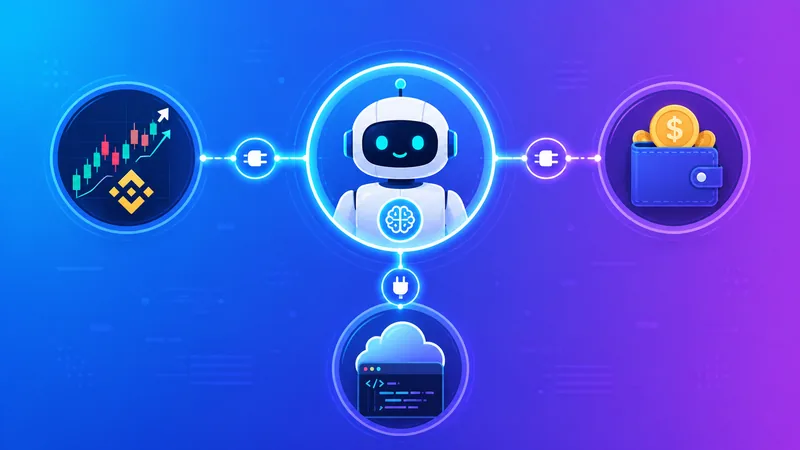
Think of MCP as the hands that let an agent reach out and use a service, and x402 as the wallet that lets it pay as it goes. Once agents can both call tools and settle payments through open standards, an entire economy of machine-to-machine transactions becomes possible — software paying software for exactly what it needs, moment to moment.
The Risks of Letting Agents Act
Handing autonomous software access to your money and systems is a genuinely bigger deal than a chatbot giving a wrong answer. The risks are real:
- Costly mistakes. An agent that misreads a goal could make trades or payments you didn't intend.
- Prompt injection. Malicious instructions hidden in a webpage or document could try to hijack an agent that has spending power.
- Runaway usage. Agents that loop and call tools thousands of times can rack up costs fast — a dynamic we covered in the AI price war, where Uber burned its annual AI budget in four months.
The early guardrails are sensible: user-set spending limits, sandbox accounts separate from real funds, and explicit permissions. The smart way to adopt agentic tools is to start small, cap what they can spend, and keep a human in the loop for anything irreversible. This is also exactly why the debate over AI oversight and safety rules is heating up just as agents gain the power to act.
Frequently Asked Questions
What is agentic AI?
Agentic AI refers to AI systems that don't just answer questions but take actions to complete goals — calling tools, running code, making payments and chaining many steps together with limited human input. Instead of a chatbot that replies and stops, an AI agent can plan a task, execute it across apps and services, check its own work, and keep going until the job is done.
What is Coinbase for Agents?
Coinbase for Agents is a tool, launched June 11, 2026, that lets AI agents access a user's Coinbase account to pull market data, execute crypto trades and pay for services within limits the user sets. It works through MCP for web-based agents like ChatGPT and Claude, and a CLI for terminal-based agents. Users can ask an agent to rebalance a portfolio, follow an investment thesis, or advise on a single trade, and can confine it to a sandbox instead of their main account.
Why did OpenAI acquire Ona?
OpenAI agreed to acquire Ona, a startup that provides secure cloud environments for AI agents, to give its Codex coding assistant persistent, long-running cloud workspaces. Ona's customer-controlled model lets agents run inside an organization's own cloud while OpenAI supplies the intelligence and orchestration. Ona has helped 2 million developers work in reproducible cloud environments. Terms were not disclosed and the deal is subject to regulatory approval.
What are MCP and the x402 protocol?
MCP (Model Context Protocol) is an open standard that lets AI agents connect to external tools and services in a consistent way — it's how an agent plugs into something like Coinbase. x402 is an open payment protocol, launched by Coinbase with AWS, Anthropic, Circle and Near, that lets agents pay for things like premium research APIs or compute on demand, without a login or subscription. Together they form the plumbing for agents that can both act and transact.
Are AI agents that handle money safe?
They introduce real risks. Giving an autonomous agent access to trading accounts and payments raises the stakes of mistakes, prompt-injection attacks and runaway behavior. Providers are adding guardrails — user-set spending limits, sandbox accounts separate from your main funds, and explicit permissions — but the technology is new. The sensible approach is to start with tight limits, use sandboxes, and keep a human in the loop for anything irreversible.
Final Thoughts
The chatbot era taught AI to talk. The agentic era is teaching it to act — to trade, pay, build, and run on its own. Coinbase putting agents in charge of trades and OpenAI buying the infrastructure to keep agents running for hours are two faces of the same shift, and they landed on the very same day for a reason: the whole industry is racing toward autonomy at once.
For users and businesses, the opportunity is enormous, but so is the responsibility. The winners won't be those who hand agents the most control fastest — they'll be the ones who pair real autonomy with tight limits, sandboxes, and human oversight. Agentic AI is here. Using it carefully is the new skill. For more on where the industry is heading, read our explainers on the AI price war and Dario Amodei's AI policy blueprint.