CoinSwitch Review 2026: Honest Look at India's Crypto App
CoinSwitch (formerly CoinSwitch Kuber) remains one of India's largest crypto apps in 2026, with more than 20 million registered users and FIU-IND registration. This is a balanced review, not a sales pitch: it weighs the app's genuinely beginner-friendly design against its mixed app-store ratings, a 2022 Enforcement Directorate inquiry, and a history of disabled withdrawals. Crypto investing is high-risk and heavily taxed in India, so the goal here is to help you decide with clear eyes. This article is informational only and is not financial advice.
Not financial advice: this is an independent, informational review. Crypto is highly volatile and you can lose your entire investment. Do your own research and only invest what you can afford to lose.
CoinSwitch in 2026: Where It Stands
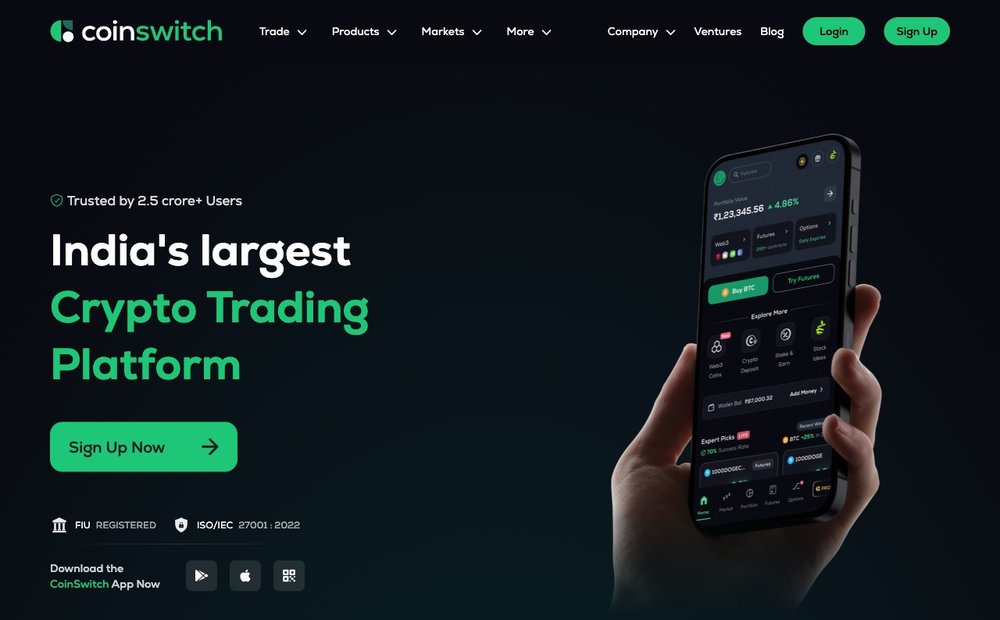
CoinSwitch, founded in 2017 and rebranded from CoinSwitch Kuber, is an India-focused crypto exchange backed by Peak XV (formerly Sequoia India), Tiger Global, Coinbase Ventures and a16z. As of 2026 it reports over 2 crore (20 million) users and access to 250-400+ virtual digital assets with INR on- and off-ramps. It is genuinely one of the larger Indian platforms, but trading volumes across the sector collapsed roughly 90% after India's 2022 crypto tax came in, and CoinSwitch's own operating revenue fell sharply (about Rs 45.6 crore in FY23, down ~82% year on year). Note: CoinSwitch itself is crypto-only; stocks and mutual funds are handled by Lemonn, a separate app from co-founder Ashish Singhal, not by CoinSwitch.
Inside the App: Lite, Pro, SIPs and Coins

CoinSwitch offers two modes: CoinSwitch Lite, a stripped-down 'Buy Now' interface aimed at first-timers, and CoinSwitch Pro, with TradingView-style charts, multiple order types and deeper liquidity for active traders. In 2026 it also supports Crypto SIPs (recurring systematic buys), spot trading from as little as Rs 100, and futures/derivatives contracts on majors like BTC, ETH and SOL. The dual-mode design is a real strength for beginners. To be clear, CoinSwitch is a crypto-only app: it does not offer Indian equities or mutual funds (that is Lemonn, a separate product).
Trading Fees and Hidden Costs
Spot trading fees are tiered by 30-day volume, roughly 0.04% to 0.40%, while futures maker/taker fees sit around 0.02%/0.05%. On top of exchange fees, every Indian crypto trade carries a mandatory 1% TDS deduction, and GST may apply to platform fees. Historically users have complained that CoinSwitch's displayed buy/sell rates and spreads can be worse than the open market, so the headline percentage is not the full cost. Always compare the final all-in rate before confirming a trade.
Security, Custody and FIU Registration
CoinSwitch is registered with India's Financial Intelligence Unit (FIU-IND) and enforces KYC, AML and CFT rules. It cites ISO/IEC 27001:2022 certification, SOC 2 Type II custody controls, 2FA and cold-wallet storage for the bulk of funds. There is no record of a CoinSwitch user-funds hack, which is a positive in a year where rival CoinDCX lost about $44M (July 2025) and WazirX suffered a ~$230M breach (July 2024). However, no exchange is risk-free: you do not hold your own private keys, so you are trusting CoinSwitch's custody. For long-term holdings, a self-custody hardware wallet remains the more conservative choice.
India's 30% Crypto Tax and 1% TDS
Heavy tax, every exchange: India taxes crypto gains at a flat 30% (plus cess) under Section 115BBH, with a 1% TDS on transfers (Section 194S). You cannot offset losses against gains or carry them forward. This applies on CoinSwitch and every other Indian exchange alike.
India taxes virtual digital assets harshly and this applies on any exchange, not just CoinSwitch. Under Section 115BBH, profits from crypto are taxed at a flat 30% (plus 4% cess and any surcharge), regardless of your income slab. A 1% TDS (Section 194S) is deducted at source on transfers. Critically, you cannot offset crypto losses against gains or any other income, and losses cannot be carried forward. Only the cost of acquisition is deductible, gas and exchange fees are not. From FY2025-26, gains must be reported under Schedule VDA in your ITR. This tax regime, not the app, is often the biggest drag on Indian crypto returns.
Pros and Cons at a Glance
Pros
Beginner-friendly, clean Lite interface with fast INR onboarding; FIU-IND registered with ISO 27001 and SOC 2 Type II certifications; large user base and broad coin selection; Crypto SIPs and a separate Pro mode that grows with you; low Rs 100 entry point; and no history of a user-funds hack, unlike several Indian peers. For a first-time Indian crypto buyer who values simplicity, the core experience is solid.
Cons
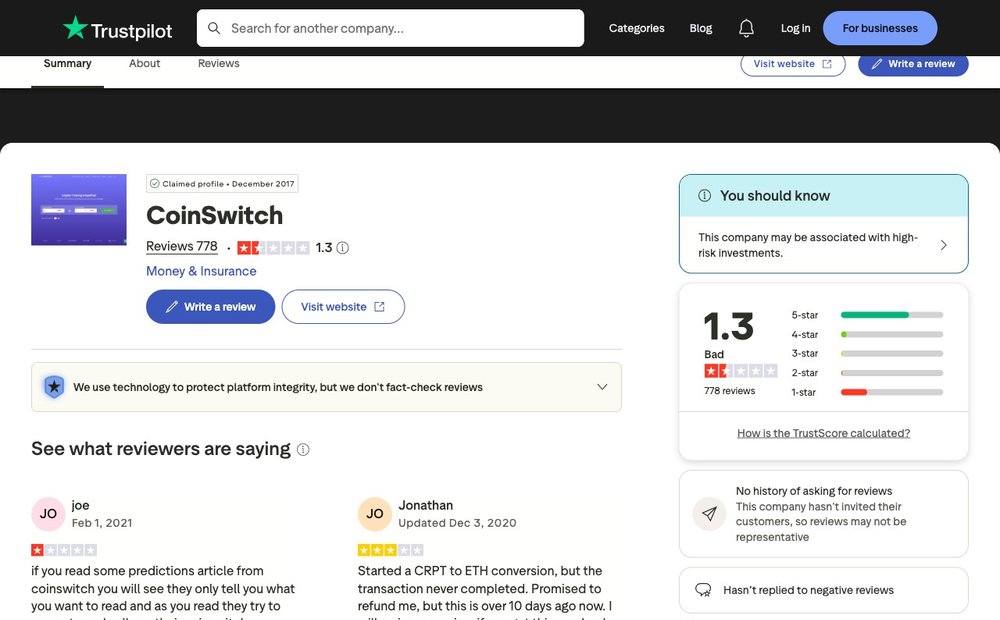
Poor third-party trust signals: CoinSwitch is rated around 1.3/5 on Trustpilot, with recurring complaints about unresponsive support, withdrawals being disabled during market surges, sudden coin delistings that leave users unable to sell, and spreads/rates that look worse than market. The company faced a 2022 Enforcement Directorate inquiry and raids over alleged FEMA/KYC issues (it said this was not a money-laundering case), disabled crypto deposits/withdrawals for months in 2022, did layoffs in 2023, and saw revenue collapse. Like all custodial exchanges, it controls your keys and your withdrawals.
Better-Fit Alternatives: CoinDCX, Mudrex, ZebPay
CoinDCX is the other large FIU-registered Indian exchange with strong liquidity, though it suffered a ~$44M operational-wallet hack in July 2025 (it says no user funds were lost). Mudrex (FIU-registered, SOC 2 Type II) is good for passive investors via its Coin Sets crypto baskets and SIPs. ZebPay, founded in 2014, is India's oldest exchange with a long unbroken security record and heavy cold-storage use. WazirX is best approached with caution: its ~$230M hack in July 2024 forced a year-long shutdown, with operations and 85% fund distribution only resuming in late 2025. No exchange is risk-free, compare fees, security history and support before choosing.
Final Verdict: Who CoinSwitch Suits
CoinSwitch is a reasonable starting point for a first-time Indian crypto buyer who values a simple interface and an FIU-registered platform with no user-funds hack on record. But its weak third-party trust signals (around 1.3/5 on Trustpilot), its history of disabled withdrawals, and the punishing 30% tax that applies on every Indian exchange mean you should keep balances modest, withdraw what you do not need, and compare it against CoinDCX, Mudrex and ZebPay before committing. Treat crypto as high-risk money you can afford to lose.
Sources and Further Reading
- CoinSwitch official website
- India crypto tax guide (ClearTax)
- Best Indian crypto exchanges (Koinly)
- CoinSwitch reviews on Trustpilot
- CoinDCX $44M hack report (TechCrunch)
- 2024 WazirX hack (Wikipedia)
Frequently Asked Questions
Is CoinSwitch safe and legit in 2026?
CoinSwitch is a legitimate, FIU-IND registered Indian exchange with ISO/IEC 27001 and SOC 2 Type II certifications, 2FA and cold-wallet storage, and no record of a user-funds hack. That said, it has a low Trustpilot score (around 1.3/5) with complaints about support and withdrawals, and it faced a 2022 Enforcement Directorate inquiry. It is custodial, so you do not control your keys. It is legitimate, but not risk-free, do your own research and only invest what you can afford to lose. This is not financial advice.
Is crypto legal in India in 2026?
Yes, buying, holding and trading crypto is legal in India in 2026, and FIU-registered exchanges like CoinSwitch operate under anti-money-laundering rules. However, crypto is not legal tender, and gains are taxed very heavily (a flat 30% plus a 1% TDS). The Reserve Bank of India has historically been cautious about crypto, so regulation can change. Legal does not mean low-risk.
How is crypto taxed in India?
Under Section 115BBH, profits from virtual digital assets are taxed at a flat 30% (plus 4% cess and any surcharge), no matter your income slab. A 1% TDS is deducted at source on transfers under Section 194S, which you reconcile when filing. You cannot offset crypto losses against gains or any other income, losses cannot be carried forward, and only the purchase cost is deductible, not fees. From FY2025-26 you report gains under Schedule VDA in your ITR. This heavy regime can erode returns significantly.
CoinSwitch vs CoinDCX: which is better?
Both are large, FIU-registered Indian exchanges. CoinSwitch leans toward beginners with its simple Lite mode and has no user-funds hack on record. CoinDCX offers deeper liquidity and more advanced trading, but suffered a ~$44M operational-wallet hack in July 2025 (it says customer funds were unaffected). CoinSwitch suits first-timers wanting simplicity; CoinDCX suits more active traders. Compare current fees, coin lists and support before deciding. This is not financial advice.
Can you withdraw INR from CoinSwitch?
Yes, CoinSwitch supports INR deposits and withdrawals to your linked bank account after KYC, subject to processing times and limits. Be aware, though, that the platform has a documented history of disabling deposits or withdrawals during periods of regulatory pressure or high volatility, and some users report delays. Withdrawal availability can change, so do not assume instant access to funds, especially during market surges.
This article is informational only and is NOT financial, investment, legal or tax advice. Cryptocurrency is highly volatile and risky; past performance, certifications and registrations do not guarantee future safety. Verify current fees, features and regulations, and consider consulting a qualified adviser, before acting.