SpaceX Filed Its S-1 and the Numbers Are Staggering
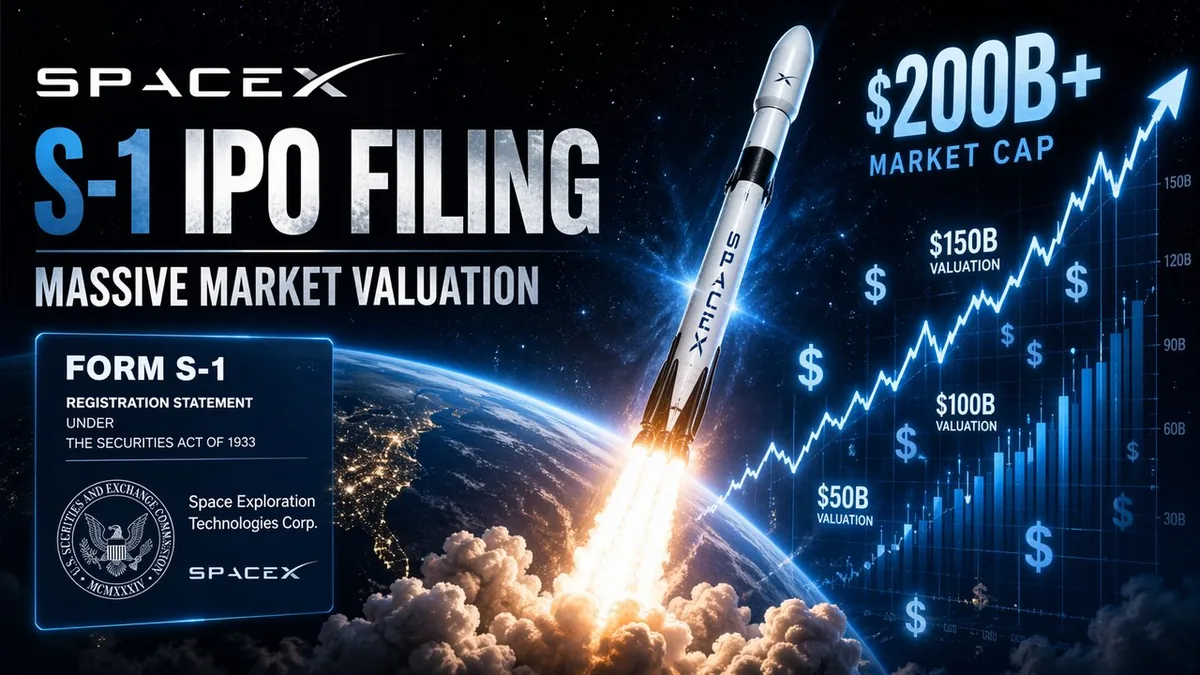
SpaceX filed its S-1 IPO document on April 1, 2026, targeting a $75 billion raise and a June 2026 Nasdaq listing at a $1.75 trillion valuation. The headline numbers are extraordinary — but the filing also reveals the thing that actually makes SpaceX worth $1.75 trillion, and it isn't rockets.
Starlink Is the Business
Starlink generated $11.4 billion in revenue in 2025 — 842% revenue growth over two years. The satellite internet service now has over 10 million subscribers globally. Without Starlink, SpaceX is a launch services company with extraordinary technical capabilities and significant defense contracts. With Starlink, it is a global telecommunications infrastructure provider with a rocket division attached. The S-1 makes the financial center of gravity unmistakably clear.
This context reframes the $1.75 trillion valuation. Investors are not primarily betting on rockets or Mars. They are betting on a low-Earth orbit satellite internet monopoly with near-zero terrestrial infrastructure cost and an expanding global subscriber base.
The xAI Complication
xAI, Elon Musk's AI company, merged into SpaceX in February 2026 at a combined valuation of $1.25 trillion. The S-1 therefore includes xAI's operations and assets — meaning the IPO is not just a space company or a telecom company, but also an AI company. How public market investors price that combination will be one of the defining IPO questions of 2026.
What the IPO Changes
A public SpaceX is a different animal than the private company that has operated outside quarterly earnings pressure since 2002. The $75 billion raise, if successful, would be one of the largest IPOs in US history. It would also give SpaceX access to public capital markets for the first time — and give Elon Musk a new lever for financing projects that currently depend on private funding rounds.
My Take
The $1.75 trillion valuation is defensible if Starlink continues its subscriber growth trajectory — and the global demand for broadband in underserved markets is real. The risk is concentration: Musk controls SpaceX, xAI now merges into it, and Starlink's regulatory approvals depend on government relationships in dozens of countries. That is an enormous amount of single-person key-man risk to ask public investors to price into a $1.75T market cap.
Related Articles
- SpaceX Wants to Make Its Own GPUs and the S-1 Filing Explains Why
- SpaceX Is De-Emphasizing Mars and the Real Reason Is More Interesting Than You Think