SpaceX Is De-Emphasizing Mars — And the Real Reason Is More Interesting Than You Think
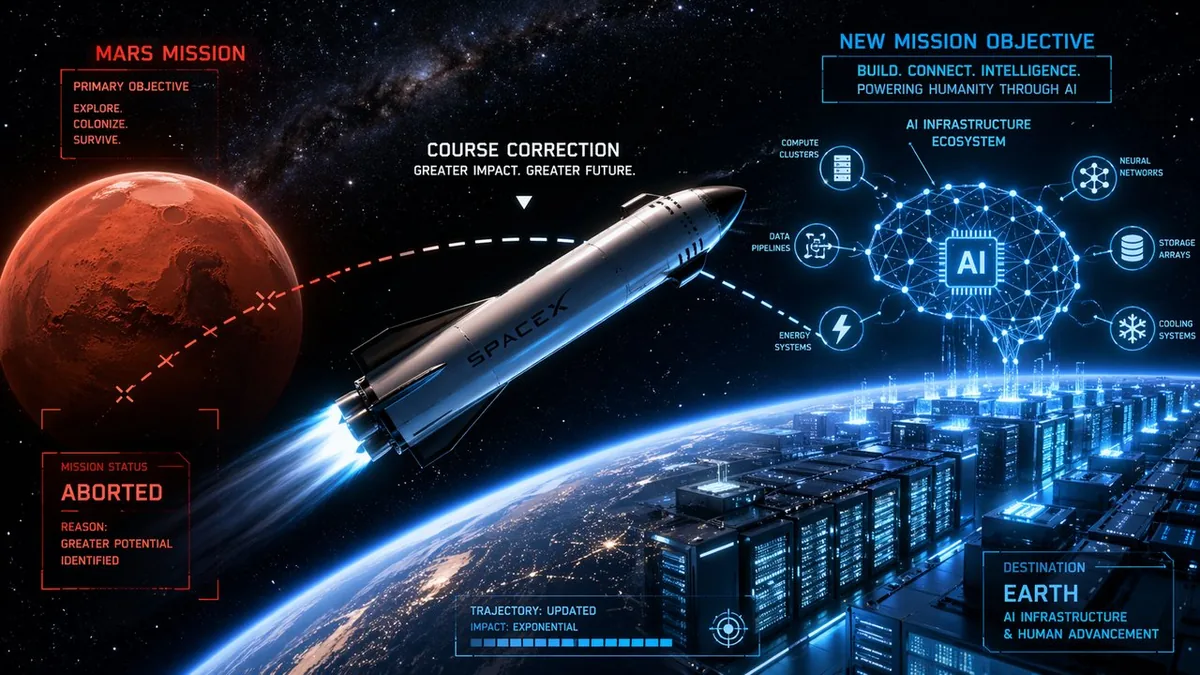
The Mars dream has always been Elon Musk's founding mythology for SpaceX — the reason the company exists, the destination that justified every Falcon 9 landing and every Starship explosion. So when the New York Times reports that Musk has quietly de-emphasized Mars as a near-term priority, it's worth understanding what's actually driving the shift. The answer isn't that Musk gave up on Mars. It's that SpaceX's economic reality has changed dramatically.
What's Actually Happening
Sources told the NYT that internally, SpaceX's focus has shifted toward revenue-generating businesses — primarily Starlink satellite internet and emerging AI infrastructure plays — as the company prepares for a potential IPO. Mars missions don't generate near-term revenue. Starlink does. AI data center connectivity does. The organizational emphasis has followed the money.
Musk hasn't publicly disavowed Mars — the long-term vision remains part of SpaceX's identity. But day-to-day resource allocation, leadership attention, and near-term planning are increasingly oriented around commercial and government satellite contracts, not interplanetary missions.
Why It Matters
SpaceX's shift matters for three reasons. First, it's a signal about IPO strategy: a company pitching to public market investors needs a compelling near-term revenue story, not a decades-long Mars colonization timeline. Second, it validates the Starlink bet — the satellite internet business has proven it can generate real revenue, giving SpaceX a commercial foundation that Mars missions never provided. Third, it raises questions about what happens to NASA's reliance on SpaceX for deep space missions if the company's priorities continue to drift toward commercial LEO and AI infrastructure.
For context on how the SpaceX ecosystem is expanding beyond rockets, see our piece on SpaceX's option to acquire AI coding tool Cursor for $60 billion.
My Take
This is rational, not a betrayal of the mission. Mars colonization at scale is a multi-decade, multi-trillion dollar project. It requires a financially sustainable SpaceX to fund it. If Starlink and AI infrastructure revenue build the capital base that eventually funds Starship Mars missions, the de-prioritization is a feature, not a bug.
What I'd watch is whether Musk's attention follows the same pattern. The Mars vision has historically served as a recruiting tool — it's why exceptional engineers choose SpaceX over better-paying tech jobs. If that vision fades in the internal culture, the talent calculus changes. SpaceX's competitive advantage has always been rooted in mission-driven engineers willing to work harder for less. Lose the mission, and you're just another aerospace contractor competing on salary.
FAQ
Is SpaceX abandoning Mars? No — the long-term vision remains. The shift is about near-term resource allocation and IPO positioning, not a permanent abandonment of the interplanetary mission.
What is SpaceX focusing on instead? Starlink satellite internet revenue, government launch contracts, and emerging AI and satellite infrastructure opportunities.
When is SpaceX planning to IPO? No official timeline has been announced, but reports suggest IPO preparations are underway, likely focused on the Starlink business.
Does this affect NASA's Artemis moon program? Not directly in the near term — SpaceX's Starship is still contracted for NASA lunar lander missions, and those development timelines are separate from Mars ambitions.