The Best Loan Origination Software (LOS) in 2026 for Lenders
Picking a loan origination system is the single biggest tech decision a lender makes — it shapes pull-through rate, compliance posture, and borrower experience for the next decade. The 2026 LOS market has bifurcated: ICE/Encompass and nCino still dominate enterprise mortgage and commercial lending, while API-first platforms like LoanPro and TurnKey Lender are eating consumer, auto, and embedded lending. Below are the ten LOS platforms most worth a serious evaluation this year, across mortgage, commercial, and consumer/auto use cases.
Key takeaways:
- Encompass and nCino still anchor the enterprise mortgage and commercial markets in 2026, but API-first platforms are eating consumer and embedded lending.
- Match the LOS to the collateral class first — mortgage, commercial, and consumer/auto platforms are not interchangeable.
- Borrower-facing POS layers like Blend, Maxwell, and Floify can modernize the front end without a full LOS migration.
- AI features only matter if the vendor can show you explainable adverse-action reasons, a clear data-source map, and fair-lending monitoring built in.
- Integration surface (Plaid, FICO, PPE, eClose, core banking, CRM) is now as important as core LOS features.
The Best Loan Origination Software in 2026 at a Glance
| LOS platform | Lending type | Pricing model | Best for |
|---|---|---|---|
| Encompass by ICE | Mortgage (retail, wholesale, correspondent) | Quote-based enterprise | Banks & IMBs |
| Blend | Mortgage + consumer | Subscription + per-loan | Modern borrower front end |
| nCino | Commercial, SMB, retail, mortgage | Enterprise (Salesforce) | Banks on cloud banking |
| Finastra Fusion LaserPro | Commercial, SMB, consumer | Quote-based enterprise | Community banks |
| LoanPro | Consumer, auto, embedded | API-first, usage-based | Fintechs |
| TurnKey Lender | Consumer, SMB, BNPL | Tiered SaaS | Fast AI decisioning |
| Maxwell | Mortgage (IMBs, community) | Subscription + per-loan | Small–mid mortgage lenders |
| Floify | Mortgage POS & docs | Per-seat subscription | Loan officers & brokerages |
| Calyx Path | Mortgage (brokers, SMB) | Per-user subscription | Calyx Point upgrade |
| Origence | Consumer, auto, indirect, mortgage | Credit-union focused | Credit unions / CUDL auto |
The Picks, Reviewed
1. Encompass by ICE Mortgage Technology
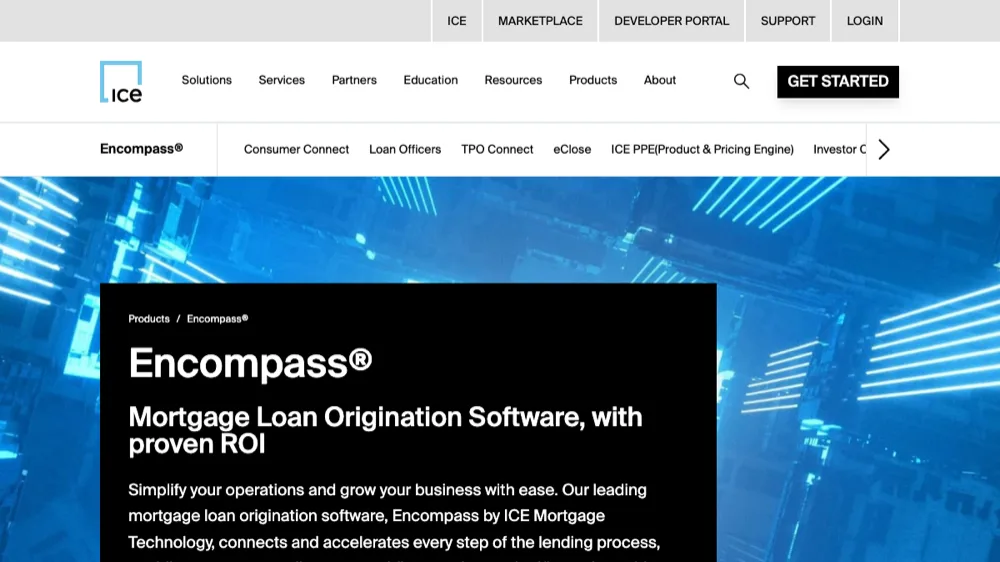
Mortgage (retail, wholesale, correspondent) · enterprise pricing, quote-based · best for banks and IMBs
Encompass remains the default mortgage LOS for a large share of U.S. lenders, covering the full lifecycle from application through closing and investor delivery. ICE's tight integration with its own pricing engine, eClose, and Simplifile recording network is genuinely hard to match. The trade-off is cost and rigidity: deployments are long, customization runs through ICE-certified partners, and the platform offers limited flexibility outside core mortgage workflows. It is the safe enterprise pick for 2026, not the nimble one.
Visit Encompass by ICE Mortgage Technology »
2. Blend
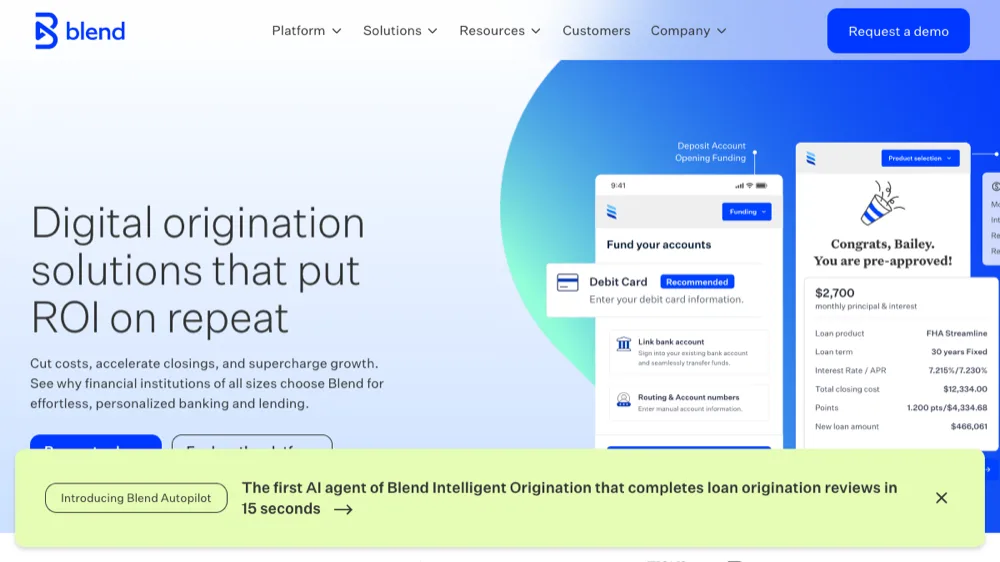
Mortgage + consumer (HELOC, deposit, credit card) · subscription + per-loan fees · best for lenders that want a modern borrower-facing front end
Blend is best understood as a borrower-experience and document-collection layer that sits in front of a back-office LOS rather than replacing it. Lenders running Encompass, MeridianLink, or similar systems use Blend at the top of the funnel and hand a completed file to their underwriting system. In 2026 its consumer-banking suite (HELOC, deposit, credit card origination) is increasingly the bigger growth story than mortgage. Strong fit if your application abandonment rate is your biggest problem.
3. nCino
Commercial, small business, treasury, retail, mortgage · enterprise, Salesforce-licensed · best for banks standardizing on cloud banking
nCino is the cloud banking platform built on Salesforce that has become the de facto commercial LOS for mid-to-large banks. It covers onboarding, application handling, underwriting, portfolio management, and loan approvals in one model, with a growing footprint in small business and retail. Because it inherits Salesforce's data model and AppExchange, it slots cleanly into institutions already on the platform. Expect Salesforce-scale licensing and a multi-quarter implementation.
4. Finastra Fusion LaserPro
Commercial, small business, consumer · enterprise, quote-based · best for community banks
Fusion LaserPro is the industry workhorse for compliant loan documentation, used by thousands of U.S. community banks and credit unions. Its strength is the maintained library of attorney-reviewed loan documents that stay current with state and federal regulations — a major liability shield. As an origination platform it pairs naturally with Finastra's broader Fusion stack, though many institutions adopt LaserPro purely as the docs engine inside another LOS.
Visit Finastra Fusion LaserPro »
5. LoanPro
Consumer, auto, embedded lending, business credit · API-first, usage-based · best for fintechs
LoanPro is an API-first lending platform covering origination, servicing, collections, and payments in a single system, used by 600+ lenders managing more than 25 million loans. It is the platform of choice when speed of program launch, configurability, and clean APIs matter more than turnkey banker UX. Strong fit for auto lenders, BNPL, card programs, and embedded-finance plays. Not the right pick if you want a packaged branch-officer workflow out of the box.
6. TurnKey Lender
Consumer, SMB, BNPL, equipment finance · tiered SaaS · best for fast AI decisioning deployments
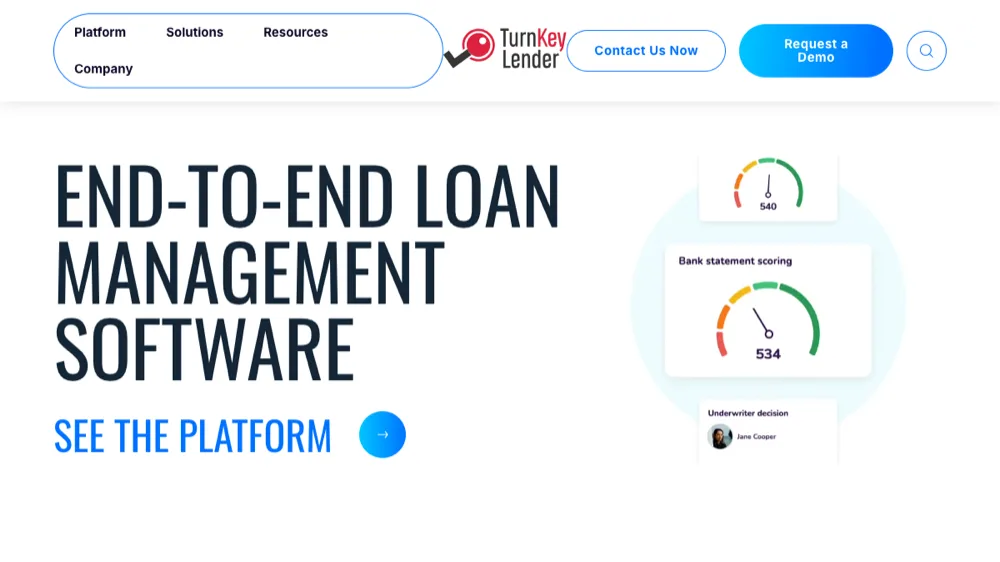
TurnKey Lender is a cloud, all-in-one lending platform serving 200+ clients across 50+ countries, combining origination, servicing, and ML-powered credit decisioning in one unified system. It is unusually fast to stand up — deployments measured in weeks — at the cost of less deep customization than enterprise platforms. The built-in AI scoring and automation make it especially attractive for non-bank lenders and embedded programs.
7. Maxwell
Mortgage (IMBs, community lenders) · subscription + per-loan · best for small-mid mortgage lenders
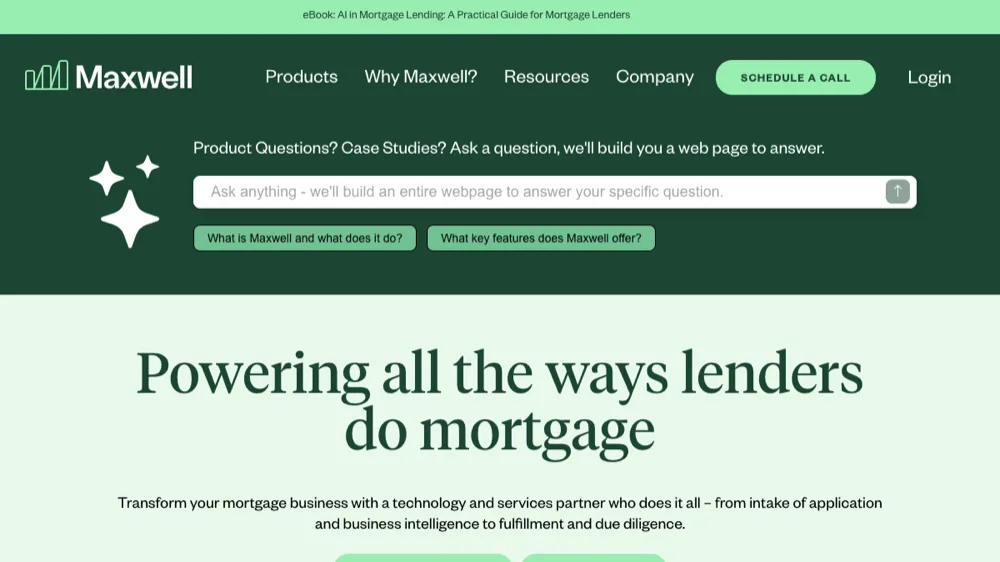
Maxwell focuses squarely on independent mortgage banks, community banks, and credit unions that can't justify enterprise tooling. The platform pairs a modern borrower point-of-sale with Maxwell Fulfillment (outsourced processing and underwriting) and Maxwell Capital (correspondent investor outlet). The combination lets a small lender punch well above its weight on borrower experience without rebuilding ops.
8. Floify
Mortgage point-of-sale and document collection · per-seat subscription · best for loan officers and brokerages
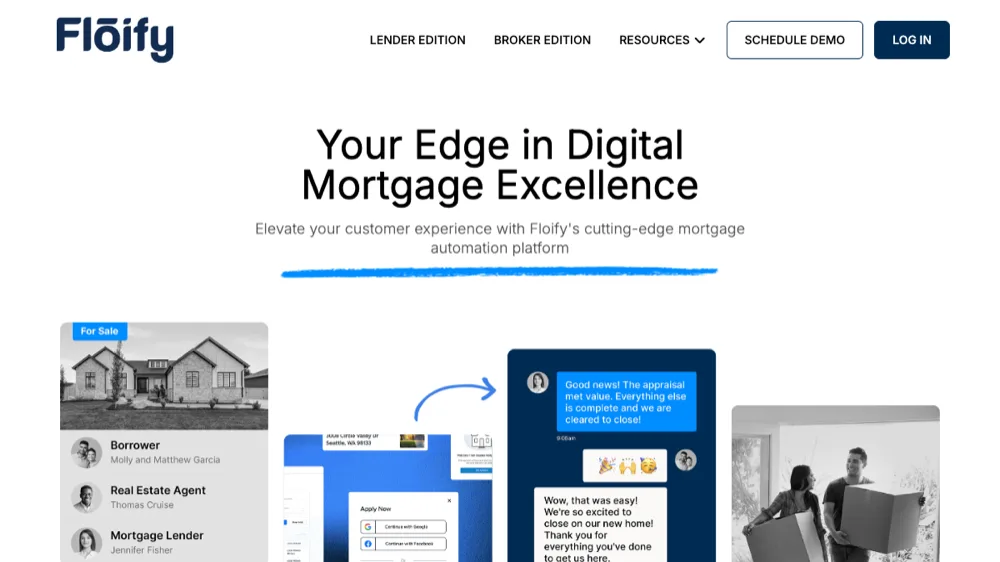
Floify is a mortgage point-of-sale that optimizes borrower communication, document collection, and 1003 intake — explicitly designed to complement, not replace, an LOS. It integrates directly with Encompass, Calyx, and LendingPad, making it a popular front-end for loan officers and broker shops that don't want to swap their core system. In 2026 it remains one of the cleanest ways to modernize the borrower handoff.
9. Calyx Path
Mortgage (brokers, small to mid-size lenders) · per-user subscription · best for cloud-Point upgrade
Calyx is the veteran mortgage LOS provider behind Calyx Point, the desktop system that has run mortgage brokerages for decades. Calyx Path is the cloud-native successor: a browser-based LOS aimed at brokers and small to mid-size lenders that want a familiar Calyx workflow without the desktop footprint. Pricing remains broker-friendly compared with Encompass.
10. Origence
Consumer, auto, indirect, mortgage · credit-union focused · best for CUDL indirect auto
Origence (formerly CU Direct) is the lending platform purpose-built around credit unions, anchored by the CUDL indirect auto network that connects thousands of credit unions with dealers. Its arc+ origination platform extends the same approach to direct consumer and mortgage lending, with member-experience and dealer-side tooling that generic LOS vendors can't match. If you run a credit union, Origence is on the shortlist by default.
How to Choose the Right LOS in 2026
The first cut is by collateral class. Mortgage LOS platforms (Encompass, Calyx Path, Maxwell, Floify) are organized around TRID, the 1003/URLA, the GSE selling guides, and investor delivery — none of that matters for a credit card or auto program. Commercial LOS platforms (nCino, Finastra) center on relationship-level credit memos, covenants, syndication, and CRE structures. Consumer and auto platforms (LoanPro, TurnKey Lender, Origence) optimize for high-volume, low-touch decisioning, dealer or merchant integrations, and tight coupling with servicing. Picking the wrong category is the single most common — and most expensive — LOS mistake.
The 2026 differentiator is AI and ML, and not in a marketing-deck way. The serious platforms now ship asset and income verification driven by direct payroll and bank-data connections (Plaid, Argyle, Truv, Finicity), document classification and data extraction on uploaded paystubs and tax transcripts, automated fraud and synthetic-identity detection on application intake, and ML-assisted underwriting that produces explainable adverse-action reasons. When you evaluate a vendor, ask exactly which models are theirs, which are wrapped third parties, and how adverse-action codes are generated — fair-lending regulators are paying close attention.
Compliance is where deals get blocked at procurement. For mortgage, that means TRID disclosure timing, HMDA reporting, and state-by-state high-cost-loan tests baked into the workflow. Across every asset class, ECOA and fair-lending monitoring (disparate impact testing, adverse-action notices within 30 days), the SCRA and MLA checks, OFAC screening, and BSA/AML are non-negotiable. The CFPB's 1071 small-business data collection rule, GLBA safeguards, and state privacy regimes add real implementation work. Ask vendors for a current SOC 2 Type II.
Finally, judge a platform by its integration surface. The table stakes in 2026 are bureau and alt-data access (FICO, VantageScore, Experian Boost), bank and payroll data (Plaid, MX, Argyle, Truv), pricing and PPE engines (Optimal Blue, Polly), eClose and eVault (Snapdocs, ICE eClose, DocMagic), eFolder and document storage, core banking (Fiserv DNA, Jack Henry, Finastra), and CRM (Salesforce, HubSpot, Total Expert). An LOS that requires custom middleware for any of those should be treated as a higher-cost option, even if the sticker price looks lower.
Sources & Further Reading
Related on SaveDelete: AI is reshaping loan origination, how fintech is influencing banking, CRM in banking, and how to avoid overpaying for business software.
Frequently Asked Questions
What is loan origination software, and how is it different from a loan management system?
Loan origination software (LOS) handles everything from initial application through underwriting, approval, and funding — the pipeline that turns a borrower into a booked loan. A loan management or servicing system (LMS) takes over after funding to handle payments, escrow, statements, collections, and payoff. Some 2026 platforms (LoanPro, TurnKey Lender, Origence arc) span both.
Which LOS is best for a community bank or credit union?
For credit unions, Origence is the default shortlist entry because of its credit-union-native model and CUDL indirect auto network. For community banks doing commercial and small-business lending, nCino is the dominant choice, with Finastra Fusion LaserPro common where compliance-grade documentation is the priority. On the mortgage side, Encompass remains the safe pick.
Do I need a separate point-of-sale tool like Blend, Maxwell, or Floify on top of my LOS?
Often, yes. Platforms like Blend, Maxwell, and Floify are borrower-facing POS layers that sit in front of an LOS like Encompass to modernize the application and document-collection experience. They typically lift pull-through and reduce application abandonment without forcing a core LOS migration.
How is AI changing loan origination in 2026?
AI is now embedded across intake, verification, decisioning, and fraud control rather than being a single bolt-on feature. Expect automated document classification and data extraction, direct income and asset verification via Plaid/Argyle/Truv, ML-assisted underwriting with explainable reason codes, and synthetic-identity fraud models on application intake. The compliance constraint is that every adverse decision must still produce defensible, ECOA-compliant adverse-action reasons.
What compliance regulations should an LOS handle out of the box?
For U.S. lenders the baseline is TRID disclosure timing and tolerance tracking for mortgages, ECOA/Regulation B adverse-action notices and fair-lending monitoring, HMDA data collection and reporting, SCRA and MLA checks, OFAC and BSA/AML screening, and GLBA-grade data safeguards. Small-business lenders should ask specifically about CFPB 1071 data collection.
How much does loan origination software cost in 2026?
Pricing varies by an order of magnitude. Broker and small-lender mortgage LOS like Calyx Path or Floify typically run $50–$200 per user per month. Mid-market platforms like Maxwell and TurnKey Lender land in the low five figures monthly plus per-loan fees. Enterprise platforms like Encompass and nCino are quote-only and routinely run six to seven figures annually.
Information is based on public sources and vendor pages current as of June 2026. Details, prices and plans change frequently — verify on the official site before relying on them.