Kodiak AI Raises $100M at a Steep Discount — Stock Plunges 37% on Down Round
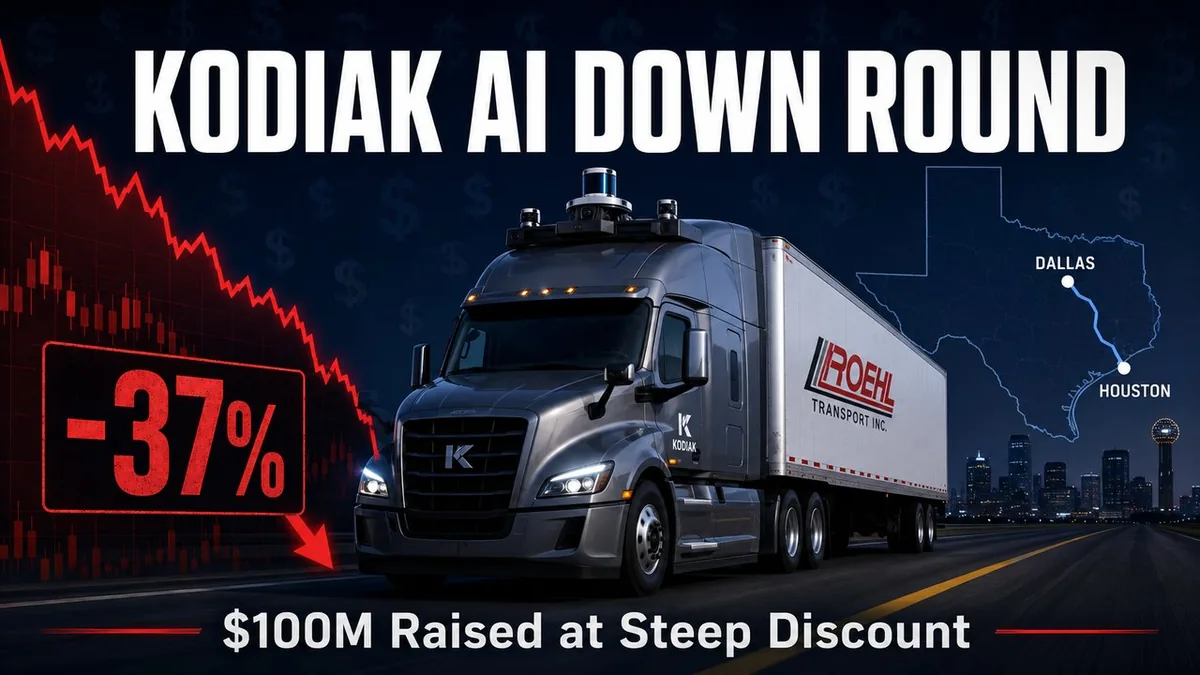
Kodiak AI just raised $100 million at $6.50 per share. The closing price the day before was $9.10. The stock dropped 37% in after-hours trading. Existing backer Ares Management led the round. The financing included warrants letting investors buy more shares at as low as $6. None of these are the terms of a company in good shape. They are the terms of a company that needs cash and is taking it on the only terms available.
Kodiak went public in September 2025 via a SPAC merger that valued the company at roughly $2.5 billion and raised $275 million (including $145 million in PIPE). Eight months later, it is raising emergency money at a discount that implies the public valuation is wrong by a meaningful margin. Q1 2026 revenue was $1.8 million. Operating loss was $37.8 million. The math is brutal: at current burn, the new $100M buys somewhere between two and three quarters of runway.
This is not just a Kodiak story. Aurora's high-profile McLane deal happened this week (driverless freight in Texas, no human in the cab). Kodiak's down round happened the same week. Two AV trucking companies, two opposite outcomes, same week. The thesis isn't dead — it is bifurcating, and Kodiak is on the wrong side of the split.
The Numbers Tell a Specific Story
From the SEC filing, Kodiak's earnings release, and TechCrunch coverage:
- Pre-announcement valuation: ~$2.5B at September 2025 SPAC merger
- New round share price: $6.50 (vs $9.10 closing price = ~28% discount)
- After-hours stock drop: 37%
- Q1 2026 revenue: $1.8M (up from $1.4M YoY — 29% growth, but tiny absolute base)
- Q1 2026 operating loss: $37.8M (double prior year period)
- Lead investor: Ares Management (existing backer, not a fresh outside vote of confidence)
- Warrant terms: Investors can buy additional shares at as low as $6 — further dilution
- Operational status: Trucks still operate with human safety drivers; full driverless “later this year” per CEO Don Burnette
- Safety validation: 86% complete as of April 2026 (Kodiak's own metric)
- New commercial deal: Roehl Transport — 4 weekly Dallas-Houston round trips (autonomous freight, with safety driver)
Why Aurora Is Winning and Kodiak Is Bleeding
Same industry, same geography (Texas Dallas-Houston corridor), same product category (autonomous freight). Different outcomes. The question is why.
The first answer is operational maturity. Aurora's pilot started in 2023, hit two round-trips daily by mid-2024, and just upgraded to fully driverless this week. Kodiak's safety validation is still 86% complete. Aurora has McLane as a commercial customer running real freight at scale. Kodiak has Roehl Transport on 4 weekly round-trips. Aurora is fully driverless. Kodiak is still safety-driver-required.
The second answer is structural. Aurora has the Hirschbach Motor Lines MOU for 500 trucks (closing 2026) and a partnership with Paccar (truck OEM agreement that bakes Aurora into the cab from the factory). Kodiak does not have an OEM-level integration of comparable depth. In autonomous freight, the OEM relationship is the moat — being able to ship a truck pre-equipped from the manufacturer dramatically reduces unit economics for fleet customers vs retrofitting.
The third answer is capital. Aurora is publicly listed with a market cap over $5B and runway through 2027 on conservative burn. Kodiak's $100M down round buys ~2-3 quarters at current burn. Aurora has time to perfect operations; Kodiak is on the clock.
My Take
The Kodiak down round is the first real public-market signal that the AV trucking thesis is bifurcating, not collapsing. Two years ago, the thesis was “all the autonomous trucking startups will eventually win because freight is too big a market for any one player to dominate.” That thesis is now wrong. The market is consolidating into a winners-bracket (Aurora, possibly Plus or Waymo Via if they re-emerge) and a losers-bracket (Kodiak, Embark already wound down) faster than anyone expected.
The reason is that autonomous trucking has the same dynamics as autonomous ride-hailing: the first company to achieve full driverless at scale captures the customer relationships and the OEM relationships, both of which are sticky. Aurora is now the first. Kodiak is the second, and being second to a customer like McLane in a market like Texas is much closer to last than to first.
The $100M down round is rational on Kodiak's end. The alternatives were worse: take the dilution to keep the lights on, or shut down. They took the dilution. The warrant terms allowing further share purchases at $6 telegraph that more dilution is coming if Kodiak does not hit milestones. The honest question for Kodiak shareholders right now is whether the company can ship full driverless before runway runs out and whether full driverless will, in 2027, be commercially differentiated enough to win customers from Aurora's already-deployed fleet. That is a hard bet at any valuation.
The other thing worth flagging: this is a really good time to be a McLane or Roehl Transport — the customers — because Aurora and Kodiak are now competing on price and terms, not just on technology. Customers who run multi-modal fleets get to extract concessions from both. Watch for fleet operators announcing “dual-supply” arrangements to keep both vendors competitive over the next 12 months.
Frequently Asked Questions
What is a 'down round' and why is Kodiak's notable?
A down round is a fundraising round at a lower valuation than the previous round. Kodiak's $6.50/share is roughly 28% below the prior day's close of $9.10 and well below the implied SPAC valuation from September 2025. Down rounds are typically taken when a company has no better alternatives — the dilution is steep but it keeps the company alive.
How does Kodiak compare to Aurora?
Both target autonomous freight on similar US routes. Aurora is publicly listed with $5B+ market cap, fully driverless on the McLane Dallas-Houston route, and a Paccar OEM integration. Kodiak still requires safety drivers, has 86% safety validation completion, and a smaller commercial customer (Roehl Transport, 4 weekly round-trips). Aurora is structurally ahead.
Is Kodiak going to run out of money?
The $100M raise extends runway by an estimated 2-3 quarters at current burn ($37.8M Q1 operating loss). Without a revenue inflection or another raise before end-of-2026, runway becomes a serious concern. The warrant terms allow further dilution at $6, suggesting more capital could be raised at lower prices if needed.
Why did the stock drop 37%?
The market priced in: (1) the $100M issued at a 28% discount to the prior close — anyone who held shares above $6.50 took an immediate paper loss, (2) further dilution risk from the warrants at $6, and (3) the implication that Kodiak could not raise on better terms — which signals weak commercial momentum. Combined, that dropped the share price toward the new round's price.
What does this mean for autonomous trucking generally?
The AV trucking thesis is bifurcating, not failing. Aurora won McLane this week with full driverless deployment; Kodiak took emergency capital the same week. This is the consolidation phase: the market is concentrating around a small number of operationally-mature winners while the rest take dilution or shut down. Customers benefit from the competition between the survivors.
The Bottom Line
Kodiak's $100M down round is rational survival capital and a clear public-market vote of no confidence. The AV trucking thesis is splitting in two: a winners' bracket led by Aurora with full driverless deployment and OEM relationships, and a losers' bracket where Kodiak and others now compete on price for the customers Aurora hasn't already won. Watch for full-driverless milestone slippage from Kodiak; if “later this year” slips into 2027, the runway math gets uglier fast.
Related Reading
- Aurora Wins McLane Deal for Driverless Truck Routes Across Texas
- Volkswagen Quietly Becomes Rivian's Largest Shareholder
- SAP's €1B Bet on Prior Labs