Volkswagen Quietly Becomes Rivian's Largest Shareholder, Displacing Amazon — What It Means
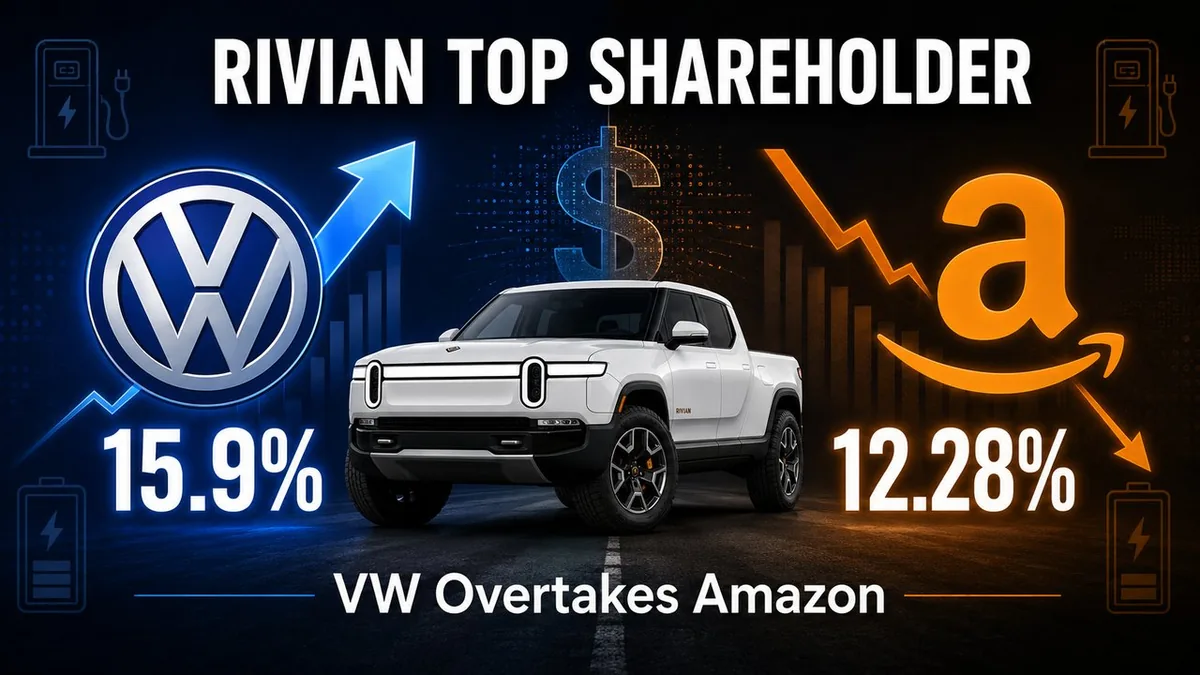
Volkswagen now owns 15.9% of Rivian. Amazon owns 12.28%. As of this week, the German automaker is officially Rivian's largest outside shareholder — quietly displacing Amazon from a position it had held since the 2021 IPO. VW got there by buying 209.7 million shares (up from 8.6% in less than two years) and writing a third $1 billion check in March 2026 as part of a larger $5.8 billion joint venture inked in November 2024.
This is the part of the EV story Wall Street has not been pricing correctly. Most analysts treat the VW-Rivian relationship as a strategic-but-side-bet hedge that VW took when its in-house software stack (CARIAD) became a multi-year embarrassment. The shareholding shift suggests something different is happening: VW is gradually buying its way into the cap table while Amazon's position is being diluted, and neither company seems particularly interested in correcting the optics.
The Numbers Tell a Specific Story
VW's $5.8B JV commitment has been deployed in tranches: $1B initial, $1B in mid-2025, and $1B in March 2026 after the VW ID.EVERY1 (a small four-door hatchback) completed its winter testing milestone. That leaves $2.8B yet to deploy. Each tranche has been tied to specific Rivian engineering deliverables — an unusually structured deal for a strategic investment, suggesting VW negotiated milestone-gated equity rather than upfront cash.
Amazon's stake, meanwhile, has gone from 20% at IPO to 12.28% today — a dilution of nearly 8 percentage points in five years. Amazon has not publicly sold a single share. The shrinkage is entirely from Rivian's secondary issuances (including the convertible notes that funded R2 production) and from VW's targeted accumulation. The 100,000-van delivery agreement Amazon signed with Rivian in 2019 remains active, but Amazon's strategic ownership posture has clearly receded.
Rivian itself just hit two milestones that matter: R2 assembly line came online in April 2026, and customer deliveries are expected “in coming weeks.” R&D spending in 2025 hit $1.7B, up from $1.6B the prior year, with most of the increase going to autonomy — a category that the JV explicitly excludes from VW's reach. That carve-out is a tell.
Rivian Cap Table: 2021 IPO vs May 2026
| Shareholder | 2021 IPO | May 2026 | Net Change |
|---|---|---|---|
| Volkswagen Group | 0% | 15.9% (209.7M shares) | +15.9 pp |
| Amazon | 20% | 12.28% | −7.72 pp (no shares sold; dilution only) |
| Oryx Global Partners | n/a | 8.6% | n/a |
| Vanguard Group | ~5% | 5.1% | ~flat |
| RJ Scaringe (Founder) | ~5% | 1.1% | −3.9 pp (diluted) |
| JV capital deployed by VW | $0 | $3B of $5.8B committed | $2.8B yet to deploy |
VW's Real Bet Isn't on Rivian's EVs — It's on Rivian's Software
VW's CARIAD software unit has been the company's most public failure of the last five years. ID.3 launches were delayed because of it. Multiple CEOs have been reorganized over it. Porsche and Audi launches kept slipping for the same reason. The Rivian JV, narrowly read, is what VW is doing instead of trying to fix CARIAD: license a working zonal architecture and software stack from a company that already shipped it (the R1S/R1T platform), rebadge it for VW vehicles, and ship.
The first product of that bet is the VW ID.EVERY1, a small hatchback intended for the European market. By the time it ships, VW will have effectively outsourced the most complex part of its EV roadmap — the embedded software — to a Rivian-controlled architecture. That is not how German automakers historically buy from US partners. It is more like how the smartphone industry buys SoCs from Qualcomm.
Why Amazon Quietly Stepped Back
The unspoken story is Amazon's. The company was Rivian's earliest believer, ordered 100,000 electric vans, and famously sat on the cap table at IPO. But Amazon's strategic posture has softened. The delivery van rollout has been slower than originally projected. AWS has its own internal demands. The retail business is increasingly focused on AI agents and Whole Foods grocery economics. And electric trucks — specifically Rivian-built electric trucks — are no longer a centerpiece of Amazon's logistics narrative.
Quietly letting your stake dilute from 20% to 12.28% without selling a share is one of the cleanest ways to signal a retreat without taking the headline hit of a sale. Amazon got the same outcome — a reduced exposure — without the press cycle that “Amazon dumps Rivian shares” would have triggered. That is corporate strategy at its most patient.
My Take
VW just executed one of the smartest under-the-radar M&A plays in the auto industry, and it is going to look obvious in three years. The conventional read is that VW “invested in” Rivian. The accurate read is that VW is incrementally acquiring the software architecture of an entire vehicle generation, milestone by milestone, while keeping the optics of a partnership. By the time VW finishes deploying the remaining $2.8B, the company's effective ownership of Rivian's IP could be much higher than 15.9%.
Amazon's drift, meanwhile, is the inverse signal: a sophisticated player concluding that Rivian is no longer central to its strategic future, even though the relationship remains commercially active. When Amazon makes a long-term capital decision — even a passive one — the rest of the market should pay attention. The 100,000-van order does not change that. Strategic ownership and commercial procurement are two different commitments.
The genuine risk for Rivian is concentrated dependency. As VW's stake grows, Rivian's autonomy and customer-facing R&D become harder to fund without new dilution — which makes VW's ownership grow further. Five years from now, the question for Rivian's board is going to be whether RJ Scaringe still has effective control of his company's roadmap, or whether the silent voting bloc in Wolfsburg has started to set it. R2 is the test case. If VW's input shapes R2's product decisions, that is where this story stops being a partnership and starts being something else.
Frequently Asked Questions
What is VW's exact stake in Rivian now?
Volkswagen owns 15.9% of Rivian (209.7 million shares), up from 8.6% less than two years ago. The increase comes from staged $1B tranches paid against JV milestones, the most recent being the VW ID.EVERY1 winter testing completion in March 2026.
How much has Amazon's stake dropped?
From 20% at Rivian's 2021 IPO to 12.28% today — a roughly 8-percentage-point drop. Amazon has not publicly sold any shares; the dilution is from Rivian secondary issuances and VW's targeted accumulation.
What does the VW-Rivian JV actually cover?
The $5.8B joint venture covers electrical architecture and software development for VW vehicles. AI and autonomy technologies are explicitly excluded from the JV scope, which lets Rivian retain control over its self-driving roadmap.
Is Amazon still buying Rivian vans?
Yes. The 100,000-van agreement signed in September 2019 remains active. Amazon's commercial procurement is independent of its equity ownership, and the delivery van rollout continues.
When will the first VW vehicle on Rivian's platform ship?
The VW ID.EVERY1, a small four-door hatchback intended for the European market, completed winter testing in early 2026. A consumer launch date has not been formally announced. Rivian's own R2 starts customer deliveries in “coming weeks” per the company's April 2026 update.
The Bottom Line
VW now owns more of Rivian than Amazon does. The headline matters because of what the trend implies: VW is methodically acquiring Rivian's software architecture for European EVs, while Amazon is quietly drifting toward a less-strategic relationship without the optics of a sale. With $2.8B of JV capital still to deploy, VW's stake will keep climbing. Whether that becomes a partnership-of-equals or a creeping de facto takeover is the next two years of EV cap-table watching.
Related Articles
- SAP's €1B Bet on Prior Labs: Why Tabular Foundation Models Could Be Enterprise AI's Real Frontier
- Pennsylvania Sues Character.AI After Chatbot Posed as Licensed Psychiatrist
- Anthropic Nears $1.5B Wall Street JV with Blackstone, Goldman, Hellman & Friedman