PLM vs PDM vs PIM Systems Explained (2026 Guide)
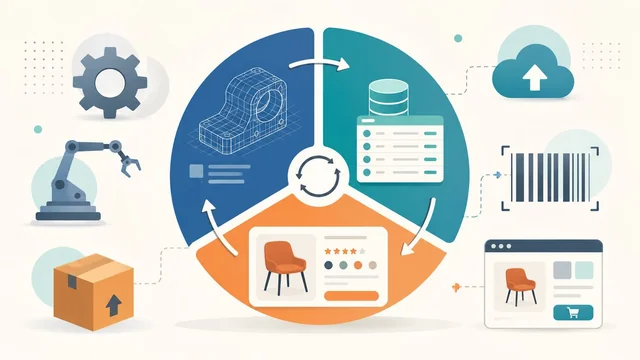
PLM, PDM and PIM sound interchangeable but they manage completely different things across the lifecycle of a product. Pick the wrong one and you'll either bury engineering data inside a marketing tool or try to syndicate product catalogues out of CAD software — both painful. Here's exactly what each system does, where the boundaries lie, when you need which (or all three), and what the major vendors look like in 2026.
Quick comparison
| Acronym | Stands for | Manages | Used by |
|---|---|---|---|
| PLM | Product Lifecycle Management | Entire product lifecycle — concept, design, manufacturing, service, end-of-life | Engineering + manufacturing + compliance teams |
| PDM | Product Data Management | Engineering data: CAD files, BOMs, drawings, revisions | Design engineers, drafters, mechanical / electrical engineers |
| PIM | Product Information Management | Sales / marketing product data — descriptions, images, prices, categories | E-commerce, marketing, merchandising teams |
PLM — Product Lifecycle Management
PLM is the broadest of the three. It tracks a product from initial concept through engineering, prototyping, manufacturing, distribution, service, and end-of-life retirement. PLM brings together engineering data (BOMs, drawings, CAD files), manufacturing data (process plans, work instructions, supplier info), quality data (CAPAs, audits), and compliance data (regulatory submissions, environmental disclosures) under one platform.
What PLM is for: Engineering-heavy organisations — aerospace, automotive, industrial machinery, medical devices, consumer electronics, pharmaceuticals — where multiple disciplines (mechanical, electrical, software, manufacturing, quality) need a single source of truth for what a "product" is and how it's evolving.
Major PLM vendors in 2026:
- Dassault Systèmes 3DEXPERIENCE / ENOVIA — the global leader, dominant in aerospace and automotive
- Siemens Teamcenter — strong in automotive, industrial machinery, electronics
- PTC Windchill — common in medical devices and industrial
- Autodesk Fusion 360 Manage (formerly Fusion Lifecycle / Upchain) — SaaS-first PLM for SMBs
- Arena (PTC Arena) — cloud-native, mid-market
- Duro and OpenBOM — modern startup-friendly cloud PLM
PDM — Product Data Management
PDM is the engineering-data subset of PLM. It manages CAD files (mechanical and electrical), drawings, bills of materials, and revision history — ensuring that when two engineers work on the same assembly, they don't overwrite each other, and that anyone looking at "the latest design" actually sees the latest version.
PDM is usually tightly coupled to a specific CAD tool: SolidWorks PDM Professional, Autodesk Vault, PTC Windchill PDMLink, Siemens Teamcenter Rapid Start. Some teams use PDM-only and never adopt full PLM; many start with PDM and grow into PLM as their organisation gets bigger and product complexity rises.
What PDM is for: Small to mid-size mechanical / electrical design teams whose primary problem is "we keep emailing the wrong version of the CAD file" rather than "we need to manage the full lifecycle".
Major PDM vendors in 2026:
- SolidWorks PDM Professional
- Autodesk Vault
- PTC Windchill PDMLink
- Siemens Teamcenter Rapid Start
- SyncFAB, eDrawings, and a long tail of CAD-tool-specific vaults
PIM — Product Information Management
PIM is the sales / marketing side. It stores the customer-facing product information — titles, descriptions, marketing copy, images, videos, dimensions, categories, attributes, prices, variants — and syndicates it out to your e-commerce site, Amazon, Walmart, eBay, Google Shopping, print catalogues, in-store digital signage, retailer partner portals, and channel data feeds.
If you sell more than a couple of hundred SKUs across more than one channel (web, marketplaces, retail partners), you need PIM. Otherwise you'll be hand-maintaining the same product description in 6 places and getting it wrong somewhere.
What PIM is for: E-commerce companies, retailers, brand manufacturers, B2B distributors. Anyone whose product catalogue is published outside their primary system of record.
Major PIM vendors in 2026:
- Akeneo — the open-source-roots leader in modern PIM, mid-market
- Salsify — the US enterprise leader, syndication-focused
- inriver — the Nordic alternative with strong B2B
- Contentserv — European enterprise
- Plytix — the SMB-friendly modern PIM
- Pimcore — open-source PIM + DAM + MDM
- Shopify products module (functions as light PIM for small Shopify-only sellers)
How they relate to each other
Think of it as a chain. PDM manages engineering data inside the CAD environment. PLM wraps PDM with additional lifecycle context — manufacturing, quality, compliance — and produces an "engineering BOM" describing how the product is built. PIM picks up where PLM stops — it transforms the engineering BOM into the customer-facing product page with marketing copy, lifestyle photography, retailer-specific attributes, and channel-specific feeds.
Many manufacturing companies use all three: PDM-inside-PLM for engineering, PIM for go-to-market. Pure e-commerce companies that don't manufacture often use only PIM. Pure engineering companies that don't sell direct often use only PLM (and PDM as a component of PLM).
Which one(s) do you need?
- You design products that get manufactured: PLM (or at minimum PDM if you're small).
- You sell products online across multiple channels (your site + marketplaces + retailers): PIM.
- You design + manufacture + sell direct-to-consumer: PLM + PIM, with the BOM and product attributes flowing from PLM into PIM.
- You're a small mechanical engineering team using SolidWorks: SolidWorks PDM Professional alone covers most needs for years.
- You're a Shopify store with under 200 SKUs and one sales channel: Shopify's built-in product module is your PIM — you don't need a separate tool yet.
- You're a regulated medical-device or aerospace company: PLM is non-optional — the audit trail, ECO process and design history file requirements make spreadsheets non-viable.
Side-by-side feature comparison
| Feature | PDM | PLM | PIM |
|---|---|---|---|
| CAD file management | ✓ (core) | ✓ (via PDM module) | — |
| BOM management (engineering) | ✓ | ✓ (multi-BOM) | — |
| Engineering change orders (ECO) | Limited | ✓ (core) | — |
| Quality & compliance workflows | — | ✓ | — |
| Marketing & sales attributes | — | Limited | ✓ (core) |
| Multi-channel syndication | — | — | ✓ (core) |
| DAM (digital assets, photos, videos) | — | Limited | ✓ (often bundled) |
Frequently asked questions
What is the difference between PLM and PDM?
PDM manages engineering data — CAD files, drawings, BOMs, revisions — usually tightly coupled to a specific CAD tool. PLM wraps PDM with the broader product lifecycle: change management, manufacturing process planning, supplier coordination, quality, compliance, and end-of-life retirement. PDM is a subset of what a full PLM platform does. Many small engineering teams start with PDM-only and adopt full PLM as their product complexity and regulatory requirements grow.
Is PIM the same as a product catalogue management system?
Effectively yes — PIM is what modern vendors call the product catalogue management system. Older terms like "catalogue management", "product content management" and "master data management for products" are largely subsumed under PIM today.
Do I need both PLM and PIM?
If you design and manufacture physical products that you also sell direct or through retailers, yes — PLM handles the engineering and manufacturing side, PIM handles the sales / marketing side. They usually integrate so that key product attributes (dimensions, weight, certifications, SKU) flow from PLM into PIM, and PIM enriches them with marketing copy, photography and channel-specific data.
How much does PLM, PDM or PIM software cost?
PDM tied to a CAD tool: roughly included in the CAD licence cost or $1,200–$3,000 per user per year. Cloud-native PDM startups (Duro, OpenBOM): from $30 per user per month. PLM: enterprise PLM (3DEXPERIENCE, Teamcenter, Windchill) is six-figures-plus annual; SaaS PLM (Arena, Fusion 360 Manage) ranges $1,000–$5,000 per user per year. PIM: SMB PIM (Plytix, Akeneo Community) from $0–$1,000 per month; mid-market enterprise PIM (Akeneo Enterprise, Salsify, inriver) from $40,000–$200,000+ annually.
Can ERP replace PLM, PDM and PIM?
No, but they integrate. ERP (SAP, Oracle, NetSuite, Microsoft Dynamics) manages financials, inventory, manufacturing execution and order fulfilment. PLM feeds the engineering BOM into ERP for manufacturing; PIM feeds enriched product information from ERP into commerce channels. ERPs sometimes include lightweight PIM or basic engineering data features, but for any meaningful complexity in design or sales channels you'll want dedicated tools.