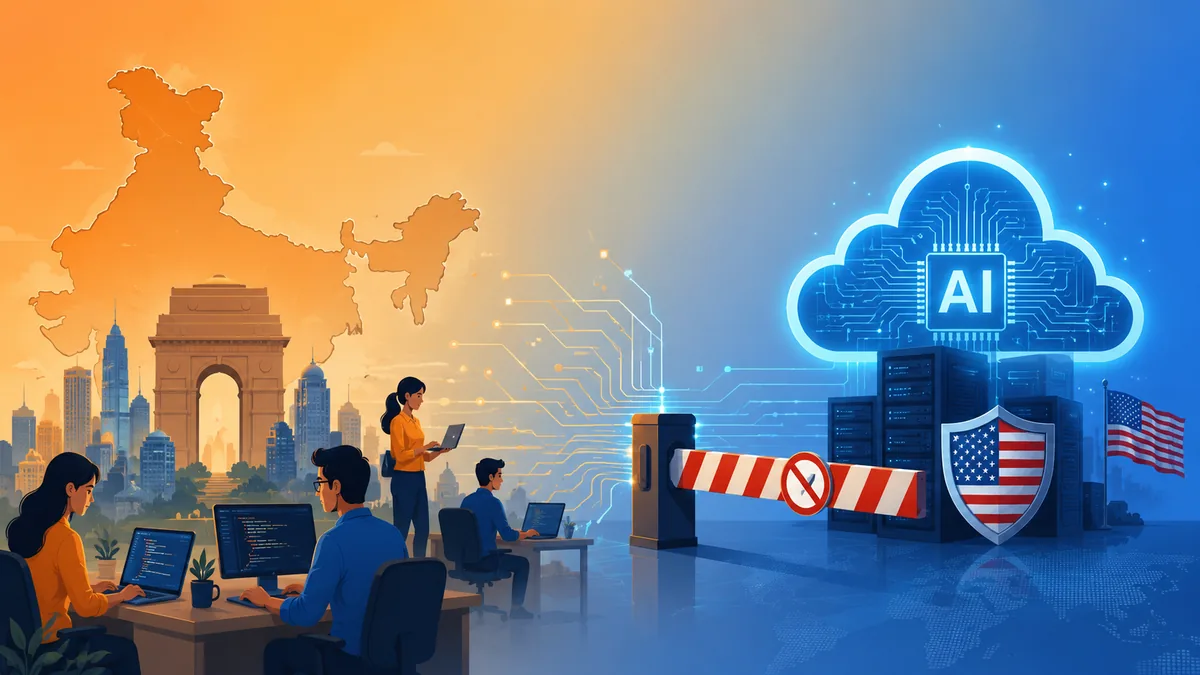
When the US government ordered Anthropic to suspend access to its two most powerful models, Fable 5 and Mythos 5, for all foreign nationals, the company complied by switching them off worldwide. (We covered the full story in US Blocks Foreign Access to Anthropic's Fable 5 & Mythos 5.) Nowhere did that land harder than India — reportedly Anthropic's second-largest market.
Indian IT giants had been betting big on Claude. Overnight, that bet looked a lot riskier. Here's what the ban actually means for India's technology industry — and, just as importantly, what it doesn't.
Quick Context
- What happened: A US export-control directive suspended Fable 5 and Mythos 5 for foreign nationals; Anthropic disabled both models globally to comply.
- Why India matters: India is said to be Anthropic's #2 market, with deep enterprise adoption.
- The sting: The cutoff came just as Indian IT firms were scaling Claude across their workforces and clients.
- The silver lining: Only the two newest models are affected — other Claude models still work.
Why India Feels It Most
India's IT services sector is the world's back office, and over the past two years it has raced to embed generative AI into everything from software development to business process outsourcing. Anthropic's Claude became a favorite for enterprise work thanks to its strong coding and long-context capabilities — and Indian firms adopted it aggressively, both internally and for clients.
That made India unusually exposed when access was pulled. A decision taken in Washington on a Friday evening rippled straight into delivery centers across the country, turning a tool that thousands of engineers had been trained on into a question mark.
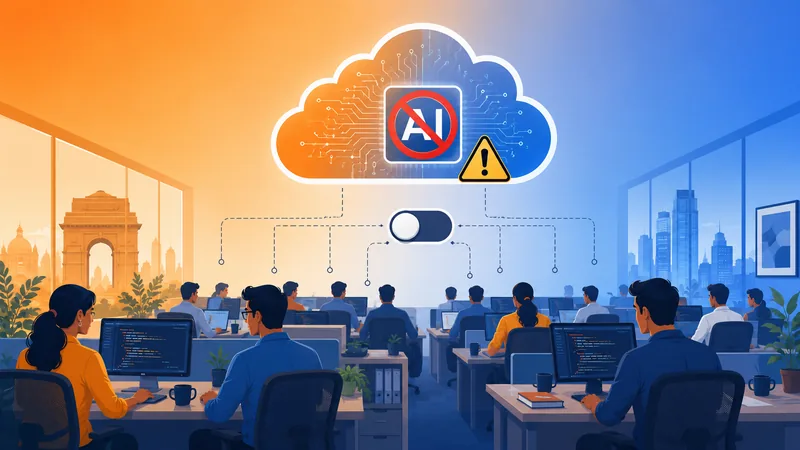
Who's Exposed: TCS, Infosys & More
The biggest names in Indian IT had moved closest to Anthropic, which is exactly why the timing stung.
| Company | Anthropic exposure |
|---|---|
| TCS | Reportedly training ~50,000 employees on Anthropic's models; just announced a partnership to bring Claude to regulated industries |
| Infosys | Recently entered collaborations with Anthropic on enterprise AI |
| Broader IT services | Many firms built client offerings and internal tooling around Claude |
The deeper worry isn't a single outage — it's supply-chain reliability. When a core part of your delivery stack can be switched off by another country's government overnight, every strategy built on it inherits that risk.
What's Actually Blocked (and What Isn't)
It's important not to overstate the damage. The order targeted only two models. Here's the clear picture:
| Status | Models |
|---|---|
| Suspended (globally) | Claude Fable 5, Claude Mythos 5 |
| Still available | Other Claude models (Opus, Sonnet, Haiku) and all rival platforms |
So Indian teams relying on standard Claude models — or on OpenAI, Google, and others — can keep working today. The real cost is confidence: the episode showed that access to the very best frontier models can vanish without warning, which forces a rethink of how much to depend on any one foreign supplier.
The Sovereign-AI Debate
Predictably, the ban reignited India's debate about "sovereign AI" — the idea that the country needs homegrown or self-hostable models it can control, rather than renting frontier intelligence from US labs.
"Blaming Infosys, TCS or Zoho for India's AI gap is lazy." — a sentiment voiced by Indian founders, who argue the country's edge is applying AI at scale, not necessarily building frontier models from scratch.
Both sides have a point. Dependence on US-controlled models is now demonstrably a strategic risk. But building and running frontier models is extraordinarily expensive, and India's genuine strength has long been deploying technology across industries at scale. The likely answer isn't either/or — it's reducing single-vendor risk while continuing to lead in applied AI.
How Indian Firms Can De-Risk
For any company that felt this week's whiplash, the playbook is straightforward:
- Go multi-model. Don't standardize on one provider. Keep OpenAI, Google, and open-weight options ready as fallbacks.
- Use a routing layer. Abstract model calls so you can switch providers in hours, not weeks — the same model-routing approach driving cost savings in the AI price war.
- Keep workflows model-agnostic. Avoid hard-coding prompts or features to one model's quirks.
- Evaluate self-hostable open models. For sensitive or mission-critical work, models you can run yourself can't be switched off by a third party.
Done well, diversification turns an overnight ban from an existential crisis into a manageable inconvenience.
Frequently Asked Questions
How does the Anthropic ban affect India?
India is reportedly Anthropic's second-largest market, so the US export-control directive suspending Fable 5 and Mythos 5 for foreign nationals hit Indian users and companies directly. Because Anthropic disabled both models globally to comply, Indian developers and enterprises lost access to its two newest flagship models, creating uncertainty for firms that had built plans around them.
Are all Claude models blocked in India?
No. Only Fable 5 and Mythos 5 were suspended. Anthropic's other models — such as Claude Opus, Sonnet and Haiku — remain available, in India and elsewhere. So Indian teams using standard Claude models can keep working; the disruption is concentrated on the two newest, most capable models and on the confidence of relying on a single foreign AI supplier.
Why are TCS and Infosys exposed?
India's largest IT services firms had leaned into Anthropic. Reports say TCS had been training around 50,000 employees on Anthropic's models and had just announced a partnership to bring Claude to regulated industries, while Infosys had entered collaborations of its own. A sudden cutoff of the newest models raises questions about the reliability of an AI supply chain those strategies depend on.
What does this mean for India's AI ambitions?
It has reignited a debate about India's dependence on foreign AI models and the case for "sovereign AI" — homegrown or self-hosted models India can control. Critics note that relying on US-controlled frontier models leaves Indian firms exposed to geopolitical decisions made overnight, while others argue India's strength lies in applying AI at scale rather than building frontier models from scratch.
How can Indian companies reduce this risk?
The main lesson is to avoid single-vendor dependence: adopt a multi-model strategy that can fall back to other providers (OpenAI, Google, open-weight models), use model-routing layers that make switching easy, keep critical workflows model-agnostic, and evaluate self-hostable open models for sensitive or mission-critical tasks. Diversification turns an overnight cutoff from a crisis into an inconvenience.
Final Thoughts
For India's IT industry, the Anthropic ban is less a catastrophe than a warning shot. Day-to-day work continues on other models, but the strategic lesson is real: in 2026, access to the best AI is a geopolitical variable, not a given. The firms that treat this as a prompt to diversify — rather than a reason to panic — will come out stronger.
We'll keep tracking how this unfolds for Indian tech and the wider industry. For more, read our coverage of the export-control order itself, Claude Fable 5, and the 2026 AI price war.