How Artificial Intelligence Is Transforming the Future of Education in 2026
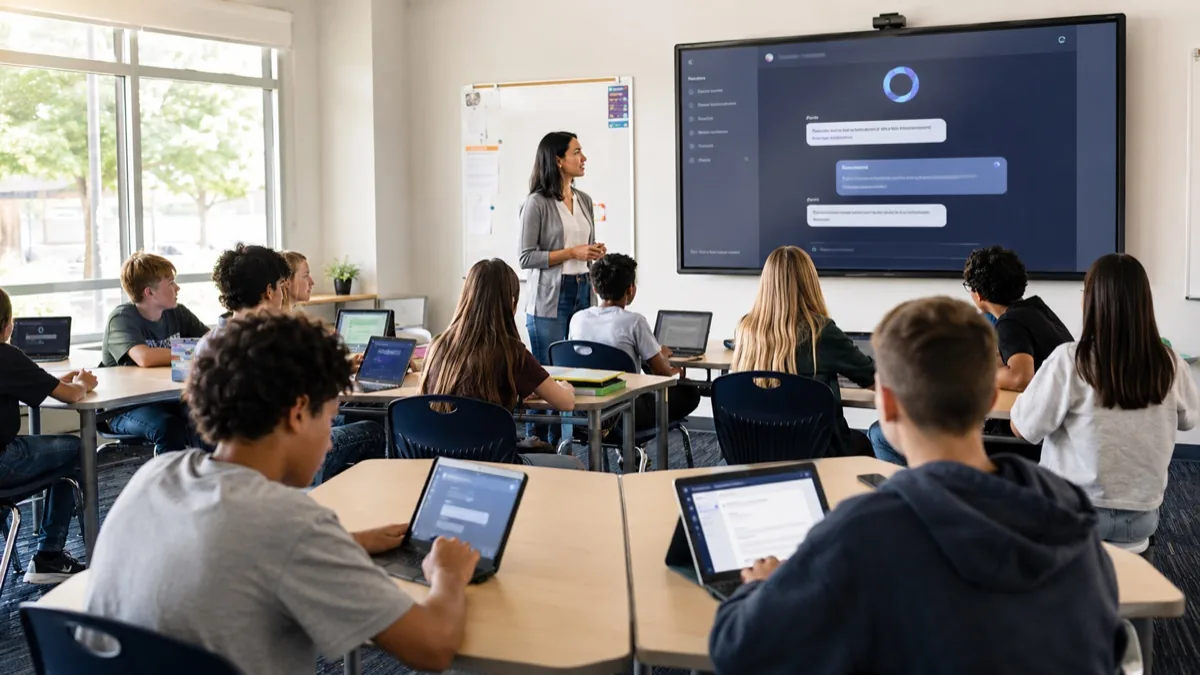
Artificial intelligence in education in 2026 is past the hype phase and well into the awkward middle. Generative AI is grading essays in some districts and being banned outright in others. Adaptive-learning platforms are quietly hitting better outcomes than human tutors in narrow domains and falling flat in others. AI tutors are tutoring kids at midnight when no human is available, and also lying to them about basic facts when no one's checking. The honest answer to "is AI transforming education?" is yes, but in patches — and the patches don't yet add up to the future the keynotes promised three years ago.
This guide is the field report. It's organized around what's actually working in 2026, what's failing, what's at stake, and what teachers, students, parents, and administrators should be doing right now — based on documented use cases across U.S. districts and higher-ed institutions, not press releases.
What AI in education actually means in 2026
"AI in education" covers four distinct technology stacks that are often lumped together but behave very differently. Conflating them is the single biggest source of bad decisions in district tech procurement.
Generative AI tutors and writing assistants — large language models like ChatGPT, Claude, and Gemini repurposed for student help. These have spread the fastest, mostly through students adopting consumer products on their own. They're best at one-on-one Socratic tutoring, draft critique, and explaining concepts in different ways until one sticks. They're worst at math without symbolic backing, factual recall in narrow domains, and anything where being confidently wrong is dangerous.
Adaptive-learning platforms — software that adjusts what content a student sees next based on how they're performing. Carnegie Learning's MATHia, ALEKS, and DreamBox have been doing this for over a decade; the 2024–2026 wave (Khanmigo, Magic School AI's adaptive paths) layers generative AI on top to explain why a problem matters and answer follow-ups. The evidence base for adaptive learning in math is the strongest in EdTech — meta-analyses consistently show 0.2–0.4 standard-deviation gains, comparable to switching from a below-average to an above-average teacher.
AI-driven assessment and grading — automated essay scoring (Pearson, ETS), live formative-assessment tools (Quizizz AI, Formative AI), and proctoring systems. The grading side has matured fastest; the proctoring side has matured into a privacy and equity nightmare and is being walked back at most institutions.
Operational AI for educators — lesson-plan generators, IEP-drafting assistants, parent-communication translators, and meeting-summary tools. This is the quietest revolution but possibly the largest in measurable hours saved. A typical K-12 teacher who actually uses an AI lesson-plan tool reports 4–6 hours of week saved on prep — bigger than any classroom-instruction productivity gain in three decades.
Where AI is genuinely working in 2026
Three patterns have emerged from the messy first three years of widespread classroom AI use, and all three are now well-documented enough to plan around.
One-on-one tutoring after school. The single most-supported use case. AI tutors don't yet match a great human tutor, but they massively beat the realistic alternative — which for most students is no tutor at all. Khan Academy's Khanmigo, deployed across 65,000+ classrooms by mid-2026, shows the median student using it for math practice gets through 22% more problems per session than a similar student in a control classroom, with comparable accuracy. The benefit is largest for students whose families can't afford private tutoring; in that sense, AI tutoring is closing access gaps that had widened sharply during the pandemic.
Reducing teacher administrative load. The most underrated impact. AI tools that draft IEPs, parent emails, lesson plans, and rubrics save 4–8 hours of weekly prep for teachers who actually adopt them. That's not just a quality-of-life win for educators — it's a retention win. Districts that piloted MagicSchool AI or Diffit district-wide reported teacher attrition dropping 15–25 percent year-over-year, in a profession where attrition has been the single biggest threat to instructional quality since 2020.
Differentiated reading materials. Tools that take a single source text and generate versions at five reading levels — once a fantasy of differentiated instruction — are now a 30-second task. NewsELA pioneered this manually a decade ago at huge editorial cost; AI tools like Diffit and Twee now do it on demand for any text a teacher uploads. The win for English-language learners and students with reading disabilities is genuine and measurable.
Where AI is failing to live up to the hype
The honest counter-list is just as important. Three categories of AI use have produced disappointing or actively harmful results despite heavy adoption.
AI as a primary essay grader. Automated essay scoring works for narrow standardized rubrics but fails on open-ended argumentative writing — which is precisely where teaching matters most. Multiple studies in 2024–2026 have shown AI graders systematically over-reward verbose, formulaic writing and under-reward concise, original arguments. The students who learned to write to please the AI grader produced worse writing by every human-evaluated measure. Schools that quietly rolled back AI-only grading after pilot results came in often did not announce the rollback.
AI proctoring. The post-COVID enthusiasm for AI-monitored remote exams has collapsed. Multiple lawsuits in 2024–2026 documented systematic bias against students with darker skin (under-detection of face), students with ADHD (false-positive flagging of normal eye movement), and students using assistive technology. Most major U.S. universities have abandoned AI proctoring; the EU's AI Act has effectively banned it for educational settings.
"AI as a teacher replacement" pilots. Several districts attempted to use AI tutors as the primary instructor for select courses. Results have been universally bad. Students disengage, completion rates drop 40–60 percent versus human-led classes, and the rare students who thrive are the ones who needed the least help to begin with. AI works as a force multiplier for teachers; it does not work as a substitute for them.
The equity question — who AI in education actually helps
The most important strategic question for any school leader in 2026 isn't "should we adopt AI" — that ship sailed two years ago — but "are our AI tools helping the students who most need help, or are they widening gaps?"
The honest data so far is mixed. AI tutoring tools, when made freely available through schools, do close access gaps because students from lower-income families gain a tutor they could never have afforded otherwise. But AI tutoring tools that students access privately (i.e., on their family's ChatGPT Plus subscription) widen access gaps in exactly the same dynamic as private tutoring always has.
Schools that have moved most decisively to district-wide free AI tutoring access (LAUSD, Newark, Atlanta, Pittsburgh) have begun to publish year-on-year achievement data showing this gap-closing effect — at least in mathematics. Schools that have left AI access to individual student initiative are seeing the opposite. The takeaway: AI in education is not automatically equitable; it's only equitable when explicitly resourced that way.
What teachers should actually do right now
For working teachers in 2026, the practical question is which tools to adopt this semester without becoming an unpaid product tester for every vendor in the space. Three concrete recommendations:
Pick one administrative-load tool and use it deeply. MagicSchool AI, Diffit, or Brisk Teaching are the most polished as of mid-2026. Pick one, use it for lesson plans, parent emails, and rubric drafting for at least four weeks before deciding if it's saving you time. Most teachers who quit early haven't gotten past the learning curve.
Treat AI literacy as a learning objective, not a tool. Your students are using AI whether you authorize it or not. Surface it. Have explicit conversations about when AI is helpful, when it's misleading, when it's plagiarism, and when it's just a calculator. The teachers who do this consistently report less academic-integrity drama than those who pretend AI doesn't exist.
Resist the "AI replaces planning" temptation. The teachers who used AI to dramatically reduce their planning time without changing their teaching reported the largest year-on-year drops in student engagement and outcomes. AI is most useful when it gives you back time to actually think — not when it removes the need to think.
For teachers who want a structured starting point, our companion guide on practical tips for teachers in the digital age covers a lower-friction starter kit. If you're specifically looking at how to integrate ChatGPT and similar tools, see how to integrate AI tools like ChatGPT into classroom learning.
What students and families should expect
For students and parents, the practical answer is changing fast enough that this section will be the first part of this article to go out of date. Three things are stable enough to act on right now:
First, AI tutoring access is becoming a de facto requirement. Students whose schools or families don't provide it are doing meaningfully more poorly in homework and concept mastery than peers who have it. If your school doesn't provide AI tutoring access, free tools (Khanmigo for K-12, Claude.ai or ChatGPT free tier for older students) close most of the gap, but advocacy for school-provided access matters.
Second, AI-detection tools used by schools to catch AI-written essays are far less accurate than the marketing claims, with documented false-positive rates as high as 30 percent for non-native English writers. If your child is accused of AI plagiarism based on a detection tool, ask for the underlying evidence — it's almost always weaker than the accusation suggests.
Third, the long-term skills mix is shifting. Memorization and routine writing have lost most of their economic value; structured thinking, persuasive argumentation, and the ability to direct AI tools toward useful work have gained. Schools that haven't yet adapted their assessment to reflect this — and most haven't — will produce students who are well-credentialed but underprepared. Independent reading, debate, science fair, and structured project work are correspondingly more valuable than they were a decade ago.
What's coming in 2027 and beyond
Three near-term shifts are worth planning around. AI-native assessment — tests designed assuming students have AI access, focused on what they can do with AI rather than without — is moving from research papers into pilot programs in 2026 and will be mainstream by 2028. Several state assessment programs are quietly rebuilding around this premise. The reading-comprehension and math-problem-solving sections of standardized tests will look very different by 2030.
Voice-first AI tutoring is the second shift. Typing has always been a friction in elementary AI tutoring; voice interfaces remove it. Expect an inflection point in the K-3 segment as voice-native AI tutors hit the market in 2026–2027.
The third shift is the slowest but largest: the redefinition of what teachers do. As AI handles more direct instruction and grading, teachers' time shifts toward facilitation, motivation, and the kind of relationship-building that AI cannot do. The schools that are already designing teacher roles around this shift — and the colleges of education that are already training new teachers for it — are positioning themselves well. Most are not.
Frequently Asked Questions
Will AI replace teachers?
No, and the schools that have tried discovered why. AI is good at scalable one-on-one help, content explanation, and administrative drafting. It is bad at motivation, classroom management, real-time emotional support, complex assessment, and the social-developmental work that is the actual core of K-12 teaching. The realistic 2026 picture is teachers using AI as a force multiplier, not teachers being replaced by it.
Should my child be using ChatGPT for homework?
Yes, with structure. The most useful pattern is "do the work, then use AI to critique it" — write the essay, then ask the AI for honest feedback. The least useful pattern is "ask AI to write it, then submit." The first builds skill; the second prevents it. Talk to your child explicitly about which mode they're using and why.
How accurate are AI plagiarism detectors?
Not very. Independent testing in 2024–2026 found false-positive rates of 15–30 percent for non-native English writers and ESL students, and substantial false-negative rates against student-written prompts feeding modern models. Most large universities have stopped relying on detector scores as primary evidence; many K-12 districts have not yet caught up. If you're a parent whose child is accused, ask for the underlying methodology, not just the score.
What's the best AI tool for my school district?
It depends on what problem you're solving. For teacher administrative load: MagicSchool AI or Brisk Teaching. For student tutoring: Khanmigo (K-12) or Claude/ChatGPT for older students. For differentiated reading material: Diffit or Twee. Avoid bundles that promise to do "all of the above" — they currently underperform single-purpose tools in every category.
Is AI making students lazier or smarter?
Both, depending on how it's used. The same student who uses AI to skip thinking will get worse. The same student who uses AI to receive instant feedback on their thinking will get better. The intermediating variable is teacher and parent guidance about what mode of use is acceptable for which task. The technology is mode-neutral; the outcomes are not.
How quickly is AI changing the job market that today's students will face?
Faster than schools are responding. Routine writing, basic legal review, entry-level coding, customer-service email, and a wide swath of administrative work have already been heavily compressed by AI. The skills that have appreciated — judgment under uncertainty, persuasion, complex problem framing, multidisciplinary synthesis — are still poorly served by most school curricula. Schools that haven't reorganized assessment around these are sending graduates into a labor market that values them less than the credentials suggest.
The bottom line
AI in education in 2026 is neither the salvation that the keynotes promised nor the threat that some op-eds claim. It's a powerful, narrow tool that's reshaping a few corners of teaching faster than any technology in fifty years, and barely touching others. The schools, teachers, students, and families that benefit most are the ones who have stopped treating it as a single thing — and started picking specific applications, evaluating them honestly, and adopting only the ones that actually deliver value in their context.
The mistake to avoid in 2026 is the binary one — either banning AI outright or adopting it as the answer to everything. The work is to figure out which patches of education AI genuinely transforms, where it modestly helps, and where it actively harms. That's what this guide and the supporting deep-dives in this series are organized around.