AI Firefighting Tech: Smarter Water, Faster Fire Control
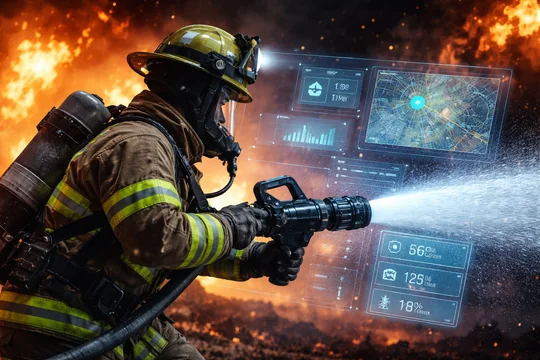
AI Firefighting Tech: The Data Gold Rush Has Begun
one startup founder didn’t just improve firefighting gear—he may have unlocked something even bigger: a new stream of real-world data that could reshape emergency response and future AI systems.
That’s the real “so what” behind today’s AI firefighting tech story.
Because while most people hear “better fire nozzles” and think incremental upgrade, the bigger shift is this: firefighting is becoming a data-driven industry—one where every drop of water, every pressure change, and every decision can be tracked, analyzed, and improved.
And that changes everything.
Key Facts: What Happened (Quick Summary)
Sunny Sethi, founder of HEN Technologies, built a firefighting nozzle system designed to suppress fires faster while using significantly less water.
Here’s what stands out:
-
HEN’s nozzle technology claims to put out fires up to 3x faster while using about two-thirds less water than older tools.
-
The company launched products commercially in 2023 and scaled quickly to 1,500 fire department customers.
-
HEN is expanding beyond nozzles into connected firefighting devices like monitors, valves, sprinklers, and pressure/flow-control systems.
-
Its platform collects operational data: water flow, pressure, hydrant use, weather conditions, and GPS-based context.
-
The company raised a $20M Series A, plus $2M venture debt, bringing total funding above $30M.
That’s the “what.” Now let’s talk about why it matters.
Why AI Firefighting Tech Matters More Than People Realize
Most industries have already gone through the “hardware to software” shift.
Cars became computers on wheels. Factories became sensor networks. Even farming became precision agriculture.
Firefighting? It’s been late to that transformation—not because firefighters don’t want innovation, but because the environment is harsh, the stakes are high, and procurement moves slowly.
HEN’s big move isn’t just “making a nozzle better.”
It’s turning firefighting equipment into smart fire equipment—connected tools that generate consistent, structured, real-world data.
The hidden problem: water is a bottleneck, not just a resource
In many fire events, water isn’t simply “available.” It’s fragile.
Pressure drops. Hydrants get overused. Multiple engines pull from the same source. Rural response depends on tankers and long refill loops.
And when teams don’t have live visibility into water usage, bad surprises happen fast.
This is why fire department water management is becoming a frontline issue—not a back-office utility issue.
The deeper shift: firefighting becomes measurable
Historically, much of emergency response performance has been hard to quantify.
But when devices can capture:
-
how much water was used
-
where it was used
-
under what conditions
-
with what outcome
…you can finally answer the questions that matter:
-
What tactics worked best?
-
Where was water wasted?
-
Which equipment performed under wind and heat?
-
How can departments train better based on evidence?
That’s not just efficiency. That’s operational intelligence.
The Bigger Trend: Predictive Emergency Response Is Coming
Here’s the part most people miss: data isn’t valuable because it looks good in dashboards.
Data becomes valuable when it enables prediction.
HEN’s approach aligns with a growing push toward predictive emergency response analytics, where systems don’t just report what happened—they help forecast what’s about to happen.
That could look like:
-
Alerts when water supply is about to drop below safe levels
-
Warnings when wind shifts will make a position unsafe
-
Better allocation of tankers and hydrants during rural operations
-
Faster incident command decisions based on live field conditions
In plain terms: fewer guesses, faster response, safer outcomes.
And there’s another layer.
Why this becomes an “AI gold mine”
AI models that understand the physical world need real data—especially from extreme environments.
Fire suppression involves pressure, heat, wind, materials, and unpredictable behavior. That’s not something you can fully simulate.
So the real long-term value might not be the nozzle.
It might be the dataset created every time the nozzle is used.
Or as the founder put it: “You can’t have good quality data unless you have the right hardware.”
Practical Implications: What Happens Next (Predictions)
This is where the story gets exciting, because the next chapter isn’t just “sell more devices.”
It’s about building an ecosystem.
Here are the most likely next steps for AI firefighting tech over the next 12–24 months:
-
Connected gear becomes the new standard
Departments will start expecting sensors and tracking the same way fleets expect telematics. -
Fire departments will demand proof, not promises
Vendors will need to show measurable outcomes: time saved, water saved, incidents stabilized faster. -
Procurement will shift toward platforms
Instead of buying one-off tools, agencies will buy systems that integrate equipment + data + reporting. -
Mutual aid operations will get smarter
When multiple departments respond together, shared data can reduce chaos and improve coordination. -
AI partnerships will emerge quietly
The companies building robotics, simulation, or physical “world models” will pay for high-quality real-world data—especially from extreme conditions.
Conclusion: AI Firefighting Tech Is Becoming a Strategy, Not a Gadget
The most important takeaway is this:
AI firefighting tech isn’t just about fighting fires faster—it’s about building a smarter response system that learns every time it’s used.
Better nozzles save water. Better data saves time. Better prediction saves lives.
And as emergency response becomes more connected, the departments that adopt measurable, data-backed systems early won’t just be “more modern.”
They’ll be more prepared for the fires—and the realities—coming next.
| Feature | Traditional Firefighting Equipment | AI-Enabled Smart Fire Equipment |
|---|---|---|
| Water usage visibility | Limited or manual tracking | Automated tracking with sensors |
| Decision support | Experience-based judgment | Data + alerts + analytics support |
| Coordination across teams | Often fragmented | More connected and shareable |
| Training improvement | Hard to quantify outcomes | Data-backed performance insights |
| Long-term value | Tool replacement cycle | Ongoing software + data value |
Bottom Line: Traditional gear fights fires. Smart systems fight fires and improve every response. Departments that want faster suppression and better planning should start evaluating connected platforms now.
Q: What is AI firefighting tech?
A: AI firefighting tech refers to connected firefighting tools and software that collect real-time data—like water flow, pressure, location, and weather—to improve decision-making. It helps crews respond faster, manage resources better, and build smarter strategies over time using analytics.
Q: How does smart fire equipment help firefighters in real time?
A: Smart fire equipment can provide live insights like water usage, pressure drops, and location tracking. This helps teams avoid running out of water unexpectedly, coordinate more effectively during major incidents, and respond faster when conditions like wind or supply change suddenly.
Q: Why is fire department water management becoming more important?
A: Fire department water management matters because water supply can fail during large fires due to pressure changes, limited hydrant capacity, or rural logistics. Better tracking helps departments prevent shortages, reduce waste, and allocate resources more effectively during fast-moving emergencies.
Q: Will predictive emergency response analytics replace human decision-making?
A: No—predictive emergency response analytics is designed to support firefighters, not replace them. It provides alerts and insights based on data patterns, helping incident commanders make faster and safer decisions while still relying on human expertise in unpredictable environments.