Trump's World Liberty Financial Privately Sold $5.9B in WLFI Tokens at Steep Discounts — Bloomberg Investigation
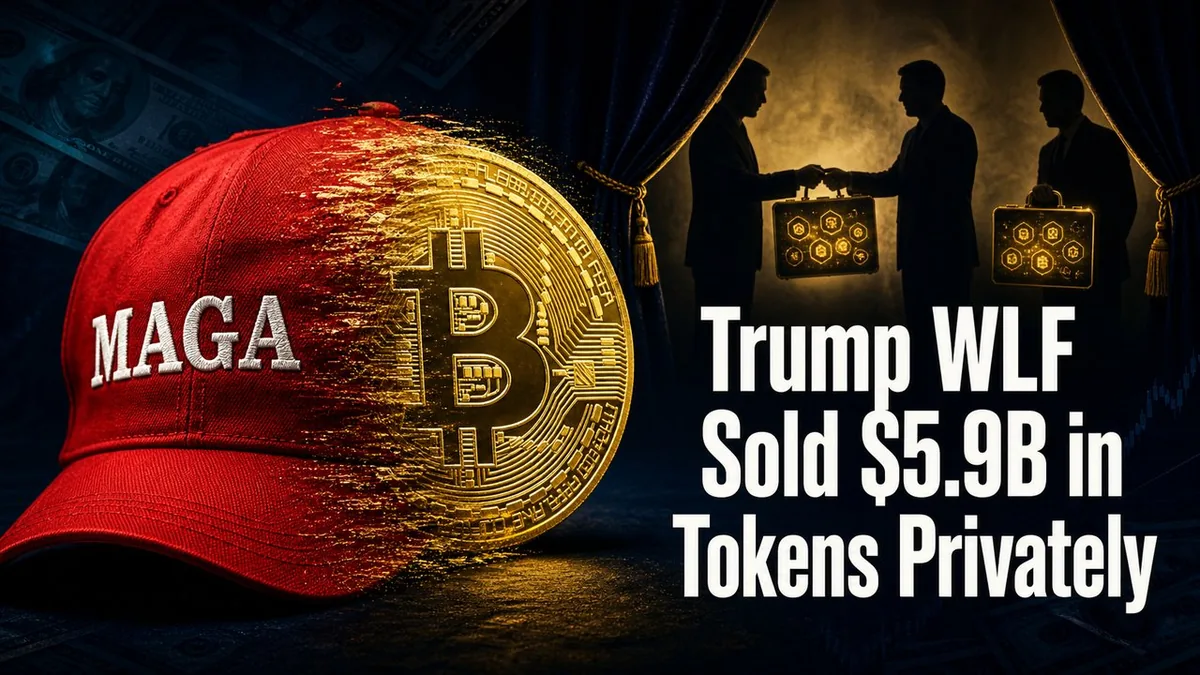
World Liberty Financial — the Trump-family-affiliated crypto venture — privately sold roughly $5.9 billion in WLFI tokens to a select group of institutional and high-net-worth investors at meaningfully discounted prices, while public token holders saw the asset's market price stagnate, according to a Bloomberg investigation published yesterday. The two-tier structure — disclosed in regulatory filings reviewed by Bloomberg's reporters — raises significant questions about preferential treatment, retail-investor protection, and whether the WLFI distribution complies with U.S. securities law.
The disclosed pattern is unusually clean. Bloomberg's reporting documents that Private placements representing roughly 38% of total token supply were sold at a 60–75% discount to the listed market price through a series of off-exchange agreements between September 2025 and March 2026. Public WLFI holders during the same period saw the token trade in a relatively narrow range, with no comparable discount opportunities offered to retail buyers. The recipients of the discounted tokens are primarily described as "strategic partners" — a term that, in this context, includes large institutional crypto funds, sovereign wealth-aligned investors, and individuals with public ties to the Trump-orbit business network.
What the filings actually show
Three distinct categories of preferential treatment emerge from the documentation. First, tiered allocation pricing: institutional buyers received tokens at $0.04–$0.08 per WLFI when the market price was hovering at $0.18–$0.21. Second, vesting concessions: most public holders are subject to one-year cliff vesting on bonus allocations, while several private placements appear to have negotiated either no vesting or accelerated unlock terms. Third, liquidity preferences: private buyers were given access to OTC desks willing to provide near-instant liquidity at terms not available to public holders.
The aggregate dollar amount Bloomberg cites — $5.9 billion — accounts for the difference between the discounted prices private buyers paid and the market value of the tokens they received. It's not a "fundraising number" in the traditional sense; it's an estimate of the wealth transfer to private buyers from market-price-anchored economic value that public holders effectively forwent. That framing is what makes the story politically explosive: it's not just that insiders got a better deal; it's that the structure of the deal itself effectively redistributed wealth from public holders to private ones.
The legal exposure
U.S. securities law generally allows for two-tier private placements when properly disclosed and when they comply with Regulation D exemptions or similar registered structures. The questions Bloomberg's reporting raises — and that securities lawyers and regulators will now be scrutinizing — are whether the WLFI structure meets those compliance bars. Three specific concerns are likely to drive any regulatory response.
First, was the dual-class economic structure adequately disclosed to public retail buyers? Disclosure requirements for tokens sold in U.S. markets are still evolving, but the SEC's recent enforcement actions suggest that tiered pricing without clear retail-investor disclosure is high-risk. Second, did the private placements comply with accreditation rules? Strategic-partner designation does not automatically satisfy SEC accreditation standards. Third, was the political dimension — preferential allocations to politically-aligned investors — properly handled under campaign finance rules? Crypto-fundraising-as-political-influence is a regulatory gray zone that has not been tested at this scale.
My Take
This story matters even if the strict-letter legal analysis comes out cleanly for World Liberty Financial. The political and reputational damage of a mainstream Bloomberg investigation documenting $5.9 billion in apparent wealth transfer from retail to insiders is severe, and the political response is going to be much more aggressive than the legal one. Expect Senate Banking Committee hearings within 60 days, expect the SEC to open a formal inquiry within 30 days, and expect a wave of state-level securities regulators to follow.
The deeper structural question is whether politically-affiliated crypto ventures should be allowed to operate with the same regulatory ambiguity as ordinary crypto projects. The argument for tighter oversight is that political connection creates inherent conflict of interest in token allocation, market making, and information disclosure. The argument against tighter oversight is that selective enforcement based on political affiliation is itself a form of regulatory capture. Neither argument is satisfactory; both point to the underlying issue, which is that crypto's regulatory framework is still too ambiguous to handle high-profile politically-adjacent ventures cleanly.
For broader market participants, the practical takeaway is that politically-affiliated tokens are now categorically high-risk. Regulatory exposure is meaningful, retail trust is shaken, and institutional money will be reluctant to acquire exposure with the WLFI investigation as a fresh data point. Expect WLFI's market price to face sustained downward pressure over the next 90 days as the narrative crystallizes.
What this means for crypto regulation
Three implications. First, expect renewed legislative focus on crypto disclosure standards for retail-distributed tokens — the CLARITY Act framework will likely be amended in committee to address tiered-pricing disclosures. Second, expect politically-affiliated crypto ventures broadly to face heightened scrutiny — TRUMP, MAGA, and related token projects will all see their structures re-examined. Third, expect retail crypto investor education programs to push hard on "two-tier risk" as a concrete category that retail holders should understand before buying any new token launch.
For World Liberty Financial specifically, the strategic question is whether the venture can survive in any form once the regulatory and political response plays out. The answer probably depends on the political environment more than the legal one — under aggressive enforcement, WLFI's structure will be challenged hard; under accommodative enforcement, it could persist. Either way, public trust has been damaged in a way that won't fully recover without major structural changes.
Frequently Asked Questions
What does the $5.9 billion figure represent?
It represents the estimated wealth transfer from public WLFI holders to private buyers, calculated as the difference between the discounted private-placement prices and the market price of the tokens during the same period. It's not a fundraising amount in the traditional sense.
Who got the discounted tokens?
Per Bloomberg, the recipients are described as "strategic partners" — including institutional crypto funds, sovereign-wealth-aligned investors, and individuals with public ties to the Trump-orbit business network. Specific names are partially disclosed in the filings.
Is this legal?
The legal analysis is unsettled. Two-tier private placements can be legal when properly disclosed and when they comply with Regulation D or similar exemptions. The question is whether WLFI's structure meets those compliance bars and whether public retail investors received adequate disclosure.
Is the SEC investigating?
As of publication, no formal SEC inquiry has been confirmed. Public reporting and political commentary suggest a formal inquiry is likely within 30 days. The SEC has not commented on the investigation status.
The Bottom Line
Bloomberg's investigation is the most consequential reporting on a politically-affiliated crypto venture to date. The $5.9 billion wealth-transfer framing, combined with documented two-tier pricing, creates real regulatory and political exposure for World Liberty Financial regardless of the strict legal analysis. Expect Senate hearings, SEC inquiry, and sustained downward pressure on WLFI's market price over the next 90 days.
Related Articles
- US Senate Bans Itself From Prediction Markets
- US Treasury Discloses $500M in Seized Iranian Crypto
- UK FCA Confirms Tokenized Funds Work