US Senate Unanimously Bans Itself From Prediction Markets; Democrats Urge CFTC to Rein In Event Contracts
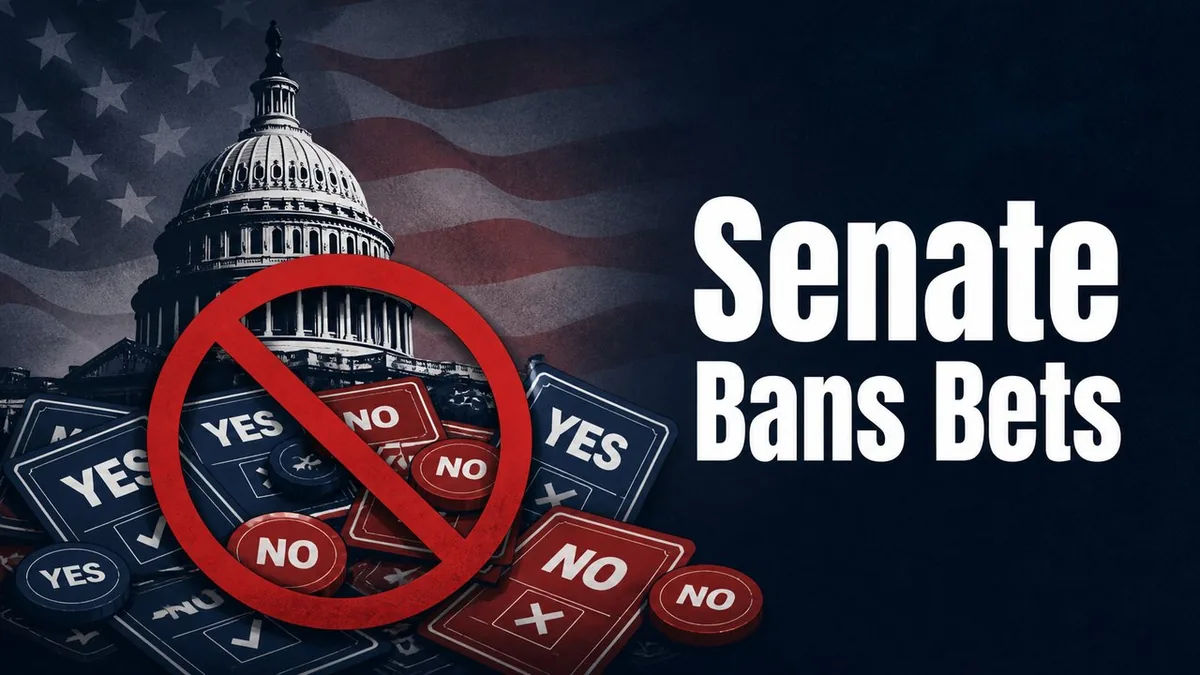
The US Senate unanimously passed an internal rule Thursday banning members and staff from participating in prediction markets, citing growing concerns about insider trading and conflicts of interest. Within hours, a separate group of Senate Democrats sent a formal letter to the CFTC urging the commission to "rein in" prediction markets — particularly the rapid expansion into sports betting and political event contracts that has mainstreamed Polymarket and Kalshi over the past 18 months.
The internal Senate rule prohibits any senator, senator's spouse, dependent child, or staff member from holding or trading positions on prediction market platforms. Violations carry penalties up to and including expulsion. The rule passes amid the broader Polymarket/Chainalysis insider-trading detection partnership announced earlier this week.
Why the Senate moved
Three triggering events:
Documented insider activity. An MIT-affiliated research group published a study in March showing that prediction-market positions on Senate vote outcomes were systematically profitable for traders with apparent insider information. The study identified at least 14 instances where positions were taken hours before a public vote announcement, with above-random returns.
Polymarket's mainstream growth. Polymarket's expansion into sports betting and political event contracts has dramatically expanded both volume and the public-facing visibility of prediction markets. The Chainalysis partnership announced this week was Polymarket's response to growing surveillance concerns; the Senate rule is the political response.
Bipartisan agreement on member conduct. While prediction-market regulation is broadly contested in Congress (libertarian-aligned Republicans support; progressive Democrats oppose), the narrow question of "should Senators bet on their own decisions" achieved unanimous support. Less politically risky than the broader regulatory question.
The Democratic letter to CFTC
The letter from Senators Warren, Markey, Booker, and seven others asks the CFTC to:
Reclassify event contracts. Treat political and sports prediction markets as gambling rather than financial derivatives, removing them from CFTC oversight and pushing regulation to state gambling commissions.
Mandate stricter ID verification. Require platforms to use enhanced KYC including residency verification and political-affiliation disclosure for political contracts.
Cap position sizes. Limit individual positions on political contracts to $10,000 — designed to prevent large-scale market manipulation while allowing retail participation.
The letter has no formal regulatory force; it's a political signal. But the CFTC has historically been responsive to coordinated congressional pressure, and the agency has been cautious about expanding event-contract licensing under the current administration.
The platforms most affected
Polymarket: The largest US prediction market by volume. Has been the primary target of regulatory attention since its 2024 expansion. The Chainalysis insider-detection partnership is a defensive move; pre-emptive against more aggressive regulation.
Kalshi: CFTC-licensed and more compliance-forward. Position-size caps would affect Kalshi but the company has been preparing for regulatory tightening for two years. Less existential threat than for Polymarket.
PredictIt: Smaller volume, academic-research focused, generally lower-risk for regulators.
Sports prediction platforms (DraftKings, FanDuel via prediction features): Less affected directly but the broader "is this gambling vs derivatives" question affects their event-contract products.
My Take
The Senate rule is uncontroversial and probably gets implemented quickly. The Democratic CFTC letter is the more interesting signal — it represents a coalition forming around the position that political-event prediction markets are gambling and should be regulated as such. That's bad for Polymarket specifically because their model depends on CFTC licensing rather than state-by-state gambling regulation. If the CFTC actually moves on the letter's recommendations, Polymarket's US expansion plans get materially complicated. Whether the CFTC acts is the open question — the Trump-administration CFTC has been more permissive than the prior commission, but congressional pressure can move the needle. My base case: rule book tightening over the next 12 months, probably in the form of stricter KYC and lower position caps. Outright reclassification as gambling is unlikely under this administration but possible under the next. Watch how Polymarket responds — their political-contract volume probably stays elevated near-term but legal-cost overhead rises substantially.
FAQ
Does the Senate rule cover sports betting in prediction markets? Yes — the rule covers any participation in any prediction market, regardless of contract type.
Were senators actually betting on their own votes? The MIT study identified suspicious patterns; specific individual identification is harder. The Senate rule is partly responsive to evidence and partly preventive.
What about House members? The House has not passed an equivalent rule but reportedly will consider one within 30 days. House ethics rules already cover financial conflicts more broadly.
The Bottom Line
US Senate unanimously bans itself from prediction markets; Senate Democrats urge CFTC to rein in event contracts more broadly. Polymarket's US expansion plans are most affected. Watch the CFTC's response over the next 90 days for whether this becomes formal regulatory tightening.