The Bank of England Is Expected to Hold Rates Even as Markets Bet on Hikes
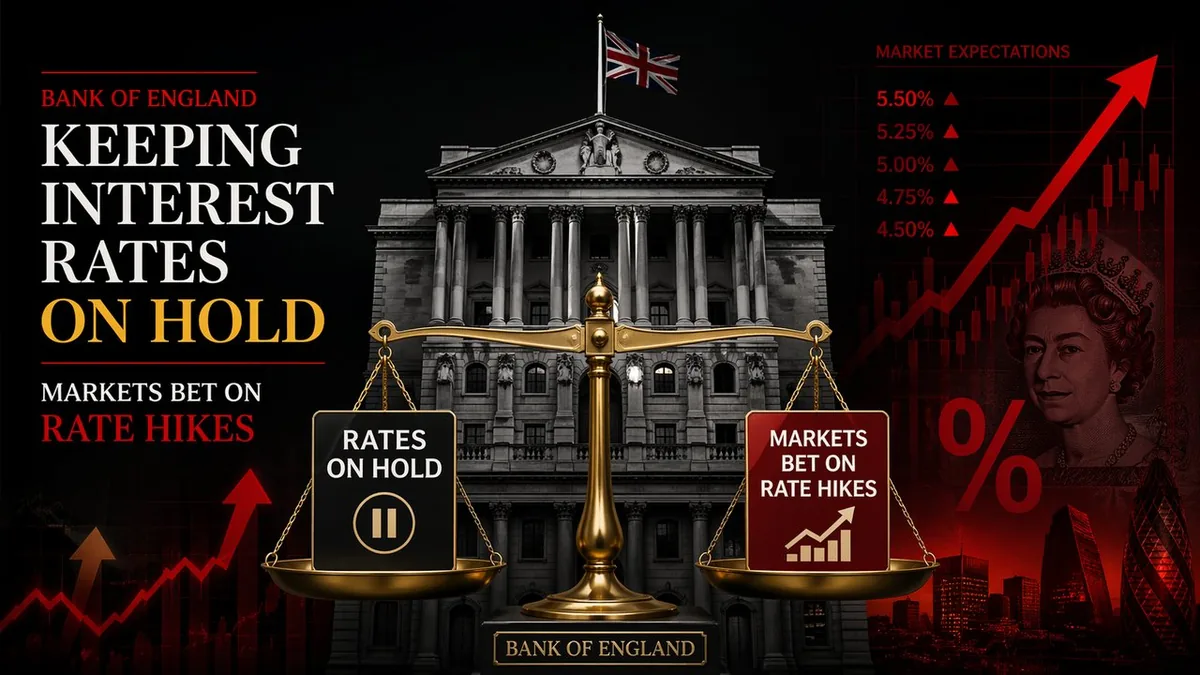
The Bank of England is widely expected to keep interest rates on hold at its upcoming meeting, even as financial markets have ramped up bets on rate increases — creating an unusual divergence between market pricing and expected central bank action that traders are watching carefully.
Why Markets Are Pricing in Hikes
UK inflation has remained stickier than the Bank of England's forecasts predicted. Services inflation in particular — which the BoE tracks closely as a measure of domestic price pressures — has not cooled at the pace that would typically justify maintaining or cutting rates. Combined with a resilient UK labor market and wage growth that continues to outpace inflation targets, the case for tightening is not unreasonable on paper.
Markets have responded by pricing in a non-trivial probability of at least one rate increase in the near term — a repricing that has lifted UK gilt yields and strengthened sterling against the euro and dollar in recent sessions.
Why the BoE Is Expected to Hold Anyway
Despite the inflationary data, the BoE faces a growth problem. The UK economy is fragile, with consumer spending under pressure from the cumulative effect of rate increases already delivered, rising household energy costs, and ongoing uncertainty around trade relationships. Raising rates into a weakening economy risks tipping the UK into recession — a risk the Monetary Policy Committee appears unwilling to take while the data remains mixed.
The BoE's communication has also been notably cautious. Governor Andrew Bailey and other MPC members have emphasized data dependence without signaling imminent tightening — a posture that typically signals "hold" even when market pricing diverges.
The Market-BoE Divergence
When markets price in rate moves that central banks don't deliver, the resulting disappointment can move currency and bond markets sharply. If the BoE holds — as expected — sterling could soften modestly against pairs where rate hike expectations had been driving strength. UK gilt yields would likely ease. The move would be a classic "buy the rumor, sell the fact" reversal.
My Take
Central banks and markets are speaking different languages right now. Markets are pricing inflation risk; the BoE is managing growth risk. Both are right about different things. The BoE's hold decision isn't a dismissal of inflation concerns — it's a judgment that raising rates further into a weakening UK economy creates more risk than it resolves. That judgment might prove wrong if inflation accelerates again. But for now, the BoE is playing a patient game, and patience is not the same as inaction.
Related Articles
- An ECB Policymaker Just Hinted That a Rate Increase May Be Necessary
- The DOJ Is Expected to Drop Its Criminal Probe of Fed Chair Powell
- US Consumer Sentiment Just Hit a Record Low