The number is staggering: startups around the world raised a record $510 billion in the first half of 2026, according to Crunchbase data. To put that in perspective, it's more than the $440 billion invested across all of 2025 — packed into just six months, and the highest half-year total ever recorded.
On the surface, that reads like a golden age for founders everywhere. But the headline hides a stranger, more lopsided reality. This wasn't a rising tide lifting every boat. It was a tsunami of cash pouring into a tiny handful of frontier AI labs — and, for everyone else, a fairly ordinary year.
A Record That Broke Every Record
The raw figures are historic across the board. Investors poured $305 billion into startups in Q1 and another $205 billion in Q2 — both individual quarters set records. Not since the frothy peak of 2021 has venture capital moved at anything close to this pace.
But 2021 and 2026 are very different animals. Five years ago, the money was spread across thousands of companies in crypto, fintech, delivery and SaaS. This time, the story fits on a single index card: artificial intelligence.
It's Really an AI Story
Here's the number that reframes everything: more than 70% of all global startup capital in Q2 went to AI companies, up from just under 50% a year earlier. AI didn't just lead the market — it became the market.
Strip AI out of the picture and the "record-breaking" year evaporates. The overall total was dragged to its all-time high almost single-handedly by a boom in one sector — and, within that sector, by an even smaller cluster of names.
The Two Companies That Ate Venture Capital
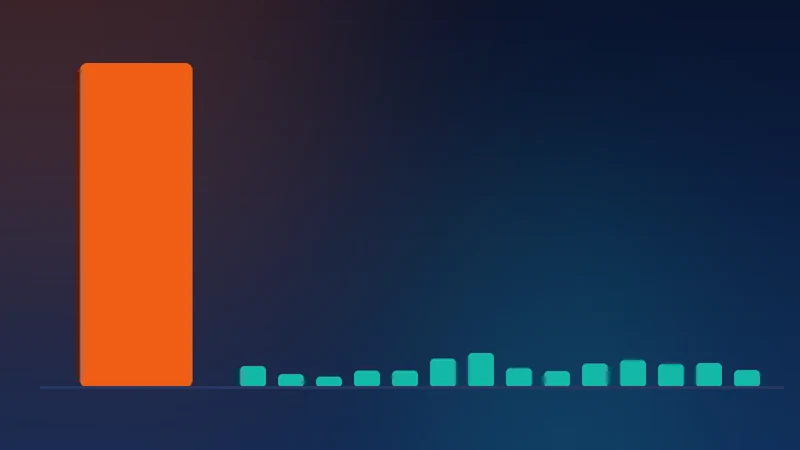
Two firms tower over the entire dataset. OpenAI and Anthropic alone took roughly $217 billion in the first half — an astonishing 43% of all startup funding on Earth.
- OpenAI raised about $122 billion — the largest private funding round in history — at a valuation near $852 billion.
- Anthropic followed with roughly $65 billion at a valuation approaching $965 billion, briefly becoming the most valuable private company on Crunchbase's board.
Two companies. Nearly half of every venture dollar on the planet. There is simply no precedent for capital concentrating like this.
The Catch: Strip Out Four Deals
This is where the "record" starts to look less like a boom and more like a mirage. Crunchbase's own analysis is blunt: if you remove just four mega-rounds — OpenAI, Anthropic, xAI and Waymo — the rest of global startup activity tracked close to ordinary 2024–2025 levels.
In other words, a normal fundraising year is wearing a record-breaking costume. Four transactions accounted for roughly two-thirds of a quarter's total venture dollars. For the tens of thousands of startups outside that charmed circle, 2026 doesn't feel like a gold rush at all — it feels like business as usual, or harder.
A New Kind of Money
These aren't traditional venture rounds, either. When a company raises $122 billion, no cluster of Sand Hill Road funds can write that check. Increasingly, the giant AI rounds are capital-markets events anchored by strategic giants like Amazon, NVIDIA and Microsoft — the same companies that also supply the chips and cloud these labs run on.
That blurs an important line. Is it an investment, or a pre-payment for compute? When your biggest backer is also your biggest supplier, the "funding" starts to look a lot like a circular flow of money between a few enormous balance sheets — a dynamic worth watching closely as the debate over an AI bubble intensifies.
The Exits Are Booming Too
It's not all inflows. After years of a frozen IPO market, the exit door finally swung open — spectacularly. SpaceX went public at a $1.77 trillion valuation, raising about $75 billion in the largest IPO ever recorded. You can read the full breakdown in our coverage of the record-shattering SpaceX IPO.
Then, less than a week later, SpaceX confirmed plans to acquire Anysphere — the maker of the popular AI coding tool Cursor — for around $60 billion. Mega-IPOs and mega-acquisitions are back, and like the funding boom, they're overwhelmingly AI-flavored.
So, Is It a Bubble?
That's the trillion-dollar question, and honest people disagree. The bull case is that this money is chasing genuine, exploding demand: businesses really are paying for AI, compute really is scarce, and the winners could be the most valuable companies of the next decade.
The bear case is written in the concentration itself. When nearly half of all venture capital funnels into two pre-profit companies at near-trillion-dollar valuations — financed in part by their own suppliers — that's exactly the kind of reflexive, self-reinforcing loop that has preceded past bubbles. Either way, one thing is clear: the $510 billion headline tells you much less about the health of startups than it first appears.
Frequently Asked Questions
How much did startups raise in the first half of 2026?
Global startups raised a record $510 billion in the first half of 2026, according to Crunchbase. That is more than the $440 billion invested across all of 2025, and it is the highest total for any half-year period on record. Q1 accounted for $305 billion and Q2 for $205 billion, with both quarters setting records of their own.
How much of the funding went to AI?
AI dominated the total. More than 70% of all global startup capital in Q2 went to AI-focused companies, up from just under 50% a year earlier. In other words, the record wasn't a broad startup boom — it was an AI boom that pulled the overall number to a new high.
Which companies raised the most money?
OpenAI and Anthropic. OpenAI's roughly $122 billion round — the largest private funding round in history — valued it at about $852 billion, while Anthropic's roughly $65 billion round valued it near $965 billion, briefly making it the most valuable private company on Crunchbase's board. Together the two firms took about $217 billion.
Is the record really just OpenAI and Anthropic?
Largely, yes. OpenAI and Anthropic alone accounted for 43% of all H1 2026 startup funding. Crunchbase notes that if you strip out just four mega-rounds — OpenAI, Anthropic, xAI and Waymo — the rest of global startup activity tracked close to ordinary 2024–2025 levels. The 'record' is powered by a tiny number of enormous deals.
Does this mean we're in an AI bubble?
It depends who you ask. Bulls argue the money is chasing real revenue and genuine demand for AI compute and products. Skeptics point to the extreme concentration — a handful of firms absorbing nearly half of all venture dollars at trillion-dollar valuations — as a classic warning sign. The honest answer is that the headline number tells you far less about startup health than it appears.
What about startup exits and IPOs?
Exits surged too. SpaceX went public at a $1.77 trillion valuation, raising about $75 billion in the largest IPO ever — and less than a week later confirmed plans to buy Anysphere, the maker of the AI coding tool Cursor, for roughly $60 billion. After years of a frozen IPO market, giant AI-adjacent exits are finally flowing.
What does this mean for non-AI startups?
It's a tougher environment than the record suggests. With AI companies soaking up more than 70% of the capital and a few mega-rounds dominating headlines, founders outside of AI face investors who are more cautious and more selective. For most startups, 2026 feels less like a boom and more like a normal — even competitive — fundraising year.
Final Thoughts
Records are supposed to be simple: bigger is better. But the $510 billion of 2026 is a record with an asterisk the size of a data center. Yes, more money flowed into startups than ever before — and yes, almost all of it flowed into AI, and mostly into two companies whose valuations now rival the largest firms on the planet.
Whether that's the early innings of the most important technology shift in a generation or the top of a historic bubble, we won't know for a while. What we do know is that "record venture funding" no longer means what it used to. In 2026, it's less a measure of startup health than a scoreboard for a very small number of very large bets.