Palantir Is Reportedly Helping the IRS Investigate Financial Crimes
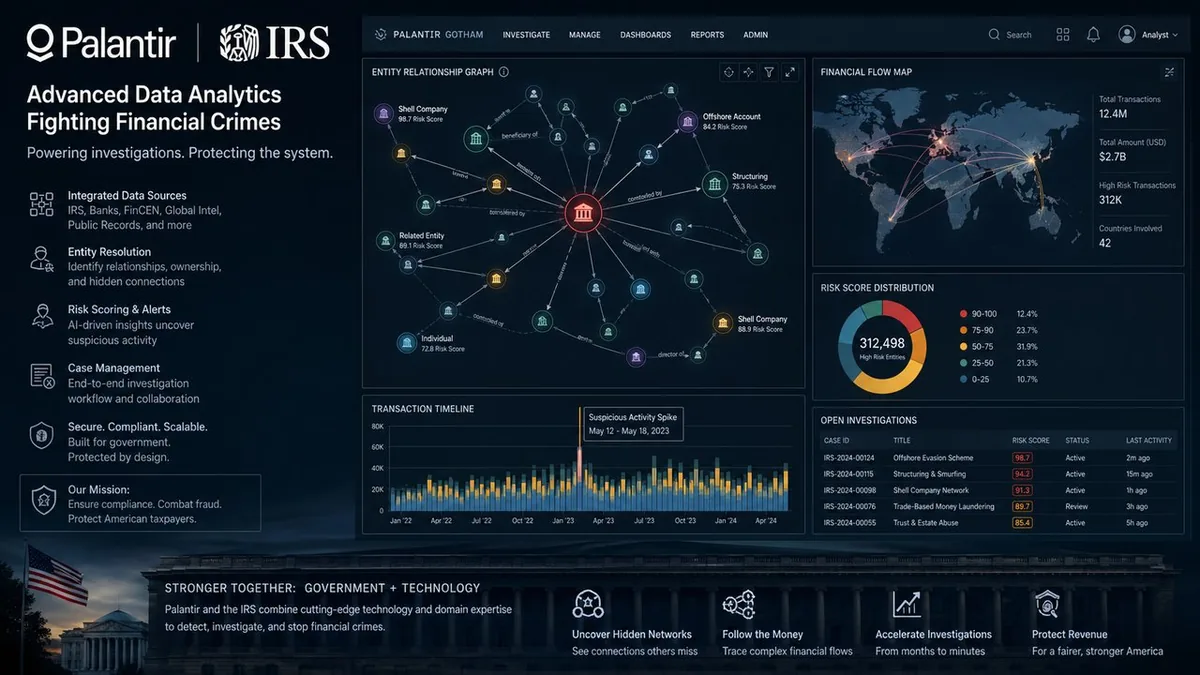
Palantir, the data analytics firm known for its work with defense and intelligence agencies, is reportedly assisting the IRS in investigating financial crimes. The partnership applies Palantir's data integration and pattern detection capabilities to the IRS's enforcement operations — an expansion of Palantir's government footprint into domestic tax compliance.
What Palantir Does
Palantir's core product is a data integration and analysis platform that can ingest disparate data sources, surface connections, and help investigators build cases. In defense and law enforcement contexts, it's been used to connect transaction records, travel data, communications metadata, and other signals to identify criminal networks. Applied to the IRS, it would work similarly — finding patterns across financial data that human analysts might miss at scale.
Why the IRS Is a Logical Client
The IRS has a documented and well-publicized backlog in enforcement against high-income non-filers and complex financial crime. The agency has historically been under-resourced relative to the complexity of the tax avoidance schemes it's trying to identify. Palantir's platform is specifically designed for the kind of large-scale data correlation that makes these investigations tractable.
The Privacy Concerns
Palantir's government work consistently generates civil liberties concerns — not because the legal authority is absent, but because integrated data analysis tools lower the barrier to surveillance at scale. An IRS-Palantir partnership raises questions about what data sources are being connected, what oversight exists, and whether financial behavior outside the IRS's direct mandate ends up in the analysis.
My Take
Palantir doing IRS work is unsurprising — it's a natural extension of their model. The concerning part isn't the financial crime focus, it's the data integration scope. "Financial crimes" is a category that can expand quickly when you have a powerful pattern-matching platform and broad agency mandate.
The Bottom Line
Palantir at the IRS is effective government contracting meeting enforcement need. The oversight question — what data goes in, what comes out, who reviews it — is what distinguishes a useful tool from a surveillance infrastructure problem.