Nvidia at 0% Share in China — Jensen Huang Says US Export Controls 'Largely Backfired'
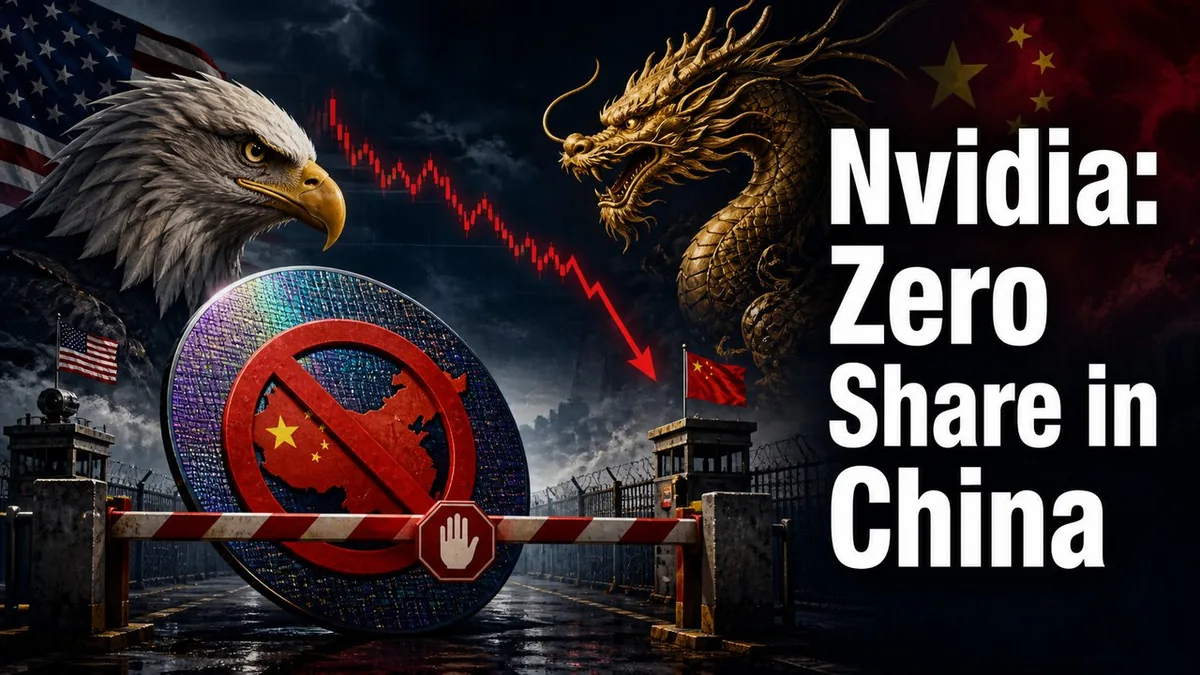
Nvidia's market share for AI accelerators in China has dropped to effectively zero, CEO Jensen Huang said publicly today, calling the U.S. export controls regime "largely backfired" in their original strategic intent. The statement — delivered at a Computex-adjacent media briefing and amplified across multiple outlets — is the most direct admission yet from a major U.S. semiconductor CEO that the Biden-era and Trump-extended chip export framework has produced unintended consequences that materially hurt American interests.
The 0% share number itself is striking but not entirely surprising. China's domestic AI accelerator capability — led by Huawei, Cambricon, and Biren — has matured rapidly under export-controls pressure. SMIC's 7nm node has improved yield and thermal characteristics enough to support competitive AI chip designs. Add the H20 export ban (April 2025) and the more recent restrictions on the H200 derivatives, and there's effectively no Nvidia commercial product left that's both export-compliant and genuinely competitive in the Chinese market.
What Jensen Huang actually said
The full quote, per multiple outlets present at the briefing: Nvidia's "AI accelerator share in China is approximately zero percent", and the U.S. export controls have "largely backfired" by accelerating Chinese domestic capability development without producing the intended capability gap. Huang was explicit that this is not a near-term phenomenon — it's been the trajectory for 18+ months — and that further tightening of controls produces diminishing strategic returns.
The political framing matters. Huang has historically been measured in public commentary about U.S. policy. His escalation to direct critique signals that Nvidia has concluded that further constructive engagement on the controls is unlikely under the current administration, and that public pressure is the remaining lever. That is a meaningful inflection in the U.S. tech-industry posture toward AI export policy.
The economics behind the 0%
Nvidia's pre-controls revenue in China was approximately $10-15 billion annually, with AI accelerators representing a growing share of that mix. Today's figure is reported to be a fraction of historical levels, and the AI accelerator component has been almost entirely absorbed by Huawei's Ascend 910C and 910D series, plus Cambricon's MLU-series and Biren's BR104. Chinese hyperscalers (Alibaba, Tencent, Baidu, ByteDance) have largely completed their transition away from Nvidia for new AI workloads.
The market-share loss has not materially hurt Nvidia's overall financials because U.S. and allied-market AI demand has more than absorbed the displaced revenue. But the strategic implication is clear: Chinese AI infrastructure is now built primarily on Chinese silicon, which means future strategic leverage from chip-controls is meaningfully reduced. That's the "backfire" Huang is pointing to.
My Take
Huang is correct on the merits, and the political pushback is overdue. The export controls regime achieved its stated short-term goal — slowed Chinese AI capability — but at the cost of catalyzing a structural domestic-silicon investment cycle that's now self-sustaining. Eight months from now, when NIST publishes its next DeepSeek evaluation and the Chinese-domestic AI capability gap has narrowed further, the controls debate will look very different.
The deeper structural question is what U.S. policy should do now. Three options are debated. Option 1: extend controls further — strangle Chinese AI capability through the largest possible perimeter of restrictions. This is the maximalist position; declining marginal effectiveness suggests it's not worth the cost. Option 2: maintain status quo — keep the existing framework, accept that Chinese capability continues developing, focus on U.S. capability acceleration. This is the consensus emerging position. Option 3: relax controls selectively — restore some commercial access in exchange for compliance commitments and intelligence-sharing concessions. This is unlikely politically but produces the best long-term outcomes.
The most likely policy trajectory is Option 2 — maintenance with marginal adjustments rather than substantive reform. That means the 0% Chinese market share for Nvidia is probably durable, and the structural shift in Chinese AI infrastructure is permanent.
What this means for AI hardware globally
Three implications worth tracking. First, expect continued bifurcation of the global AI hardware market into Western (Nvidia/AMD/TPU/Trainium-dominant) and Chinese (Huawei/Cambricon/Biren-dominant) ecosystems with limited interoperability. Second, expect Chinese AI hardware exports to non-aligned markets (Southeast Asia, Middle East, parts of Africa and Latin America) to grow as Chinese vendors seek scale economies outside their domestic market. Third, expect renewed U.S. Congressional debate over AI export framework when the next Defense Authorization Act cycle begins.
For Nvidia specifically, the 0% China statement is partly strategic positioning. By declaring the loss publicly, Huang reduces investor expectations, makes the compensating U.S./allied growth look stronger, and creates pressure for policy revision. None of those outcomes are bad for Nvidia commercially, even though the loss itself was structurally negative.
Frequently Asked Questions
Is Nvidia really at 0% in China?
"Approximately zero" per Huang, in the AI accelerator category specifically. Nvidia continues to sell some non-AI products (consumer GPUs, professional graphics, networking) in China. The AI accelerator category — H100/H200/B100/B200 and successors — is what Huang's statement refers to.
What replaced Nvidia in Chinese AI deployments?
Primarily Huawei's Ascend series (910C, 910D, and the upcoming 910E), plus Cambricon's MLU and Biren's BR104. These are the dominant alternatives in Chinese hyperscaler and government AI infrastructure.
How much revenue did Nvidia lose?
Pre-controls China revenue was approximately $10-15 billion annually. The current loss is meaningful but absorbed by stronger-than-expected U.S. and allied market growth, so Nvidia's overall financials have not been materially damaged.
Will export controls be relaxed?
Politically unlikely under the current administration. The most plausible outcome is incremental maintenance of the existing framework rather than substantive reform.
The Bottom Line
Jensen Huang's public statement that Nvidia is at zero percent share in China — and that export controls "largely backfired" — is the most consequential industry critique of U.S. AI export policy to date. The structural shift is permanent, and the policy debate will increasingly focus on what to do next rather than whether the original framework worked. Watch for renewed Congressional engagement on this issue through 2026.
Related Articles
- NIST: DeepSeek V4 Trails US AI by 8 Months
- Nvidia Releases Nemotron-3 Nano Omni
- Anthropic in Talks With UK Chip Startup Fractile