India's 1.5 Million Annual CS Graduates No Longer Have a Scale Advantage as AI Coding Erodes the Edge
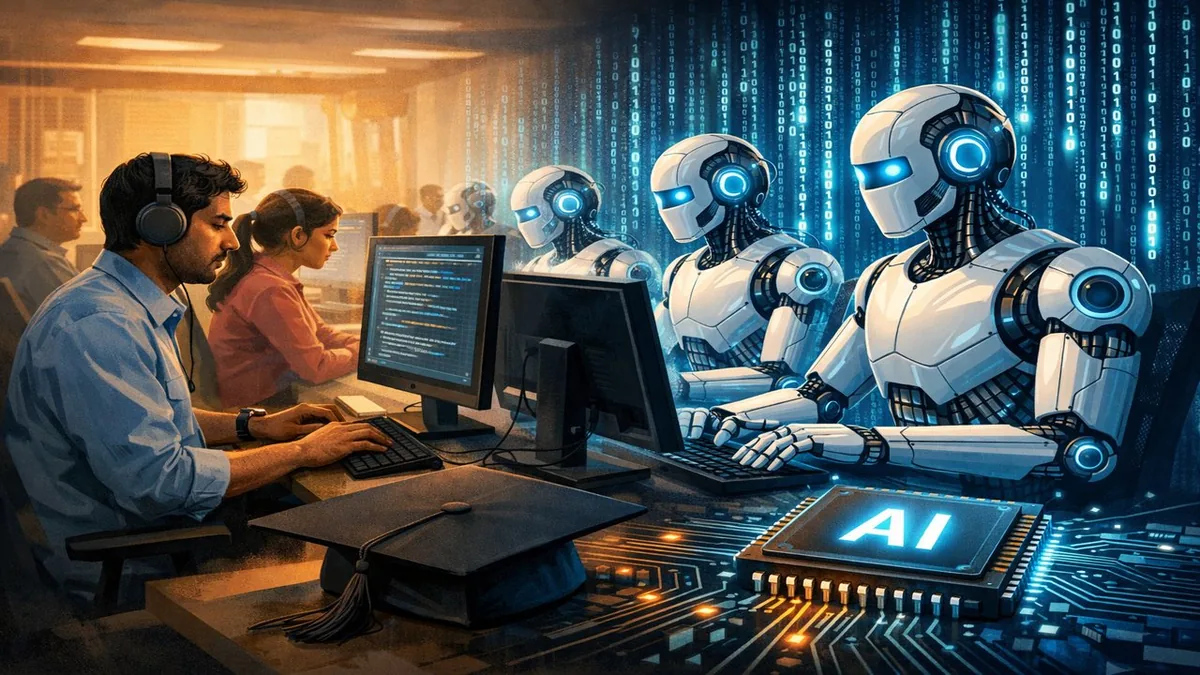
India produces over 1.5 million computer science graduates every year — a pipeline that has for decades powered the country's dominance in global software services and IT outsourcing. But the rise of AI coding tools is fundamentally disrupting the economics behind that scale. When a single developer with an AI assistant can do the work that previously required a large team, the raw headcount advantage that India's educational output provided becomes significantly less valuable. Infosys, one of India's largest IT services companies, is already restructuring its hiring accordingly.
The Scale Play and Why It Worked
India's IT services model was built on a specific arbitrage: large numbers of skilled English-speaking developers available at lower wage rates than Western markets, combined with process discipline that allowed large-scale software development at predictable cost. Companies like TCS, Infosys, Wipro, and HCL became global enterprises by being able to staff projects with hundreds or thousands of engineers quickly and cost-effectively.
The value of scale was inseparable from the value of volume: more developers meant more capacity to take on more work. That equation held for 30 years. AI coding tools are disrupting both variables simultaneously — reducing the number of developers needed per unit of output, and lowering the skill floor required to produce working code.
What AI Coding Changes
Tools like GitHub Copilot, Claude, and specialized coding models can now handle significant portions of routine software development: writing boilerplate, converting between languages, generating tests, reviewing code, and explaining legacy systems. Tasks that historically required a 10-person team can increasingly be handled by 3-4 developers augmented by AI, compressing the demand side of the equation even as India's CS graduate supply continues to grow.
More consequentially, the quality differential between AI-assisted junior and senior developers has narrowed considerably for routine tasks. This reduces the pure headcount premium that India's volume provided while increasing pressure to differentiate on AI fluency rather than raw coding capacity.
Infosys Changes Its Hiring
Infosys has announced it is revamping its hiring model to prioritize AI skills over traditional hiring volume. Rather than recruiting primarily for coding ability that can be scaled across large teams, the company is reorienting toward candidates who can direct and orchestrate AI systems, evaluate AI outputs, and build the higher-level architectures that AI tools augment. This is a fundamental shift in what a "software engineer" at a large Indian IT services company is expected to do.
The Bottom Line
India's CS graduate pipeline remains a significant asset, but its value proposition is changing. The transition from volume coding to AI-augmented development is compressing demand for pure headcount at exactly the moment supply continues growing. For India's IT sector, the question is whether the educational system and the industry can shift fast enough to produce the AI-skilled talent the next decade demands — or whether the scale advantage that built the industry becomes a liability in an era where less coding means fewer jobs per unit of output.
Related Articles
- Google Negotiating Deal With US DOD to Deploy Gemini in Classified Settings
- Anthropic Secures London Office for 800 People
- Jensen Huang on Nvidia Supply Chain Moat and ASIC Threat