Google Maps Gets an AI Upgrade: Smarter Search, Better Navigation
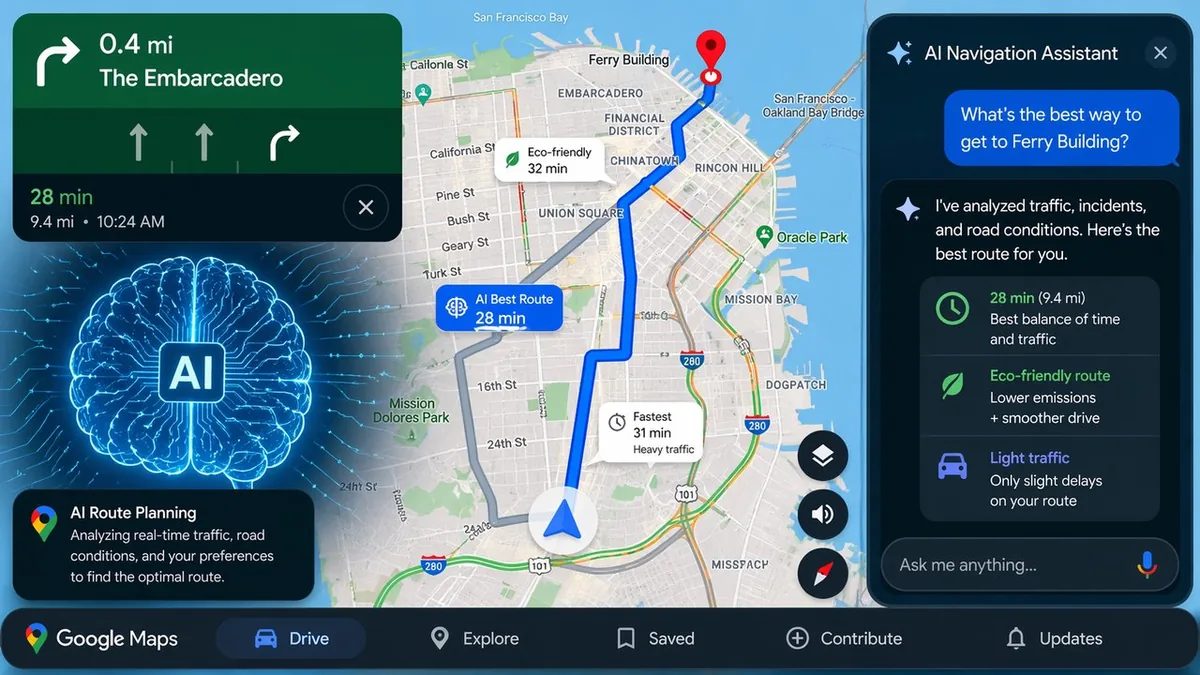
Google Maps is getting smarter — and this time the changes aren't just incremental UI tweaks. Google is embedding Gemini-powered AI into Maps to make search more conversational, recommendations more contextual, and navigation more aware of real-world complexity. If it works as advertised, the way most people find and navigate places is about to change significantly.
What's Actually Happening
Google is rolling out a set of AI-powered upgrades to Maps that leverage its Gemini models. Key features include: natural language search (ask "coffee shop with good wifi near my meeting" instead of typing keywords), AI-generated summaries of places pulled from reviews and photos, and smarter routing that factors in contextual signals beyond traffic — things like parking availability, crowding patterns, and entrance accessibility.
The updates are being rolled out globally on Android and iOS, with some features available immediately and others phased over the coming weeks. Google is also integrating Maps more tightly with Search and Google Lens for "live" overlay navigation — point your camera and see directions superimposed on the street ahead.
Why It Matters
Google Maps has over 1 billion monthly active users. Even small improvements to navigation and discovery at that scale have enormous real-world impact — fewer wrong turns, better local business discoverability, more efficient city movement. But the bigger story is strategic: this is Google showing that Gemini isn't just for Search and Workspace. It's being woven into every high-engagement product Google owns.
For local businesses, the AI summary and recommendation features could be a double-edged sword. Better AI curation might mean more visibility for highly-rated places — but it also means Google is becoming the intermediary between searchers and businesses in an even more opaque way. If Gemini's summaries don't accurately represent your restaurant or shop, you might never find out why foot traffic dropped. For a look at how AI is reshaping other platform products, see our piece on Duolingo's content strategy shift and what it signals about platform economics.
My Take
The natural language search upgrade is the one I'm most interested in. Current Maps search is keyword-based and unforgiving — if you don't phrase your query the right way, you get irrelevant results. Conversational search that understands intent is a genuine usability improvement, not just a marketing feature.
My concern is the usual one with Google AI rollouts: inconsistency. AI-generated summaries are only as good as the underlying data, and Google's review ecosystem has well-documented problems with fake reviews, spam, and gaming. If Gemini summarizes a place based on manipulated reviews, users get confidently wrong information delivered in a beautiful interface. The UX gets better. The trust problem gets worse. Google needs to solve the data quality problem before the AI layer makes it invisible.
FAQ
What AI features is Google adding to Maps? Conversational natural language search, AI-generated place summaries from reviews and photos, smarter context-aware routing, and enhanced AR navigation via Google Lens integration.
When are these features available? Rolling out now on Android and iOS globally, with some features phased over the coming weeks. Availability may vary by region.
Does this require a Google account? Most features work without an account, but personalized recommendations and some contextual features require being signed in.
How does this compare to Apple Maps? Apple Maps has been investing in similar AI features, but Google's data advantage — breadth of reviews, photos, and real-time signals — gives it a significant edge for AI-powered recommendations.
Related Articles
- Duolingo Makes Advanced Content Free: What the Shift Means for Edtech
- Google Cloud Next 2026: AI Agents and Enterprise Tools Take Center Stage