Cloudflare Cuts 1,100 Jobs in 'Agentic AI-First' Pivot — Despite a 34% Revenue Beat
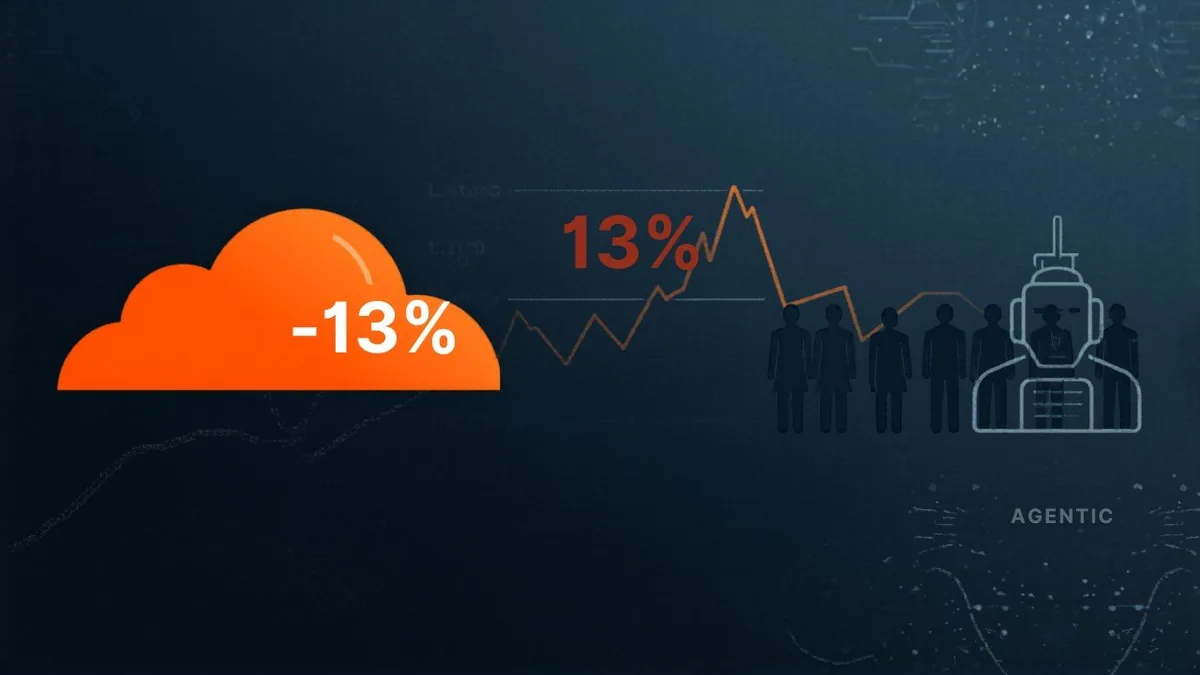
Cloudflare reported Q1 2026 revenue up 34% year-over-year to $639.8 million on Wednesday. It also announced it would cut more than 1,100 jobs globally and shift to what CEO Matthew Prince called an “agentic AI-first operating model.” The stock dropped more than 13% in after-hours trading. The contradiction between the two announcements — a beat plus a deep cut — is what tells you the real story.
This is not a company in trouble. Cloudflare's revenue growth is faster than most enterprise SaaS peers. The cuts are not coming from a panic about runway or a missed quarter. The cuts are coming from a strategic decision to use the AI-restructuring narrative to compress headcount in support, sales, and middle-management roles where Cloudflare's leadership now believes agentic AI can do the work. The market read it as exactly that and sent the stock down anyway.
What Cloudflare Actually Announced
From the earnings release and follow-up commentary across Bloomberg, Reuters, CNBC, The Information, and Cloudflare's own blog:
- Q1 2026 revenue: $639.8M, up 34% YoY — beat consensus estimates
- Layoffs: More than 1,100 jobs globally; precise breakdown by department not yet disclosed
- Framing: “Agentic AI-first operating model” (Matthew Prince)
- Stock reaction: NET down 13%+ in after-hours trading
- Severance: Standard tech-industry package; details to be filed in 8-K
- Affected products: Internal operations and customer-facing support roles; product engineering largely preserved
The 1,100 number puts the cut at roughly 25-30% of Cloudflare's reported workforce of approximately 3,800-4,200 employees as of late 2025. That is one of the largest percentage cuts at a profitable, growing tech company in 2026.
The Pattern: 'AI-First' Is Becoming Cost-Cutting Cover
Cloudflare is the third major SaaS vendor in 2026 to announce layoffs framed as an AI-restructuring rather than a traditional cost-cutting exercise. The earlier two were Salesforce (April, 1,000+ jobs in “customer success and onboarding being automated by Agentforce”) and Microsoft (March, 6,000+ jobs in “reorganizing for AI-native delivery”). The framing is consistent: AI is the reason, not the recession.
Markets have responded differently to each. Salesforce's stock rallied on the announcement (interpreted as margin expansion). Microsoft's stock was flat (already priced in). Cloudflare's stock dropped 13% — the harshest reaction of the three. The difference is that Cloudflare beat on revenue while announcing the cuts. When growth is strong, layoffs read as margin pressure or strategic confusion; when growth is weak, layoffs read as discipline. Cloudflare made the unusual choice of cutting hard while growing fast, and got punished for it.
What Roles AI Is Actually Replacing Inside Cloudflare
Based on industry reporting and the typical pattern at Cloudflare's stage, the cuts are concentrated in: tier-1 customer support (replaceable by trained chatbots reading the Cloudflare docs), inbound sales (replaceable by an AI sales agent qualifying leads), partner-channel ops (replaceable by automated onboarding), some L&D / internal training (replaceable by GPT-style internal tooling), and a layer of middle managers whose primary work was coordinating headcount that no longer exists.
What is NOT being cut, per Cloudflare's blog: core product engineering, security incident response, and the Workers AI / Cloudflare One platform teams. That tells you Cloudflare's leadership believes the AI-replaceable work is operational and customer-facing, not technical or strategic. They may be right; they may be early. The next 12 months will determine which.
My Take
The honest read is that Cloudflare is making a defensible strategic bet that markets do not yet trust. The bet: agentic AI tools will let a 2,800-person Cloudflare ship the same revenue growth as a 4,000-person Cloudflare, expanding margins by 800-1,000 basis points and re-rating the multiple. If the bet works, this is the smartest move of 2026 and Matthew Prince looks like a genius. If it does not work — if customer satisfaction craters because AI tier-1 support cannot resolve nuanced enterprise issues, or if sales pipeline narrows because human relationship-builders walk out the door — then Cloudflare's growth slows and the whole story unwinds within four quarters.
The market's 13% reaction is pricing in the second scenario. That is the right default position when a high-growth company does this — historical precedent (IBM in the 1990s, HP in the 2010s) is that aggressive headcount cuts at growing companies tend to produce short-term margin gains and long-term growth slowdowns. The exceptions (Amazon's relentless efficiency, NVIDIA's lean culture) are rare and require unusual leadership.
The other thing worth flagging: 1,100 people are losing their jobs and the framing is “AI-first.” Some of those roles probably WERE inefficient and AI can genuinely automate them. Some of them probably weren't and were just carrying water for a leadership team that wants to expand margins. The honest version of this announcement would have separated the two: “We are eliminating 600 redundant roles, and we are betting that 500 customer-facing roles will be successfully replaced by agentic AI; we will track support quality NPS quarterly and reverse the latter cut if quality drops more than X.” Nobody at this scale frames it that way. The vague “AI-first” framing is doing a lot of work.
Frequently Asked Questions
How many people did Cloudflare lay off?
More than 1,100 employees globally, representing roughly 25-30% of the company's reported workforce of 3,800-4,200 as of late 2025. The full breakdown by department has not been publicly disclosed.
Why did Cloudflare announce layoffs while reporting a 34% revenue beat?
CEO Matthew Prince framed the cuts as a structural pivot to an “agentic AI-first operating model.” The argument: Cloudflare can grow revenue with materially fewer employees if AI tools handle support, qualified-lead sales, and operational coordination. Markets disagreed; the stock fell 13%.
Which Cloudflare products are most affected?
Cloudflare confirmed product engineering and security incident response are largely preserved. Cuts concentrate in tier-1 support, inbound sales, partner channel operations, and some middle management. Customer-facing impact will likely show first in support response times and complex-issue resolution quality.
How does this compare to Salesforce and Microsoft AI-restructuring layoffs?
Salesforce cut 1,000+ in April under similar framing; stock rallied on margin-expansion narrative. Microsoft cut 6,000+ in March; stock was flat. Cloudflare's stock fell 13%, the harshest reaction of the three. The difference: Cloudflare beat on revenue, making the cuts read as strategic confusion rather than discipline.
What is an 'agentic AI-first operating model'?
The term refers to operating a company where AI agents handle a significant share of routine work — customer support tickets, sales-lead qualification, internal coordination — that was previously done by human employees. Cloudflare has not published a detailed internal definition; the framing is mostly external-narrative.
The Bottom Line
Cloudflare is making the largest AI-framed restructuring at a profitable, growing tech company so far in 2026. If the bet pays off, margins expand and the company re-rates. If it does not, customer NPS drops, growth slows, and the bet looks reckless within four quarters. The 13% market reaction reflects skepticism, not panic. Watch Q2 earnings for the first real signal — particularly support-quality metrics and net-new logo count, which will tell you whether agentic AI tools are actually doing the work that 1,100 humans used to do.
Related Reading
- SAP's €1B Bet on Prior Labs: Tabular Foundation Models
- Braintrust Confirms AWS Breach, Tells Every Customer to Rotate API Keys
- Aurora Wins McLane Deal for Driverless Truck Routes Across Texas