How Augmented Reality (AR) and Virtual Reality (VR) Are Changing the Classroom Experience
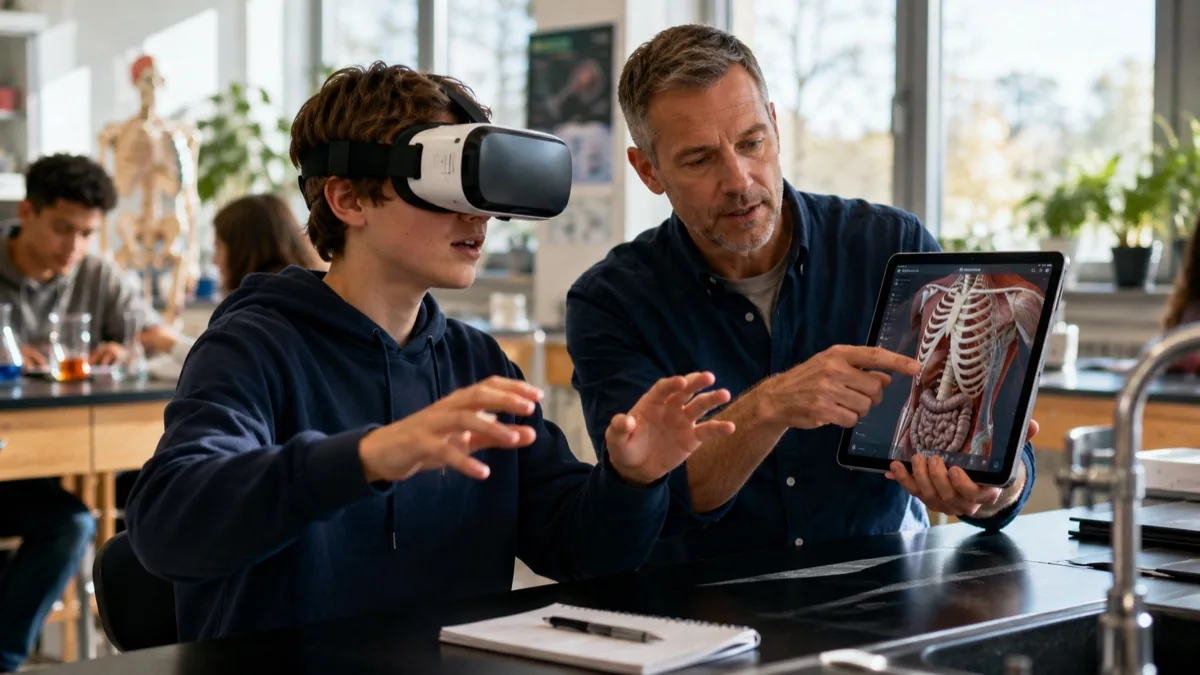
Augmented reality and virtual reality have spent a decade in the "future of education" press release. In 2026, the gap between hype and classroom reality has narrowed enough to write honestly about what's working and what isn't. The short answer: AR and VR are excellent for a narrow set of subjects where the constraints of physical space, safety, or rare access create genuine teaching problems. They're a waste of money for most other applications. The good news is that the narrow set is well-defined now, and schools that buy headsets for those specific use cases are getting real value.
This guide covers where AR and VR are actually working in U.S. K-12 and higher-education classrooms in 2026, where they're falling short despite continued investment, and what schools should know before signing a purchase order for a headset cart.
The hardware in 2026
The hardware landscape has finally consolidated. Three platforms cover almost all educational deployments.
Meta Quest (3 and 3S). The dominant K-12 platform by usage in 2026. The Quest 3S at $299 and Quest 3 at $499 are cheap enough for classroom-cart deployments, the educational content library is the largest of any platform, and the standalone (no PC required) form factor matches school IT capacity. Most school deployments today are Quest-based.
Apple Vision Pro and Vision Air. Apple's higher-end mixed-reality headsets have found a niche in higher education, particularly medical and engineering schools, where the visual fidelity matters and the per-student cost is justifiable for specific simulation use cases. K-12 adoption has been negligible due to price ($2,500-3,500).
Tablet-based AR (iPad and Chromebook). Far more common than headsets in actual classroom use. Apps like Merge Cube AR, Anatomy 4D, and JigSpace use existing school tablets to deliver augmented reality without requiring headset hardware. The educational quality is lower than VR, but the deployment friction is also dramatically lower.
Subjects where AR/VR is genuinely working
Five categories of educational use cases have produced consistently positive outcomes in 2026 — meaning the AR/VR version measurably outperforms the textbook-and-lecture alternative on student understanding and retention.
Anatomy and biology. The strongest case. Apps like Complete Anatomy, BodyMap AR, and 3D Organon let students manipulate human anatomy at the system, organ, and cell level. The retention improvement over 2D textbook anatomy is dramatic, and the equity case is real — most schools can't afford cadaver labs, but a $300 headset gets close to the same learning experience.
Chemistry molecular structures. Visualizing 3D molecular bonds, isomers, and reaction mechanisms in headset has shown measurable understanding gains for high school and intro-college chemistry. Apps like MoleculeViewer and Nanome are well-validated and have meaningful classroom adoption.
Historical recreation and virtual field trips. Classroom visits to ancient Rome, the Anne Frank house, the trenches of World War I, or the Apollo 11 mission. Quality varies wildly by app, but the best-produced experiences (Time Looper's historical recreations, Stanford's Virtual Holocaust Memory Project) produce engagement and emotional connection that traditional documentary or textbook material doesn't match.
Lab safety and equipment training. Practicing proper lab procedure in VR before doing it with real equipment dramatically reduces incidents and lets schools train with equipment they don't own. Career and technical education programs (welding, machining, automotive, electrical) are the largest growth area for VR in 2026 — programs that previously required expensive equipment and supervision can now do significant practice in headset.
Spatial subjects: architecture, engineering, geography. Subjects where students need to understand 3D structures benefit enormously. Walking through a virtual cathedral to study Gothic architecture, manipulating a structural engineering model under load, or visiting a 3D map of a watershed produce understanding that flat representations don't.
Where AR/VR is consistently failing
Three categories of educational use have produced consistently disappointing results despite continued investment.
Generic "VR field trip" replacements for actual field trips. The pattern: school can't afford a real museum visit, so it tries VR. The engagement is initially novel but doesn't sustain — by trip three, students treat it as a video. Real field trips (when possible) produce richer learning. VR makes sense as a supplement to or substitute for genuinely impossible trips (ancient Rome), not as a generic replacement for the local science museum.
Reading and writing instruction. Repeated attempts to gamify reading or composition in VR have not produced retention or skill improvements over traditional methods. The VR layer adds production cost without educational value for these subjects.
Math instruction. Despite ongoing investment, math-in-VR has not demonstrated outcomes better than standard digital tools or even pen and paper. The 3D visualization helps in narrow geometric topics, but the bulk of math instruction doesn't benefit.
The deployment realities most schools learn the hard way
Several practical issues consistently surprise schools deploying AR/VR for the first time.
Headsets need cleaning. Shared headsets in middle and high school classrooms accumulate grime fast. Proper hygiene protocols (face cushion covers, alcohol wipe-downs between users) are mandatory, and most schools underbudget for the consumables.
Motion sickness affects 15-20% of students. Some students cannot tolerate VR for more than a few minutes without nausea. This is a genuine accessibility issue and needs equivalent alternative content for affected students. AR (tablet-based) doesn't have this problem.
Account management is painful. Most consumer headsets aren't designed for shared classroom use. Quest's classroom management has improved but still requires significant IT setup. Plan for IT support, not just hardware.
The content cost is real. The free-to-cheap educational VR app library is shallow. The high-quality validated experiences typically cost $5-50 per student per year. Budgeting for content licenses separate from hardware is necessary.
For schools considering investments in any classroom technology, our broader guide on top EdTech tools for online learning covers the comparative-cost considerations across categories. The wider context of how technology is reshaping classrooms sits in our AI in education pillar.
The classroom integration models that work
Three patterns have emerged from schools getting real educational value from AR/VR in 2026:
The shared cart model. Eight to fifteen headsets on a rolling cart, shared across the grade level or subject department. Used for specific lessons, scheduled in advance, with clear hygiene and management protocols. Lower per-student cost, less compelling for daily integration but the most common functional model.
The lab model. A dedicated room with 20-30 stations, used like a computer lab. Students rotate through for specific lessons, and the room serves multiple subjects. Higher upfront cost but better utilization and easier management.
The teacher-demo model. One or two headsets the teacher uses for whole-class demonstrations (often projected to a screen so the class sees what the headset wearer sees). Lowest cost, lowest student engagement, but a reasonable bridge for schools testing the technology.
Schools that have skipped these intermediate models and tried "1:1 headsets per student" universally report poor outcomes — high cost, low actual usage, and IT chaos.
Frequently Asked Questions
Should K-12 schools be investing in VR right now?
Selectively, yes. A shared cart for the science department to use in anatomy and chemistry units, or for a CTE program to use in trade-skill simulation, makes a real case. A general-purpose classroom investment expecting transformation across all subjects does not.
What age is appropriate for VR in classrooms?
The major manufacturers recommend 13+ for extended use. Most educational research has focused on grades 6 and up. For elementary classrooms, AR (tablet-based, no headset) is the better fit until the kids are older.
How much should a school budget for an entry-level VR program?
Realistic minimum: $5,000-8,000 for a 10-headset cart with a year of content licenses, charging infrastructure, hygiene supplies, and basic IT setup. Add $2,000-3,000/year for ongoing content licenses and replacement face cushions.
What about Apple Vision Pro for K-12?
The price ($3,500 base) makes K-12 deployment economically unrealistic. Higher education programs with specific high-fidelity simulation needs (medical schools, advanced engineering) are the realistic Vision Pro audience.
Is AR or VR better for classroom use?
Different tools for different jobs. AR via existing iPads or Chromebooks has dramatically lower deployment friction and works for spatial visualization, dissection alternatives, and AR-overlay experiences. VR works better for fully-immersive simulations and emotional/experiential content. Most schools should start with AR (zero new hardware) and add VR for specific use cases.
The bottom line
AR and VR in education in 2026 are mature enough that schools can make rational purchasing decisions and get real value — but the value is concentrated in specific subjects (anatomy, chemistry, lab safety, spatial subjects, narrow historical content) and specific use cases (rare-access experiences, expensive-equipment training). The "VR is the future of education" claim has not aged well; the "VR is the future of teaching anatomy and welding" claim has aged extremely well.
For schools considering an investment, the practical path is: pick one or two specific subjects where the case is strong, deploy a shared cart, integrate it into specific units, and evaluate outcomes after a semester. Resist the broader transformation pitch. The technology earns its place in narrow but real ways, not in the all-purpose way that vendors continue to market.