Apple Explores Intel + Samsung for Main Chip Production — TSMC Diversification Talks Heat Up
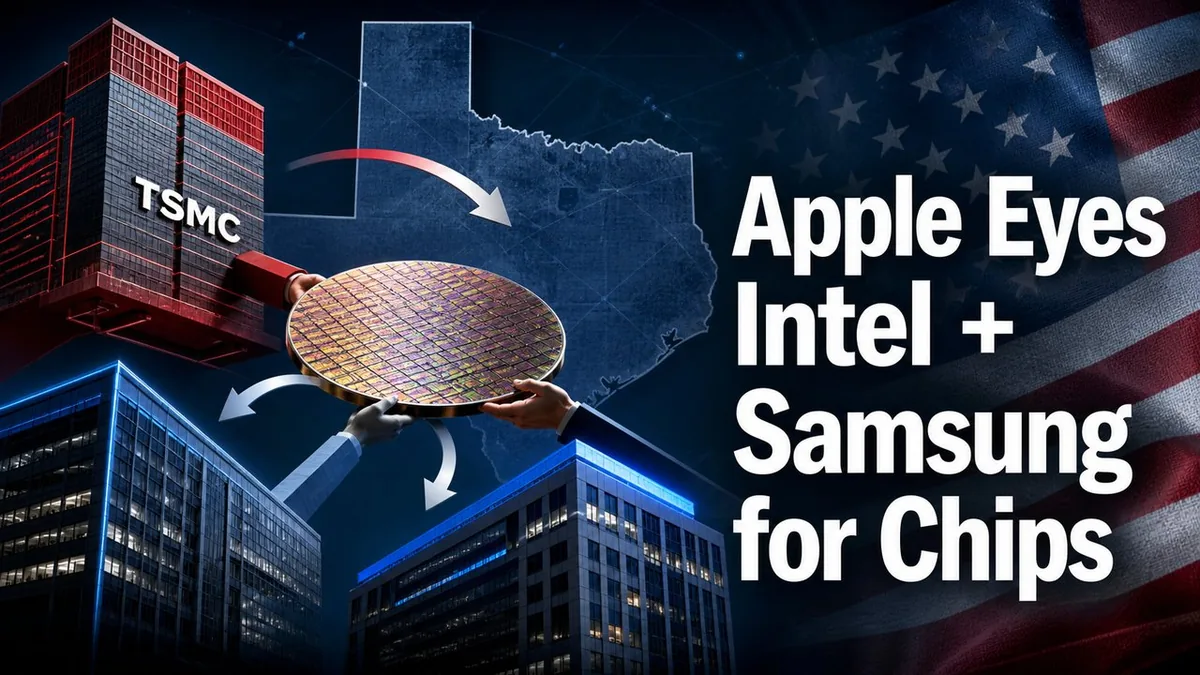
Apple has held active discussions with both Intel and Samsung about producing main device chips at U.S. fabs, Bloomberg reported this morning. Apple executives reportedly visited Samsung's new Texas fabrication plant within the past quarter and have engaged Intel about its U.S.-based foundry capacity. The talks — which Apple has not publicly confirmed — would represent the first material diversification of Apple's chip-supply strategy since the company began transitioning away from Intel processors in 2020 toward TSMC-produced Apple Silicon.
The strategic motivation is straightforward and matches broader U.S. industrial-policy direction. Apple sources nearly all of its A-series and M-series chips from TSMC's Taiwan and Arizona fabs, with the latter operating but at meaningfully lower volume than Apple's primary Taiwan supply. The TSMC concentration creates two structural risks: geopolitical (Taiwan supply disruption due to China-Taiwan tensions) and policy (U.S. CHIPS Act compliance and political pressure for domestic-sourced production). Diversifying to Intel and Samsung addresses both dimensions.
What's actually being discussed
Three production scenarios are reportedly under active evaluation. First, Intel as a secondary foundry for older-node products — Apple Watch chips, AirPods chips, and possibly older iPhone-class chips at Intel's 18A or 20A nodes once those mature. Intel's foundry business needs anchor customers; Apple's commitment would be the most credible single endorsement Intel Foundry could secure. Second, Samsung as a Texas-based production partner for specific chip generations at Samsung's new fab — likely starting with chips for Apple's smaller-form-factor products before potentially scaling up. Third, continued TSMC Arizona expansion as the primary U.S. production path for Apple's most demanding (M-series, A19+) chips, with Intel and Samsung as supplementary sources.
Apple's expectation, per the reporting, is that diversification would happen incrementally over 24-48 months rather than as a step-function shift. The first measurable production from non-TSMC fabs is unlikely before 2027, and meaningful share of total Apple chip volume from non-TSMC sources is unlikely before 2028-2029. The discussions matter today because the supply-chain commitments need to be made years in advance.
The Intel and Samsung context
Both Intel and Samsung have meaningful capacity stories to tell Apple. Intel's 18A node is broadly considered competitive with TSMC's N2 node in initial demonstrations, with the key remaining question being yield ramp. Apple has historically demanded extremely high yields, which Intel hasn't proven at advanced nodes — but Intel's foundry business is reportedly offering substantial capacity reservation discounts to lock in anchor customers.
Samsung's case is built around the new Texas fab, which is operating with positive U.S.-policy backing under CHIPS Act subsidies. Samsung has historical foundry experience producing chips for Qualcomm and others; the technology gap to TSMC has narrowed materially in the past 24 months. For Apple, Samsung's Texas operation provides U.S. production without the foundry-customer-history concerns that affect Intel.
My Take
Apple's diversification is the right strategic move and likely will happen, but the timeline is longer than the headlines suggest. TSMC will remain Apple's primary supplier for at least the next 5-7 years for the most demanding products. Intel and Samsung will become secondary suppliers for specific chip generations and product categories where their nodes are competitive and where geographic diversity has political value.
The deeper structural question is what this means for TSMC. Apple represents roughly 25-30% of TSMC's total revenue, with the highest-margin advanced-node share. Even modest diversification (10-15% of Apple's chip volume to non-TSMC sources by 2029) means meaningful TSMC revenue impact and potential margin pressure. TSMC's strategic response will be to deepen its U.S. fab buildout (likely accelerating Arizona expansion) and possibly to offer Apple preferential pricing to maintain volume share.
For Intel, an Apple anchor customer would be transformational. Intel Foundry's path to viability requires a tier-1 customer commitment; Apple at any meaningful volume validates the entire Intel Foundry investment thesis. Even a small initial commitment (Apple Watch chips, perhaps) could unlock additional Intel Foundry customer wins by demonstrating the unit economics work.
What this means for the chip industry
Three implications. First, expect continued Apple-TSMC primary relationship with marginal Intel/Samsung diversification through 2029. The "Apple leaves TSMC" narrative is overstated; the "Apple diversifies cautiously" framing is correct. Second, expect Intel Foundry to invest aggressively in Apple-relevant nodes — 18A yield improvements and 14A roadmap acceleration will be priorities. Third, expect Samsung's Texas operation to scale faster than current public projections suggest if Apple becomes a major anchor customer.
For investors in the semiconductor supply chain, the practical takeaway is mild positive for Intel and Samsung (Apple validation potential), mild negative for TSMC (structural diversification risk), and neutral for ASML and other equipment vendors (they sell to all of them). For Apple shareholders, the diversification is operationally negative in the near term (higher complexity, possible cost increases) and structurally positive in the long term (geopolitical risk reduction).
Frequently Asked Questions
Will Apple stop using TSMC?
No. TSMC will remain Apple's primary chip supplier for the foreseeable future, particularly for the most advanced M-series and A-series chips. Diversification is incremental and supplementary rather than replacement.
When could Intel or Samsung start producing Apple chips?
Not before 2027 at the earliest based on typical chip-supply qualification timelines. Meaningful production share is unlikely before 2028-2029.
What's driving the diversification?
Two factors: geopolitical risk (Taiwan supply concentration) and U.S. industrial policy (CHIPS Act compliance and political pressure for domestic production). Both have intensified through 2025-2026.
Has Apple confirmed these talks?
No. Apple has not publicly confirmed the discussions. Bloomberg's reporting is based on people familiar with the matter; Apple's standard response to such reporting is no comment.
The Bottom Line
Apple's reported diversification talks with Intel and Samsung are strategically real but operationally slow. Expect supplementary chip production from non-TSMC sources by 2027-2028, with TSMC remaining the primary supplier through 2030 and beyond. The most consequential signal is for Intel Foundry — Apple anchor customer validation could transform Intel's foundry trajectory.
Related Articles
- Cerebras Targets $26.62B IPO
- Nvidia 0% in China — Huang on Export Controls
- Anthropic in Talks With UK Chip Startup Fractile