A US Soldier Made $400,000 on Polymarket Betting on the Maduro Raid: The DOJ Just Arrested Him
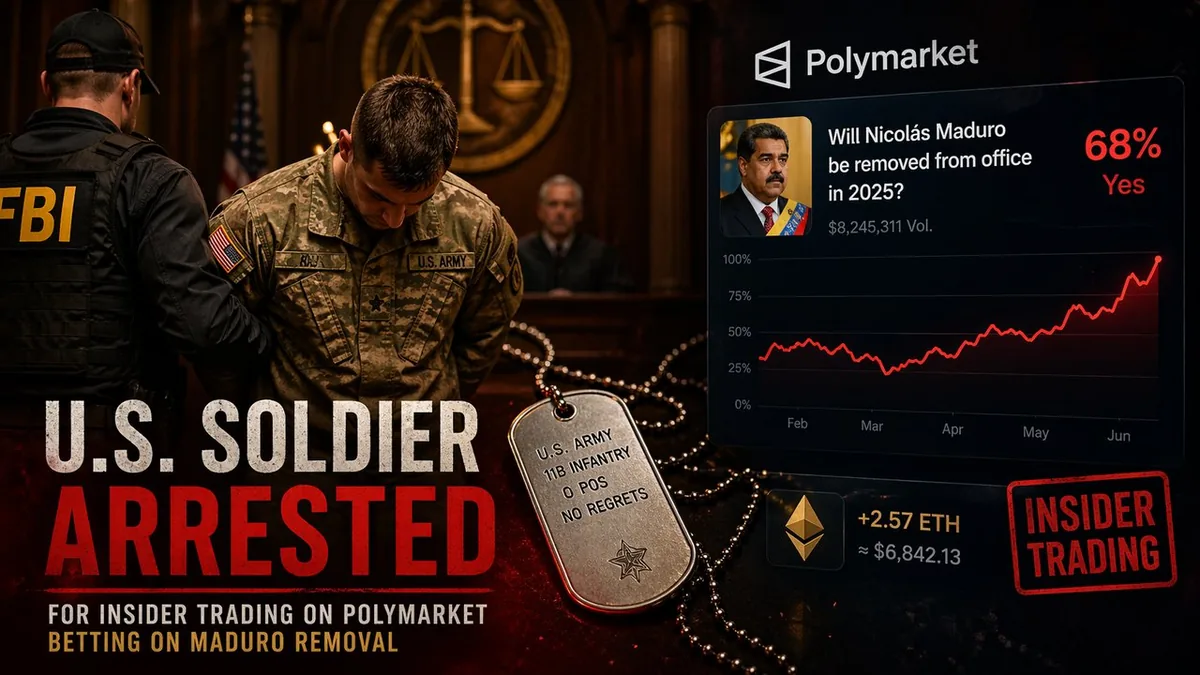
Gannon Ken Van Dyke, a US Special Forces soldier who participated in Operation Absolute Resolve — the operation that resulted in the capture of Nicolás Maduro — allegedly used classified intelligence to bet on Venezuelan prediction markets and walked away with $400,000. The Department of Justice arrested him on April 23, 2026, in what may be the first major insider trading case on a decentralized prediction market.
What He Actually Did
Between December 27, 2025 and January 26, 2026, Van Dyke opened a Polymarket account and placed 13 bets totaling approximately $33,034 on Venezuela-related markets. He had knowledge unavailable to the public about the operation and its likely outcome. He turned that $33K into over $400,000. The DOJ charges him with violating the Commodity Exchange Act, wire fraud, and unlawful monetary transactions.
Acting Attorney General Todd Blanche put it plainly: "Our men and women in uniform are trusted with classified information and are prohibited from using this highly sensitive information for personal financial gain." The legal argument is straightforward even if the instrument — a crypto prediction market — is new.
Why This Is Different from a Stock Tip
Insider trading on stock markets is well-understood: you have non-public information, you trade on it, you go to prison. Prediction markets have operated in a legal grey zone for years, partly because regulators treated them as curiosities. The DOJ's decision to bring Commodity Exchange Act charges challenges that framing directly. If prediction market bets on classified information constitute commodity fraud, the legal exposure for the sector just expanded significantly.
What This Means for Polymarket
Polymarket has positioned itself as an information aggregation tool — a way for crowds to bet on outcomes and surface collective intelligence. That framing is now under serious pressure. If the platform is a regulated financial instrument subject to commodity law, every politically or militarily sensitive market on Polymarket carries new risk. The platform itself likely bears no liability here, but the case changes the calculus for any government official who ever considers using it.
My Take
The surprise isn't that someone tried this. The surprise is how small the bet was. $33,000 initial investment for someone with that kind of informational edge is almost cautious. The bigger concern isn't Van Dyke — it's the hundreds of contractors and intelligence officials who now have Polymarket on their phones and have watched someone turn a $33K edge into $400K. This case is a warning shot, not a fix.
Related Articles
- Justin Sun Is Suing Trump-Linked World Liberty Financial: Here's the Messy Reality
- Kalshi Suspended Three Congressional Candidates for Betting on Their Own Elections