Monday.com vs Trello vs Asana in 2026: The Head-to-Head Comparison

Monday.com, Trello and Asana are still the three most popular project-management platforms in 2026, but all three have been reshaped by a year of aggressive AI rollouts: monday's Sidekick and AI agents, Atlassian's Rovo layer inside Trello, and Asana's no-code AI Studio and AI Teammates. This head-to-head breaks down current pricing, free-plan limits, AI capabilities and scalability so you can match the right tool to your team size and budget. The short version: Trello wins for simplicity and small teams, Asana for structured mid-size workflows, and monday.com for flexible, scaling, AI-heavy operations.
Key takeaways:
- Trello is the cheapest and simplest, with the most usable free plan, making it ideal for small teams and straightforward Kanban work.
- Asana hits the sweet spot for structured, mid-size teams that need dependencies, portfolios and goals without enterprise-level complexity.
- Monday.com is the most flexible and AI-aggressive platform, best for scaling, operations-heavy organisations willing to invest setup time.
- All three added major AI in 2025–2026: monday's Sidekick/AI Agents, Atlassian's Rovo inside Trello, and Asana's AI Studio and AI Teammates.
- Watch for hidden costs: monday.com's 3-seat minimum, Asana's add-on AI pricing and AI-credit metering all raise the true price beyond the headline per-seat figure.
Monday.com vs Trello vs Asana: Quick Comparison
| Monday.com | Trello | Asana | |
|---|---|---|---|
| Free plan | Up to 2 seats, 3 boards | Up to 10 collaborators | Up to 2 users |
| Cheapest paid | $9/seat/mo (Basic) | $5/user/mo (Standard) | $10.99/user/mo (Starter) |
| AI in 2026 | Sidekick + AI Agents | Atlassian Rovo | AI Studio + AI Teammates |
| Best for | Scaling ops teams (100+) | Small teams & Kanban | Structured mid-size teams |
| Main limitation | Complex setup; seat minimum | Thin reporting at scale | Cost climbs; advanced setup |
Monday.com
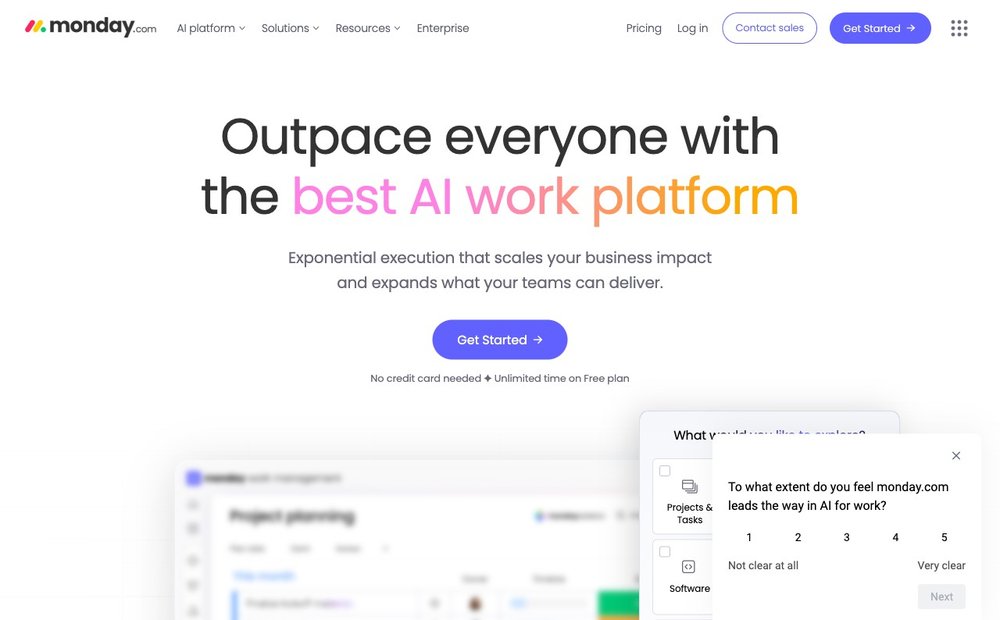
Pricing. Free (up to 2 seats, 3 boards). Paid plans bill per seat/month annually with a 3-seat minimum: Basic $9/seat/mo, Standard $12/seat/mo (most popular — adds timeline/Gantt, 250 automation/integration actions/mo, guest access), Pro $19/seat/mo (private boards, 25,000 actions/mo). Enterprise is custom-quoted; monthly billing runs ~18–25% higher.
AI in 2026. monday AI is a full platform layer in 2026, metered by AI credits per tier (~1,000/mo Basic up to ~20,000 Enterprise). Sidekick (out of beta since Jan 2026) answers questions about your data, writes and debugs automation formulas and drafts updates; AI Blocks power AI in the Workflow Builder; AI Agents act as semi-autonomous digital workers; and Vibe builds mini-apps from a prompt.
Best for. Operations-heavy and scaling teams (often 100+ users) that want one flexible 'Work OS' to run many departments with custom data structures, dashboards and automations.
Strengths. Highly visual, customisable Work OS data model; the deepest native automation and most aggressive AI-agent platform of the three; strong cross-board dashboards and reporting.
Main weakness. Flexibility brings complexity and a steeper setup curve, and the 3-seat minimum plus AI-credit metering make the true per-person and AI cost higher than it first appears.
Trello
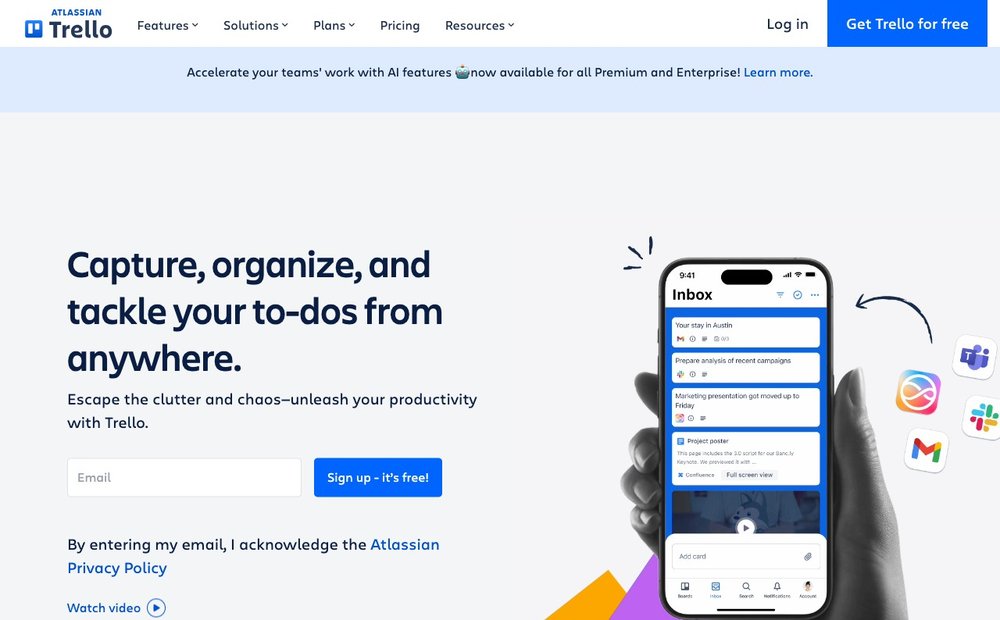
Pricing. Free forever (up to 10 boards and 10 collaborators per Workspace, 250 automation runs/mo). Paid per user/month billed annually: Standard $5/user/mo (unlimited boards, advanced checklists, 1,000 automation runs), Premium $10/user/mo (Timeline, Calendar, Dashboard, Map and Table views, unlimited automation, AI content, admin controls), Enterprise $17.50/user/mo with a 50-seat minimum.
AI in 2026. Trello plugs into Atlassian's cross-product Rovo / Atlassian Intelligence layer. In-card AI generates and transforms content (drafting and rewriting card descriptions and comments, grammar fixes, brainstorming), and boards are indexed for Rovo with full respect for permissions. Rovo Chat and Rovo Agents (now generally available, with no-code Rovo Studio) extend AI search and task execution across Trello, Jira, Confluence and connected apps.
Best for. Small teams, freelancers, startups and individual departments (typically under ~20 users) running simple, visual, linear Kanban workflows that need almost zero setup.
Strengths. The simplest and fastest to learn of the three; a genuinely useful free plan; clean Kanban-board UX plus access to Atlassian's broader Rovo AI ecosystem.
Main weakness. Kanban-first structure gets limiting as projects scale: dependencies, goal tracking and multi-team reporting need paid Power-Ups or third-party add-ons, and native reporting stays thin.
Asana
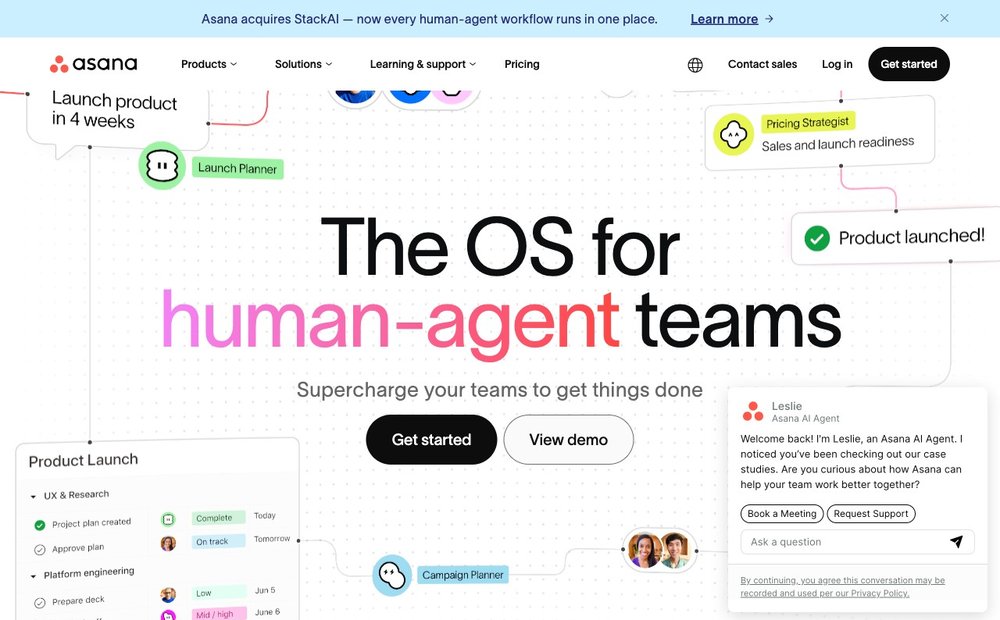
Pricing. Personal (free, up to 2 users, unlimited projects). Paid tiers bill per user/month annually with a 2-user minimum: Starter $10.99/user/mo (~$13.49 monthly), Advanced $24.99/user/mo (~$30.49 monthly). Enterprise and Enterprise+ are sales-quoted (commonly cited around $35 and $45/user/mo). AI Studio Plus is a paid add-on (~$135/account/mo annually).
AI in 2026. Asana AI centres on AI Studio, a no-code builder for AI-powered workflows, plus AI Teammates: customisable AI agents you describe in plain language, with ~30 prebuilt teammates (e.g. Campaign Brief Writer, Workflow Optimizer). AI is metered as AI Studio credits per account (50K/mo Starter, 75K Advanced, 200K Enterprise). Agentic Work Management ties together AI Teammates, AI Studio, Asana Dash and AI connectors.
Best for. Mid-size teams and cross-functional groups (roughly 20–200 users) that juggle deadlines, dependencies and multiple stakeholders and want structured projects, portfolios and goals.
Strengths. Best balance of structure and usability; strong project hierarchy, dependencies, portfolios and goals; polished no-code AI Studio and prebuilt AI Teammates for repeatable workflows.
Main weakness. Per-user pricing climbs fast for larger teams, advanced and AI features sit at higher tiers or paid add-ons, and portfolios, goals and advanced automation take real time to configure.
The Verdict: Which Should You Choose?
For small teams, freelancers and anyone who wants a free, visual, near-zero-setup tool, Trello wins. Mid-size teams that need structured projects, dependencies and goals without enterprise complexity are best served by Asana. Larger, operations-heavy organisations that want a flexible, customisable platform with the most aggressive AI-agent automation should choose monday.com, accepting a steeper setup curve and higher effective cost.
Sources & Further Reading
- Monday.com official pricing and plans
- Trello pricing page
- Asana pricing: Personal, Starter, Advanced & Enterprise
- Atlassian Rovo AI features
- Asana AI Studio and AI Teammates
Frequently Asked Questions
Which is cheapest: Monday.com, Trello or Asana?
Trello is the cheapest paid option, starting at $5/user/month on its Standard plan, and it also has the most generous free tier (up to 10 collaborators per Workspace). Monday.com's lowest paid plan is $9/seat/month but enforces a 3-seat minimum, and Asana's Starter plan is $10.99/user/month with a 2-user minimum. For free use, Trello supports the most people, while monday.com and Asana free plans cap out at 2 users.
Which platform has the best AI in 2026?
It depends on what you need. Monday.com offers the most aggressive AI-agent platform with Sidekick, AI Blocks and autonomous AI Agents metered by credits. Asana's AI Studio and prebuilt AI Teammates are the most approachable no-code way to build AI workflows. Trello taps Atlassian's broader Rovo layer, which is powerful across the Atlassian suite but lighter inside Trello itself, focused mainly on card content generation.
Is Trello good enough, or should I pay for Asana or Monday.com?
Trello is excellent for small teams, freelancers and simple visual Kanban workflows, and its free plan covers a lot. You should consider Asana or monday.com once you need project dependencies, portfolios, goal tracking, multi-team reporting or heavier automation, since Trello requires paid Power-Ups or third-party add-ons to handle that complexity.
What's the best project tool for a large or scaling company?
Monday.com is generally the strongest fit for larger or fast-scaling organisations because its Work OS architecture lets teams build custom apps and data relationships across many departments. Asana scales well for structured mid-size teams up to a few hundred users. Trello tends to create visibility gaps at scale because it grows by adding more boards rather than adding structure.
Do these tools charge extra for AI?
AI access is tied to plan tiers and usage. Monday.com and Asana meter AI by credits that increase with higher plans, and Asana sells AI Studio Plus as a paid add-on (around $135/account/month). Trello's in-card AI is included on paid plans, while the wider Rovo platform may carry its own Atlassian licensing. In all three, heavier AI usage can push your real cost above the base per-seat price.
Recommendations are based on public information, vendor pages and independent reviews current as of June 2026. Prices, plans and product details change frequently — please verify on the official site or retailer before buying. SaveDelete may earn a small commission on purchases made through links on this page, at no extra cost to you.