Hamachi Alternatives For Virtual LAN Gaming
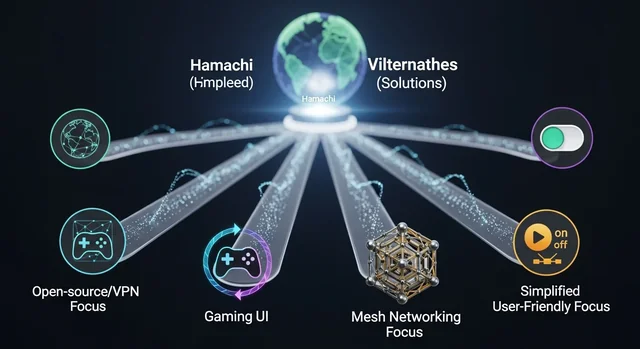
Best Hamachi Alternatives for Virtual LAN Gaming in 2025
The virtual LAN gaming landscape has evolved significantly in 2025, with numerous powerful alternatives to Hamachi emerging that offer better performance, enhanced security, and more flexible networking options. While Hamachi remains functional, its 5-player limitation and occasional connectivity issues have pushed gamers toward more robust solutions that eliminate the need for complex port forwarding and provide seamless NAT traversal.
Modern virtual LAN solutions leverage advanced technologies like WireGuard encryption, mesh networking, and peer-to-peer architectures to deliver superior gaming experiences. Whether you're hosting retro LAN parties for classic games or setting up dedicated servers for modern multiplayer titles, these Hamachi alternatives provide the reliability and performance that serious gamers demand in 2025.
Understanding Virtual LAN Gaming in 2025
Virtual Local Area Networks (VLANs) simulate the experience of traditional LAN parties by creating secure tunnels between geographically distributed players. This technology enables gamers to play legacy titles that lack modern online multiplayer support, host private servers, and enjoy reduced latency compared to traditional internet-based gaming.
Learn more in our article about 25 Best Game Apps for iPad Available For Free Download.
Key Features Modern VPN Gaming Solutions Offer
- Zero-configuration networking - Automatic peer discovery and connection establishment
- NAT traversal capabilities - Bypasses router restrictions without manual port forwarding
- Cross-platform compatibility - Support for Windows, macOS, Linux, and mobile devices
- Enterprise-grade encryption - WireGuard and similar protocols ensure secure connections
- Mesh networking topology - Direct peer-to-peer connections for optimal performance
- Dynamic IP management - Automatic assignment and management of virtual network addresses
Top 7 Hamachi Alternatives for 2025
1. ZeroTier - Open-Source Peer-to-Peer Excellence
ZeroTier stands out as the most comprehensive open-source alternative to Hamachi in 2025. Built on a robust peer-to-peer architecture, ZeroTier creates software-defined networks that behave like traditional Ethernet switches, providing exceptional performance for gaming applications.
Key Features:
- Support for up to 25 devices on free networks
- Sub-10ms latency optimization for gaming
- Advanced network rules and access control
- Self-hosted controller options for complete privacy
- Automatic mesh optimization and failover
Pricing (2025): Free for up to 25 devices per network, Professional plans start at $5/month for unlimited devices and advanced management features.
Gaming Performance: ZeroTier excels in gaming scenarios with its intelligent routing algorithms that automatically select the fastest path between peers. The platform's moon servers provide reliable relay functionality when direct connections aren't possible.
2. Radmin VPN - Unlimited Free Gaming Solution
Radmin VPN has gained massive popularity among gamers in 2025 for its completely free unlimited usage model and exceptional stability. Developed by Famatech, this solution focuses specifically on gaming applications with optimized protocols for low-latency connections.
Key Features:
- Unlimited users and networks completely free
- Gaming-optimized connection protocols
- Integrated text and voice chat functionality
- Automatic game detection and optimization
- One-click network joining with invitation codes
Pricing (2025): Completely free with no limitations or premium tiers.
Gaming Performance: Radmin VPN consistently delivers ping times under 20ms for most connections and includes built-in game-specific optimizations for popular titles like Age of Empires, Counter-Strike, and Minecraft.
3. Tailscale - WireGuard-Based Mesh Network
Tailscale leverages the cutting-edge WireGuard protocol to create secure, high-performance mesh networks ideal for gaming. Its innovative approach to key management and network coordination has made it a favorite among technically-minded gamers in 2025.
Key Features:
- WireGuard encryption for maximum security and performance
- Automatic key rotation and certificate management
- MagicDNS for easy device discovery
- Subnet routing for complex network topologies
- Exit node functionality for shared internet access
Pricing (2025): Free for up to 20 devices, Personal Pro at $6/month for 100 devices, Business plans from $18/month per user.
Gaming Performance: Tailscale's WireGuard foundation provides exceptional throughput and minimal CPU overhead, making it ideal for bandwidth-intensive gaming sessions and streaming.
4. GameRanger - Dedicated Low-Ping Gaming Platform
GameRanger remains the go-to choice for retro gaming enthusiasts in 2025, supporting over 700 classic games with built-in matchmaking and lobby systems. Its specialized gaming focus and extensive game database make it irreplaceable for certain gaming communities.
Key Features:
- Support for 700+ classic and modern games
- Integrated game lobbies and matchmaking
- Friend lists and gaming communities
- Automatic game launching and configuration
- Built-in voice chat and messaging
Pricing (2025): Free with optional Gold membership at $19.95/year for priority support and enhanced features.
You might also be interested in How Does Antivirus Software Work? Complete Guide to Modern Threat Detection (2025).
Gaming Performance: GameRanger's game-specific optimizations ensure stable connections with minimal configuration required. The platform's dedicated servers provide reliable relay services for challenging network environments.
5. Wippien - Ultra-Lightweight 2MB VPN Solution
For users with limited bandwidth or older systems, Wippien continues to provide an incredibly lightweight VPN solution in 2025. At just 2MB, it's perfect for quick gaming sessions without the overhead of larger applications.
Key Features:
- Minimal 2MB installation footprint
- Instant messenger integration
- P2P file sharing capabilities
- No server infrastructure required
- Automatic peer discovery via IM networks
Pricing (2025): Completely free and open-source.
Gaming Performance: While basic, Wippien provides stable connections for simple gaming scenarios and works well on low-specification systems where other solutions might struggle.
6. FreeLAN - Highly Customizable Open-Source Solution
FreeLAN caters to advanced users who need complete control over their virtual networking setup. Its extensive configuration options and open-source nature make it ideal for custom gaming server deployments in 2025.
Key Features:
- Extensive configuration and customization options
- Multiple network topologies (client-server, peer-to-peer, hybrid)
- Advanced security features and certificate management
- Cross-platform compatibility with detailed logging
- API access for integration with other applications
Pricing (2025): Free and open-source with community support.
Gaming Performance: FreeLAN's performance depends heavily on configuration, but properly tuned setups can achieve excellent results for dedicated gaming communities.
Related: Is Romanceast Legit and Safe to Use? A Full Security Breakdown.
7. NetOverNet - Simple Virtual LAN Creation
NetOverNet focuses on simplicity and ease of use, making virtual LAN creation accessible to non-technical users in 2025. Its straightforward approach appeals to casual gamers who want quick setup without complex configuration.
Key Features:
- One-click network creation and joining
- Automatic IP address assignment
- Simple password-based network security
- Minimal resource usage
- Windows-focused optimization
Pricing (2025): Free for basic usage with premium features available.
Gaming Performance: NetOverNet provides adequate performance for most gaming scenarios with minimal configuration overhead, though it lacks the advanced optimization features of more sophisticated solutions.
Detailed Comparison: Hamachi vs Modern Alternatives
| Feature | Hamachi | ZeroTier | Radmin VPN | Tailscale | GameRanger |
|---|---|---|---|---|---|
| Free User Limit | 5 users | 25 devices | Unlimited | 20 devices | Unlimited |
| NAT Traversal | Basic | Advanced | Excellent | Excellent | Good |
| Gaming Optimization | Limited | Good | Excellent | Good | Excellent |
| Setup Complexity | Medium | Low | Very Low | Low | Very Low |
| Cross-Platform | Yes | Yes | Windows Only | Yes | Windows/Mac |
| Open Source | No | Yes | No | Partially | No |
| Average Ping | 15-50ms | 10-30ms | 10-25ms | 8-25ms | 12-35ms |
Advanced Features Comparison
Security and Encryption Standards
Modern Hamachi alternatives have significantly improved their security implementations in 2025. Tailscale leads with WireGuard encryption, providing state-of-the-art cryptographic protection. ZeroTier implements custom encryption protocols optimized for performance, while Radmin VPN uses industry-standard AES-256 encryption.
Network Topology and Scalability
The shift toward mesh networking has been a game-changer in 2025. Unlike Hamachi's hub-and-spoke model, modern alternatives create direct peer-to-peer connections when possible, reducing latency and eliminating single points of failure. ZeroTier and Tailscale excel in this area, automatically optimizing connection paths for maximum performance.
Platform Integration and Ecosystem Support
Integration with gaming platforms and development tools has become crucial. GameRanger maintains the largest database of supported games, while solutions like ZeroTier offer APIs for custom integrations. Mobile support has also improved dramatically, with most alternatives now offering full-featured mobile clients for remote network management.
Performance Optimization Tips for Virtual LAN Gaming
Network Configuration Best Practices
- Choose geographically close peers - Physical distance significantly impacts latency
- Optimize MTU settings - Adjust Maximum Transmission Unit size for your network conditions
- Use wired connections - Ethernet provides more stable performance than Wi-Fi
- Close bandwidth-intensive applications - Streaming and downloads can impact gaming performance
- Configure Quality of Service (QoS) - Prioritize gaming traffic on your router
Game-Specific Optimizations
Different games benefit from specific network configurations. Real-time strategy games like Age of Empires require consistent low latency, while first-person shooters need minimal jitter. Many modern alternatives include game-specific profiles that automatically optimize settings for popular titles.
For more details, check out our guide on Best Application Security Tools for SDLC (2025): Top SAST & DAST Solutions.
Troubleshooting Common Virtual LAN Issues
Connection Problems
When peers cannot connect, the issue often involves NAT traversal failures. Modern solutions like ZeroTier and Tailscale include diagnostic tools to identify and resolve these issues automatically. For persistent problems, manual relay server configuration may be necessary.
Performance Issues
High latency or packet loss typically indicates routing problems or bandwidth limitations. Most alternatives include built-in network diagnostics that can identify bottlenecks and suggest optimizations. Switching to different relay servers or adjusting encryption settings often resolves performance issues.
Future of Virtual LAN Gaming Technology
The virtual LAN gaming space continues to evolve rapidly in 2025, with several emerging trends shaping the future:
Cloud Gaming Integration
Integration with cloud gaming platforms is becoming increasingly important, allowing players to host virtual LAN sessions that include both local and cloud-based participants. This hybrid approach expands the possibilities for cross-platform gaming.
AI-Powered Network Optimization
Machine learning algorithms are being integrated into network optimization, automatically adjusting routing and configuration based on real-time performance data. This technology promises to make virtual LAN gaming more accessible to non-technical users.
Blockchain-Based Networking
Experimental blockchain-based networking solutions are exploring decentralized approaches to virtual LAN creation, potentially eliminating the need for central coordination servers entirely.
Frequently Asked Questions
What is the best free alternative to Hamachi in 2025?
Radmin VPN offers the best free alternative with unlimited users and gaming-optimized performance. For open-source solutions, ZeroTier provides excellent features with support for up to 25 devices at no cost.
Do these alternatives require port forwarding?
No, modern Hamachi alternatives like ZeroTier, Tailscale, and Radmin VPN include advanced NAT traversal capabilities that eliminate the need for manual port forwarding in most network configurations.
Which solution offers the lowest latency for gaming?
Tailscale generally provides the lowest latency due to its WireGuard-based architecture and optimized mesh networking. However, performance varies based on geographic location and network conditions.
Can I use these alternatives for non-gaming applications?
Yes, all mentioned alternatives support general networking applications including file sharing, remote desktop access, and business applications. Many users employ these solutions for secure remote access to home networks.
Are these solutions compatible with older games?
GameRanger specifically targets retro gaming with support for over 700 classic titles. Other solutions work with any game that supports LAN networking, regardless of age.
How secure are these Hamachi alternatives?
Modern alternatives generally offer superior security compared to Hamachi, with solutions like Tailscale using state-of-the-art WireGuard encryption and ZeroTier implementing custom security protocols designed for peer-to-peer networking.
Can I host dedicated game servers using these solutions?
Yes, all alternatives support dedicated server hosting. ZeroTier and Tailscale are particularly well-suited for this purpose due to their advanced networking capabilities and subnet routing features.
What happens if the service provider shuts down?
Open-source solutions like ZeroTier and FreeLAN can be self-hosted, providing independence from service providers. Commercial solutions typically offer data export and migration tools, though this varies by provider.
Do these alternatives work on mobile devices?
Most modern alternatives offer mobile apps for iOS and Android, allowing smartphones and tablets to participate in virtual LAN networks. This enables mobile gaming and network management on the go.
See also: Top 7 Best PlayStation Emulator (PS emulator for Android).
How do I migrate from Hamachi to a new solution?
Migration typically involves installing the new client, recreating your networks, and inviting existing members to join the new network. Most alternatives offer import tools or guides to simplify the transition process.