Xbox Project Helix: Microsoft Unveils $1,000 Console-PC Hybrid With Custom AMD Chip
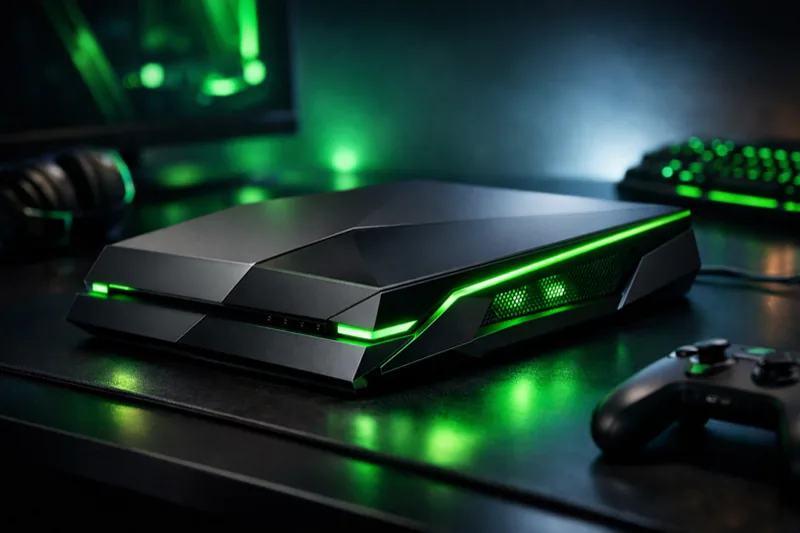
Microsoft just unveiled Project Helix, its next-generation Xbox console, at GDC 2026. It’s not just an upgrade — it’s a fundamental platform shift. Project Helix is a console-PC hybrid that plays both Xbox games and Windows PC games natively, powered by a custom AMD chip built on RDNA 5 architecture and TSMC 3nm process. Microsoft claims 20x improved ray tracing and 6x faster rasterization versus Xbox Series X. The catch? It might cost over $1,000. When your console costs as much as a gaming PC, you’ve essentially made a gaming PC with a controller UI.
What Is Project Helix?
Announced by Xbox VP Jason Ronald at GDC 2026, Project Helix has been in development for over a decade. The console features a custom AMD System-on-Chip that combines RDNA 5 GPU architecture with a dedicated Neural Processing Unit (NPU) capable of 110 TOPS at 6W. Only a fraction of the chip’s parameters are active during any given task, making it efficient despite its raw power.
The most significant feature: Project Helix runs both Xbox console games and Windows PC games natively. It uses “Xbox Mode,” a full-screen controller-optimized UI shell built on Windows. Microsoft is rolling out Xbox Mode to all Windows 11 PCs in April 2026 as preparation.
The Performance Claims
According to Microsoft and leaked specifications:
- 68 RDNA 5 compute units — 30% more than Xbox Series X, each reportedly 65% faster
- 48GB GDDR7 RAM
- 20x improved ray tracing and 6x faster rasterization versus Xbox Series X
- Native 4K at 120 FPS target
- AMD FSR Diamond — a next-gen upscaling suite with ML-based multi-frame generation and Ray Regeneration for path-traced games
If these numbers hold up in independent testing, Project Helix would be roughly twice as powerful as the PS5 Pro. But the fair comparison will be against PlayStation 6, which is expected to launch around the same timeframe.
AI-Powered Forward Compatibility
Perhaps the most interesting feature is “Forward Compatibility” — an AI system that uses Neural Rendering to automatically upscale legacy Xbox games to 4K resolution and 120 FPS with enhanced textures. No developer input required. This works across four generations: original Xbox, Xbox 360, Xbox One, and Xbox Series X/S games.
If this works as described, it could effectively kill the paid remaster industry. Why buy a $70 remaster when your console automatically upgrades the original game for free?
The $1,000 Problem
Microsoft hasn’t announced official pricing, but multiple sources estimate Project Helix will cost between $999 and $1,200. Tech journalist Moore’s Law Is Dead predicts “at least $1,000.” That puts it firmly in gaming PC territory and well above the traditional $499-$699 console price range.
This raises the obvious question: who is this for? Console gamers who want simplicity at a reasonable price? Or PC gamers who want a pre-built system? Microsoft seems to be betting that the line between console and PC no longer matters — but at $1,000+, they’re asking consumers to agree with that assessment upfront.
The Strategic Play
Project Helix isn’t just hardware — it’s a platform play. By running Windows natively, every PC game becomes an Xbox game automatically. Developers don’t need to create separate console ports. The Xbox Play Anywhere catalog already has 1,500+ titles that work across console and Windows.
Microsoft is essentially saying: we can’t beat PlayStation on exclusive games, so we’ll compete on platform breadth. If every Windows game runs on Xbox, the library gap disappears overnight.
The Bottom Line
Microsoft is betting $1,000+ that gamers want a console-PC hybrid. Project Helix promises generational performance leaps, AI-powered game upscaling, and the entire Windows game library — but at a price that blurs the line between console and gaming PC. Dev kits ship in 2027, with a consumer launch expected in late 2027 or 2028. The real question isn’t whether the hardware is impressive — it clearly is. The question is whether Microsoft can convince console gamers to pay PC prices for what is, underneath the Xbox Mode UI, essentially a gaming PC.