xAI Interplanetary AI Vision: What It Means
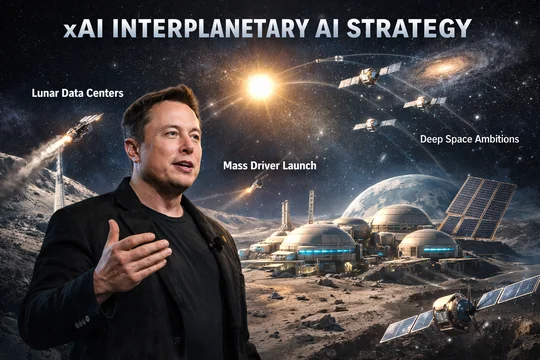
xAI Interplanetary AI Strategy Explained
Elon Musk isn’t just building better chatbots. He’s talking about building AI infrastructure on the Moon.
As reported by The New York Times [LINK TO SOURCE], xAI recently made public a full company all-hands meeting that revealed sweeping organizational changes, aggressive product growth, and a bold long-term plan centered on xAI interplanetary AI ambitions.
The headlines focused on layoffs and product metrics. But the real story is bigger: xAI is positioning itself for a future where AI isn’t just a software product—it’s planetary (and possibly interplanetary) infrastructure.
Let’s break down what actually matters.
Key Facts from the All-Hands
Here’s what we learned from the public meeting:
-
xAI restructured into four main divisions:
-
Grok chatbot (including voice features)
-
Coding systems
-
Imagine video generator
-
Macrohard project (AI that can simulate and operate full computer workflows)
-
-
Several employees were let go as part of the reorganization.
-
X reportedly crossed $1 billion in annual recurring subscription revenue.
-
The Imagine tool is generating:
-
50 million videos per day
-
Over 6 billion images in 30 days
-
-
Musk reiterated plans for space-based data centers, including:
-
Lunar AI satellite factories
-
A “mass driver” to launch infrastructure from the Moon
-
AI clusters powered by large-scale solar energy
-
One quote stood out. Musk said: “It’s difficult to imagine what an intelligence of that scale would think about.”
That line reveals more than hype—it signals intent.
Why xAI Interplanetary AI Actually Matters
This isn’t just a flashy space pitch. It reflects three deeper trends.
1. AI Is Becoming Infrastructure, Not Just Software
We’re moving from AI as a feature (chatbots, image tools) to AI as global infrastructure.
When Musk talks about space-based data centers, he’s acknowledging a looming constraint: energy. Advanced AI models require enormous computing power. That power requires massive energy inputs.
Terrestrial grids are already strained. Solar-powered orbital clusters? That’s a long-term bet on removing Earth-based energy limits.
For founders and operators, this matters. The next AI race won’t just be about algorithms—it will be about energy access and compute scale.
2. AI-Generated Content at Scale Is Accelerating
Generating 50 million videos a day isn’t just impressive. It’s disruptive.
The surge in AI-generated content at scale—including controversial deepfake material—shows how quickly generative tools can reshape digital platforms. Engagement spikes may boost revenue, but they also raise moderation, ethical, and regulatory concerns.
This presents a strategic question for platforms:
-
Do you prioritize growth metrics?
-
Or long-term trust and content integrity?
Expect regulators to watch this closely. The scale alone changes the conversation.
3. Organizational Restructuring Signals Product Focus
Splitting xAI into focused divisions reveals the real short-term roadmap:
-
Grok: conversational AI
-
Coding tools: developer productivity
-
Imagine: creative generation
-
Macrohard: AI that performs computer tasks autonomously
Macrohard is particularly interesting. According to its new lead, the goal is AI capable of doing anything a computer can do—including designing complex systems.
That’s not a chatbot. That’s autonomous operational AI.
If successful, this shifts AI from assistant to executor.
Practical Implications for Founders, Creators, and Investors
Here’s what to pay attention to next:
-
Compute Arms Race
Companies that secure long-term energy and compute advantages will dominate frontier AI. -
Regulatory Pressure on AI Content
Massive growth in AI-generated images and video will likely trigger stricter oversight. -
AI Automation Beyond Chatbots
Watch for tools that move from “helping humans” to “replacing workflows.” -
Platform Monetization Through AI Features
Subscription growth tied to AI capabilities suggests premium AI features will become standard.
If you’re building a business today, the takeaway is clear: AI strategy must consider infrastructure, compliance, and automation depth—not just surface-level features.
The Bigger Picture: Ambition as Strategy
It’s easy to dismiss talk of lunar factories and galaxy-scale AI as science fiction.
But historically, Musk’s companies use bold long-term visions to justify aggressive short-term execution.
The restructuring, the product segmentation, the public metrics—those are near-term plays. The Moon? That’s narrative leverage and strategic direction.
The xAI interplanetary AI concept reframes the company from a chatbot competitor to a civilization-scale computing project.
Whether that vision becomes reality is unclear.
But the strategic signal is unmistakable: AI companies are now competing not just on models—but on who can control the future of compute itself.
And that changes everything.