Why Amazon Bought Bee: The Future of AI Wearables
Why Amazon Bought Bee and What It Signals for AI Wearables
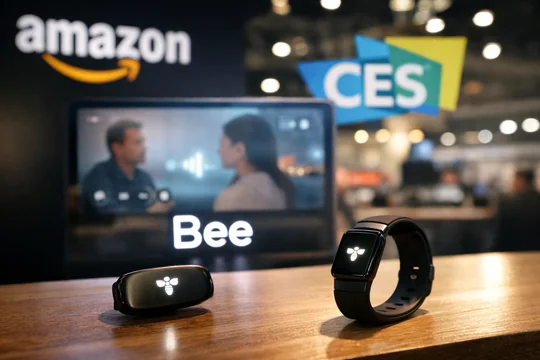
Amazon quietly made a telling move at CES 2026 by showcasing Bee, a small AI-powered wearable it recently acquired.
At first glance, Bee looks like just another gadget in an already crowded smart device market. But look closer, and Amazon’s acquisition reveals something bigger: a strategic shift toward AI that follows users everywhere, not just inside their homes.
This isn’t about replacing Alexa. It’s about extending Amazon’s AI reach into daily life.
Key Facts: What Is Bee and Why Did Amazon Buy It?
Bee is an AI wearable that can be worn as a clip-on pin or bracelet. Its core function is simple but powerful: it records conversations, transcribes them, and turns them into summaries, reminders, and insights.
Here’s what matters most:
-
Bee is designed for real-world, on-the-go use cases like meetings, classes, and interviews.
-
It acts as an AI companion that learns user habits and patterns over time.
-
It can integrate with services such as Gmail, Google Calendar, contacts, and Apple Health (with permission).
-
Audio recordings are discarded after transcription, prioritizing privacy but limiting playback use cases.
-
Amazon positions Bee as complementary to Alexa, not a replacement.
Amazon already dominates AI inside the home. Bee gives it a foothold everywhere else.
The Bigger Picture: Why This Move Matters
1. Amazon Is Betting on “Continuous AI”
Most AI assistants today are situational. You ask a question, get an answer, and move on. Bee represents a different model: continuous AI.
By learning from daily interactions, Bee builds a personal knowledge graph over time. That’s far more valuable than isolated voice commands. It allows AI to understand context, routines, and long-term behavior.
This aligns with a broader industry trend toward ambient computing—technology that works quietly in the background rather than demanding attention.
2. Wearables Are the Next AI Battleground
Smartphones were the gateway to mobile computing. Wearables may be the gateway to truly personal AI.
Apple has the Watch. Meta has AI-powered glasses. Amazon, until now, lacked a successful wearable AI story. Bee fills that gap without forcing Alexa into hardware that hasn’t resonated with consumers.
This acquisition suggests Amazon is choosing specialization over brute-force integration.
Bee vs. Alexa: A Complementary AI Strategy
Amazon executives and Bee’s founders have been clear: these products serve different environments.
- Bee understands life outside the house, while Alexa understands life inside the house.
This division of labor makes strategic sense. Instead of one AI trying to do everything poorly, Amazon is building a network of AI experiences that may eventually converge.
In the long term, this could mean:
-
Bee captures context during the day
-
Alexa acts on that context at home
-
Users get proactive assistance instead of reactive commands
That’s a powerful ecosystem play.
Practical Implications for Users and Businesses
For everyday users, Bee points to a future where AI handles cognitive overload. Instead of manually taking notes or remembering follow-ups, the device does it for you.
Early use cases already include:
-
Students recording and summarizing lectures
-
Professionals tracking meetings without note-taking
-
Elderly users getting memory support
-
Speakers and creators organizing their spoken ideas
For businesses and creators, this raises new questions about productivity, privacy, and AI trust. The fact that Bee deletes raw audio may ease adoption concerns while still delivering value.
What Comes Next for Bee and Amazon
Amazon hasn’t revealed a roadmap, but the signals are clear. Bee’s team is expanding features like voice notes, daily insights, and structured templates. Integration with Amazon’s own AI models is also on the table.
The real milestone will be convergence—when Alexa and Bee begin sharing intelligence seamlessly. When that happens, Amazon won’t just have smart devices. It will have a persistent AI presence across a user’s entire day.
That’s not a gadget upgrade. That’s a platform shift.
Frequently Asked Questions About Amazon Buying Bee
Q: What is Bee, and how does it work?
A: Bee is an AI wearable device that records conversations, transcribes them, and turns them into summaries, reminders, and insights. It learns user patterns over time to act as a personal AI companion.
Q: Why did Amazon buy Bee instead of expanding Alexa?
A: Amazon bought Bee to extend AI beyond the home. Alexa works best in fixed environments, while Bee is designed for mobile, real-world contexts like meetings, classes, and daily routines.
Q: Does Bee replace Alexa?
A: No. Amazon positions Bee and Alexa as complementary. Bee focuses on outside-the-home intelligence, while Alexa remains optimized for smart home and in-home interactions.
Q: Is Bee safe to use for privacy-sensitive conversations?
A: Bee discards audio recordings after transcription, which reduces privacy risks. However, this also limits use cases where audio playback is required for verification.