Where Tourism Is Growing Fastest in 2026: Brazil, Egypt, Ethiopia and Bhutan Lead the Charge
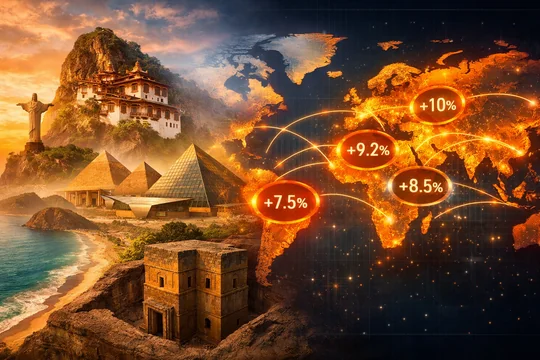
More than 1.5 billion international tourists travelled abroad in 2025, setting the stage for a record-breaking 2026. But according to the latest World Tourism Barometer published by UN Tourism, the fastest growth isn't happening where you'd expect. The biggest gains belong not to Europe's perennial favourites, but to a new wave of high-identity, emerging destinations that are rewriting the rules of global travel.
The Numbers That Matter
While Europe remained the world's most visited region — welcoming nearly 800 million arrivals and posting a solid 6% growth over 2024 — the real story lies elsewhere:
- Brazil: +37% in international arrivals — the largest year-on-year increase of any major destination
- Bhutan: +30% growth, fuelled by the country's unique high-value, low-volume tourism model
- Egypt: +20%, driven largely by the long-awaited opening of the Grand Egyptian Museum
- Ethiopia: +15%, contributing to Africa's continent-wide 8% increase — the strongest regional growth globally
- Seychelles: +13%, broadening beyond its traditional honeymoon market
"These countries fall into a growing category of high-identity, emerging destinations that are no longer niche but not yet saturated," said Steven Vigor, CEO of travel advisory firm Revigorate. "More travellers are now drawn to distinctive culture, landscapes and the possibilities of discovery."
Brazil: The Biggest Surge
No destination recorded a larger year-on-year increase than Brazil, and much of that growth has been deliberate. In 2024, Embratur (the Brazilian Agency for International Tourism Promotion) launched a promotional campaign across 40 countries, backed by significant investment in air connectivity — new direct routes and expanded capacity on existing ones.
"Achieving the growth targets for international tourism in Brazil is intrinsically linked to air connectivity," said Marcelo Freixo, president of Embratur. "There is no point in the growing international interest in getting to know Brazil if there are no direct flights or short connections at a competitive price."
Major events — including the Olympic legacy in Rio, the Football World Cup, the São Paulo Grand Prix, and the upcoming COP30 in Belém — have also transformed international perception. The profile of visitors is changing too: the "conscious luxury seeker" is replacing the bucket-list tourist, with executives travelling with families and prioritising wellness, nature, and time.
Egypt: The Grand Museum Effect
With a 20% jump in international arrivals, Egypt emerged as one of the strongest performers in the Middle East. The biggest driver has been the long-awaited opening of the Grand Egyptian Museum — a project more than 20 years in the making.
"It took more than 20 years and was announced multiple times before it finally and truly opened," said Jorge Salas-Guevara, founder of New Paths Expeditions. Tour operators report a nearly 50% increase in enquiries from 2024 to 2025, with a perceived improvement in safety encouraging more families and female solo travellers.
To manage visitor volumes, operators are increasingly encouraging slower, more curated experiences — small dahabiyas (traditional wooden sailboats) on the Nile instead of large cruise ships, and even bike tours through less-travelled routes. "Active travel is booming right now, and bike travel is completely new to Egypt," said Laurens Winkel, CEO of Boat Bike Tours.
Ethiopia: Africa's Rebound Story
Ethiopia recorded a 15% increase in international arrivals in 2025, contributing to Africa's continent-wide 8% increase. The rebound follows several years of depressed numbers linked to the conflict in the Tigray region. Since the peace agreement, the country has made significant investments in accessibility and traveller confidence, including the launch of the Visit Ethiopia platform.
Tour operators describe Ethiopia as one of the world's richest destinations for archaeology, anthropology, and natural history — from the legacy of the Axumite Empire and the rock-hewn churches of Lalibela to the Simien Mountains and the Danakil Depression.
Seychelles: Beyond the Honeymoon
The Seychelles posted a 13% rise in arrivals, positioning itself as a leader in marine conservation — protecting 30% of its ocean territory — while broadening its appeal beyond traditional honeymoon travel. Families and wellness-focused travellers are increasingly drawn to the islands, which pride themselves on inclusivity, with no private beaches anywhere in the archipelago.
The Bigger Picture
What connects all these destinations isn't luck — it's investment and identity. Brazil invested in air routes and global campaigns. Egypt bet on a world-class museum. Ethiopia rebuilt traveller confidence. Seychelles diversified its market. The countries winning in 2026 are those that made deliberate strategic choices, not those simply coasting on existing reputation.
As the era of "discovery travel" accelerates, the global tourism map is being redrawn — and the destinations investing in accessibility, authenticity, and sustainability are the ones leading the charge.
Source: BBC Travel, UN Tourism World Tourism Barometer
Related Articles
- US Work Visa Delays: Why Tech Employees Are Staying Put
- IndiGo Flight Cancellations and India's Aviation Future
- Leaked Xbox Memo: Game Pass Has Become Too Expensive
Sources
Related Articles
- US Work Visa Delays: Why Tech Employees Are Staying Put
- IndiGo Flight Cancellations and India's Aviation Future
- Leaked Xbox Memo: Game Pass Has Become Too Expensive