Waymo Self-Driving Cars Face Door Problem
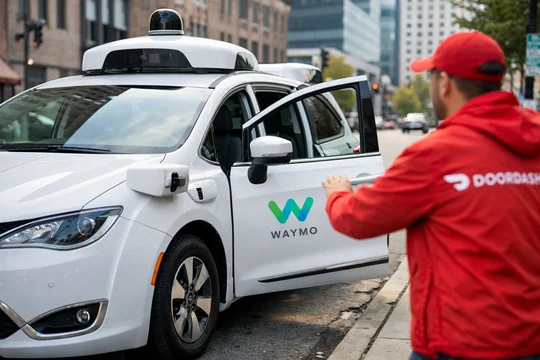
Waymo Self-Driving Cars Face a Surprising Problem
Even the most advanced AI-powered vehicles can be stopped by something as simple as an open door.
Waymo self-driving cars are occasionally being immobilized when passengers leave a door ajar. In response, Waymo and DoorDash launched a pilot program in Atlanta that pays nearby gig workers to close the doors so vehicles can get back on the road.
It sounds almost ironic. But it also reveals something important about the current state of automation.
Let’s break down what’s really happening—and why it matters.
The Key Facts Behind the Self-Driving Car Door Issue
Here’s what we know:
-
Waymo operates autonomous vehicles across six U.S. cities.
-
If a passenger leaves a door open, the car cannot move.
-
In Atlanta, DoorDash drivers can earn $6.25 (plus a completion bonus) to close the door.
-
Similar programs exist elsewhere, with higher payouts reported in Los Angeles.
-
Waymo says future vehicles will include automated door closures.
In a joint statement, the companies described it as a “pilot program” designed to improve autonomous vehicle fleet efficiency.
This is not a glitch in AI navigation. It’s a hardware and safety limitation—one that highlights how physical-world automation still depends on human backup.
Why Waymo Self-Driving Cars Still Need Humans
The bigger story isn’t about a door. It’s about infrastructure.
Autonomous vehicles are incredibly sophisticated when it comes to perception, mapping, and driving logic. But they still operate in messy, unpredictable human environments. A half-inch gap in a car door can freeze a million-dollar fleet asset.
For business leaders and tech watchers, this matters for three reasons:
-
Automation isn’t binary. It’s not “fully autonomous” or “fully manual.” Most systems exist in hybrid form.
-
Edge cases drive cost. Rare events—like an open door—can create outsized operational inefficiencies.
-
Human gig labor is becoming automation’s safety net.
Waymo raised billions to expand internationally. Yet, in certain moments, it relies on gig workers to physically intervene. That’s not a failure—it’s a design choice.
And it reflects a broader industry trend: robotics and AI often scale faster than the real-world support systems around them.
The Hidden Cost of Autonomous Vehicle Fleet Efficiency
Every idle autonomous car represents lost revenue.
Unlike human drivers, robotaxis can theoretically operate almost nonstop. That makes uptime critical. A vehicle stuck on the curb doesn’t just miss one ride—it creates traffic disruption and reduces network availability.
Paying a gig worker $10–$20 to fix the issue quickly is economically rational.
In fact, this small pilot program shows how companies are:
-
Using on-demand labor to reduce downtime
-
Outsourcing micro-maintenance tasks
-
Testing lightweight operational fixes before hardware redesign
From a cost perspective, it’s cheaper to crowdsource the solution temporarily than to halt expansion while redesigning door systems.
What This Means for the Future of Waymo Self-Driving Cars
This situation points to several likely next steps.
1. Hardware upgrades are coming.**
Waymo has already indicated future vehicles will have automated door closures. Expect more redundancy built into physical systems.
2. Micro-task gig work may expand.
Today it’s closing doors. Tomorrow it could be wiping sensors, repositioning vehicles, or handling minor resets.
3. “Autonomous” will remain partially human for years.
Despite headlines, the transition to full independence will be gradual. Hybrid models—AI plus distributed human assistance—are likely to dominate.
For entrepreneurs and operators, the lesson is clear: design for friction. Every advanced system needs a fallback layer.
If you’re building in AI, robotics, or automation, consider asking:
-
What happens when a user misuses the system?
-
What’s the lowest-cost human intervention model?
-
Can micro-tasks protect uptime without hurting margins?
These are operational strategy questions, not engineering problems alone.
The Bigger Picture: Automation Is Iterative
The open-door issue doesn’t undermine Waymo self-driving cars. If anything, it highlights how iterative real-world innovation really is.
Breakthrough technologies rarely fail because of core intelligence. They stall because of small physical-world constraints.
And companies that acknowledge those gaps—and solve them creatively—tend to win.
Waymo’s pilot program shows that the future of autonomy isn’t purely robotic. It’s collaborative.
As the industry evolves, expect more stories like this—where AI handles the complex, and humans handle the edge cases. For now, Waymo self-driving cars may need help closing doors. But they’re still opening new pathways for mobility innovation.