Waabi Robotaxi Expansion and Uber’s Big Autonomous Bet
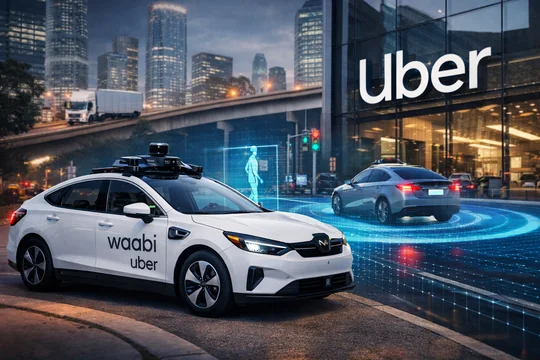
Waabi’s Robotaxi Expansion: What This Moment Really Means for Autonomous Vehicles
Autonomous driving startup Waabi has secured a massive new round of funding and announced a major partnership with Uber. On the surface, it’s another billion-dollar headline in the self-driving space. Look closer, and this move may signal a deeper shift in how autonomous vehicles are built, funded, and scaled.
Waabi’s robotaxi expansion is not just about adding cars to Uber’s platform. It’s a test of whether a leaner, AI-first approach can finally succeed where data-hungry, capital-heavy models have struggled.
Key Facts at a Glance
-
Waabi raised $1 billion in new capital.
-
The round includes $750M in Series C funding and $250M from Uber, tied to deployment milestones.
-
Uber plans to host 25,000+ Waabi-powered robotaxis exclusively on its platform.
-
This marks Waabi’s first move beyond autonomous trucking into passenger vehicles.
-
Waabi’s total funding now stands at roughly $1.28 billion.
Those are the headlines. The real story lies in how Waabi plans to deliver on them.
Why Waabi’s Robotaxi Expansion Matters Now
1. A different bet on autonomy
Most autonomous vehicle programs over the past decade followed the same playbook: massive fleets, endless real-world data collection, and enormous burn rates. Many of those efforts stalled or shut down.
Waabi is taking the opposite approach. Its core system, known as the Waabi Driver, is trained primarily in a closed-loop simulator called Waabi World. Instead of relying on millions of real-world miles, the system learns through high-fidelity digital environments that stress-test edge cases at scale.
CEO Raquel Urtasun describes it as a system that can “reason about its surroundings like a human,” learning from mistakes without armies of human labelers.
2. One AI stack, multiple markets
Historically, robotaxis and autonomous trucking evolved as separate technical stacks. Waabi is betting that a generalizable AI architecture can power both.
That’s a bold claim—especially given that players like Waymo once attempted a dual approach before retreating from trucking. If Waabi succeeds, it could redefine how autonomous systems are developed across industries, from ride-hailing to logistics and eventually robotics.
3. Uber’s platform-first strategy
Uber no longer builds its own autonomous vehicles. Instead, it acts as a global deployment layer for AV partners. With the launch of Uber AV Labs, the company is doubling down on this role.
For Waabi, this means instant access to a massive ride-hailing network without needing to build consumer-facing infrastructure from scratch. For Uber, it’s a diversified bet across multiple AV companies rather than a single in-house solution.
Practical Implications and What Comes Next
Here’s what readers—especially those tracking mobility, AI, or logistics—should watch closely:
-
Deployment timelines: No firm schedule has been announced. The pace of rollout will be a key signal of whether Waabi’s simulation-first approach delivers faster commercialization.
-
OEM partnerships: Waabi plans to integrate its technology directly at the factory level, similar to its trucking strategy. The automaker it chooses will matter.
-
Cost curves: If Waabi truly needs fewer vehicles, chips, and data centers, it could reset expectations for AV unit economics.
-
Cross-industry spillover: Urtasun has hinted that robotics could be the next vertical. Success in robotaxis would make that leap far more credible.
In the near term, don’t expect robotaxis everywhere overnight. As Urtasun herself put it, “We’re still in the first innings of deployment.” But the structure of this deal suggests Uber and Waabi are thinking in decades, not quarters.
A Broader Trend: Leaner AI, Bigger Ambitions
The Waabi robotaxi expansion reflects a wider shift in AI development. Across sectors, companies are moving away from brute-force data strategies toward smarter simulation, reasoning-based models, and capital efficiency.
If Waabi can scale robotaxis and trucks using a single AI brain, it may prove that autonomy doesn’t require infinite data—just better intelligence.
That’s a lesson the entire AI industry is paying attention to.
Frequently Asked Questions About Waabi’s Robotaxi Expansion
What is Waabi’s robotaxi expansion?
Waabi’s robotaxi expansion refers to its move into autonomous passenger vehicles through an exclusive partnership with Uber. The company plans to deploy more than 25,000 self-driving cars powered by its Waabi Driver technology on Uber’s platform.
How is Waabi different from other autonomous vehicle companies?
Waabi relies heavily on simulation rather than massive real-world data collection. Its AI system is trained and validated in a closed-loop virtual environment, allowing it to learn faster with fewer vehicles and lower costs.
When will Waabi robotaxis be available on Uber?
There is no public timeline yet. The rollout depends on technical validation, vehicle integration, and meeting deployment milestones tied to Uber’s investment.
Will Waabi still focus on autonomous trucking?
Yes. Waabi continues to develop autonomous trucks and sees trucking and robotaxis as parallel markets powered by the same underlying AI technology.
Conclusion: A High-Stakes Experiment Worth Watching
Waabi’s robotaxi expansion is more than a funding announcement—it’s a real-world test of whether autonomous vehicles can finally scale without the excesses of the past. Backed by Uber and armed with a simulation-first AI strategy, Waabi is challenging long-held assumptions about what autonomy requires.
If it works, this model could define the next generation of self-driving systems. If it doesn’t, it will still reshape how the industry thinks about efficiency, generalization, and scale.
Either way, the race just entered a new phase.