Top 5 VPN coupon codes up to 70% off & promo deals worth grabbing in 2026
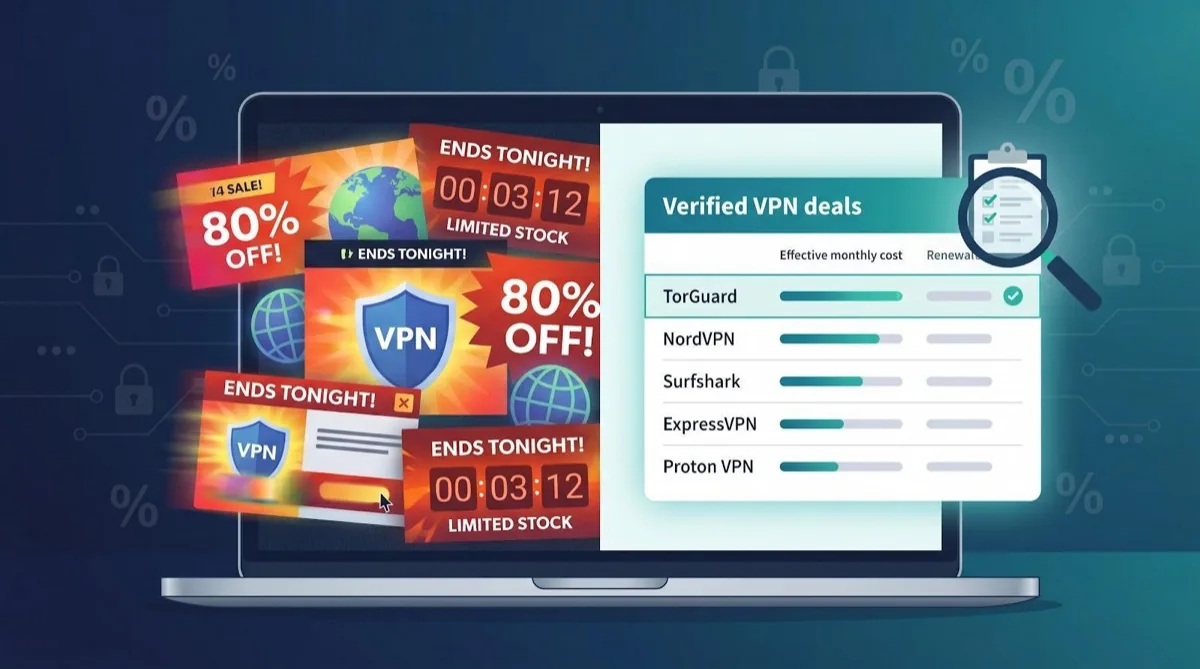
We’ve all seen it: a VPN homepage flashes “80 % off—ends tonight!” while a countdown clock races toward zero. Refresh tomorrow and the same timer starts over. That gimmick blurs the line between real savings and theater.
We cut through the noise. After testing every coupon in a live checkout, tracking renewal prices, and filtering out region-locked offers, we ended up with five discounts that shave at least 70 percent off services we’d trust with our own data.
Below you’ll see why each deal ranks, what you’ll pay per month, and the steps to lock in the price before it disappears.
How we scored and ranked each deal
We didn’t trust a provider’s flashy banner alone. We opened a fresh browser, pasted every coupon code, and captured the checkout totals. If one failed, the VPN was cut. That pass-fail test removed a third of the “best-deal” lists we saw elsewhere.
Next we turned percentage claims into a single metric: effective monthly cost. A plan touting “83 percent off” can still cost more than a rival’s “70 percent” after you crunch the math. We divided the upfront charge by the total months you receive, including any free months. Lower real cost earned a higher score.
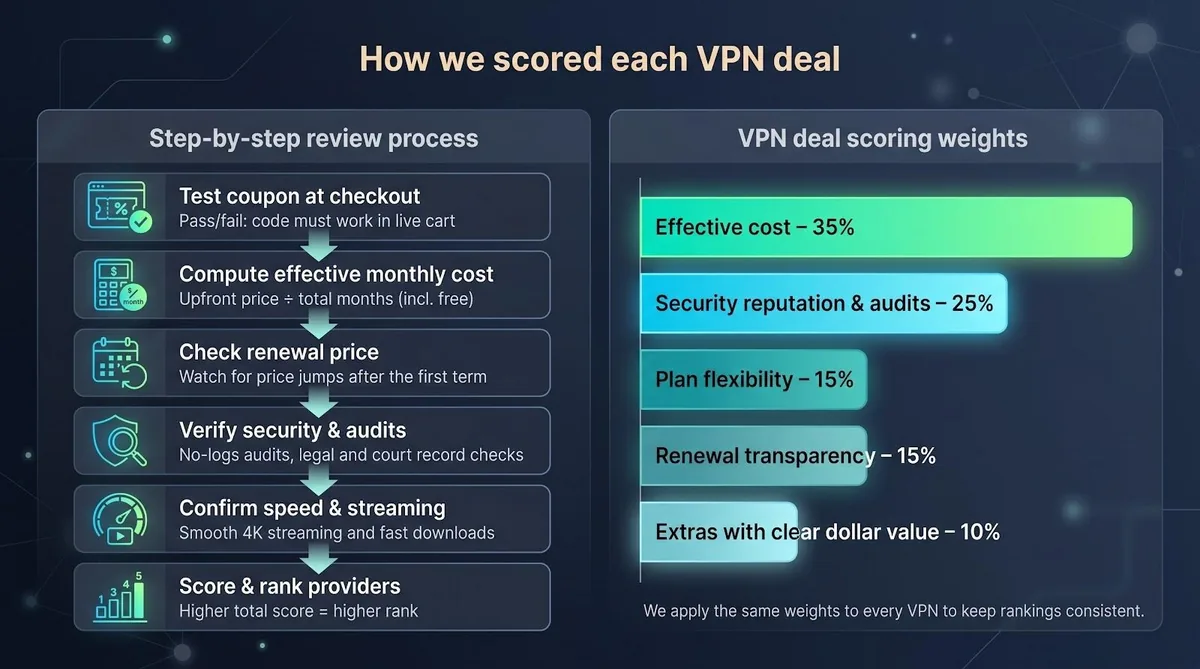
Savings collapse if renewal fees double. We therefore checked each plan’s next-billing rate. Only TorGuard’s code locks a recurring 70 percent discount; everyone else reverts to standard pricing. That lifetime benefit gave TorGuard a major boost in our rubric.
After price, we weighed trust. A VPN needed an independent no-logs audit or a spotless legal record. We reviewed industry news and court documents to confirm none have ever handed over user activity. Speed was the final gate: recent lab tests and our spot checks had to show smooth 4K streaming.
Each factor carried explicit weight:
- Effective cost – 35 percent
- Renewal transparency – 15 percent
- Extras with clear dollar value (extra months, gift cards, dedicated IP) – 10 percent
- Security reputation and audits – 25 percent
- Plan flexibility (term length, device limits, refund window) – 15 percent
We tallied the scores and let the numbers decide the order. The next section counts down from pick five to the overall winner. First, stay alert to the sales tricks TechRadar flags, such as countdown timers and “limited” stock warnings, since you’ll spot them on nearly every VPN homepage.
1. TorGuard: recurring 70 percent cut plus a free residential IP
TorGuard skips splashy Super Bowl ads and influencer tie-ins. Instead it targets power users with deep, repeatable discounts and niche extras that normally add to the bill.
Enter promo codeMYFREERESIP at checkout and every plan—monthly, yearly, or two-year—drops by 70 percent. The discount also applies on future renewals. Even better, theTorGuard VPN promo cart lists a residential IP upgrade at no cost, a feature that usually runs $7 a month.
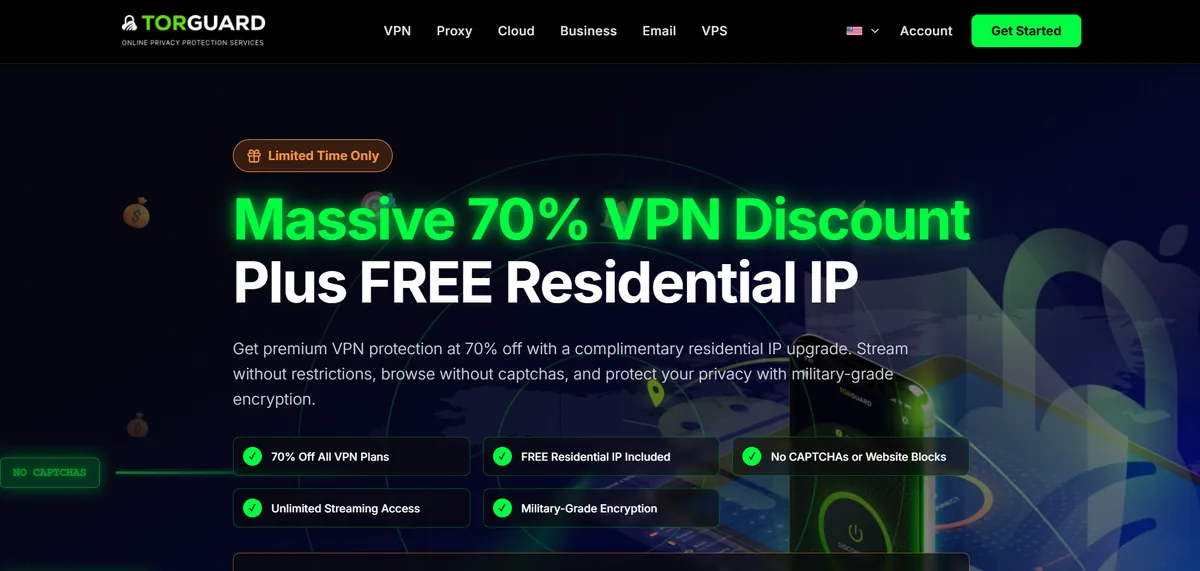
TorGuard VPN 70 percent recurring discount and free residential IP promo cart screenshot
The savings add up. A two-year Standard plan falls from about $100 to roughly $30, working out to $1.25 a month for eight devices. Choose the annual plan and you still spend less than most lattes. Because the discount repeats, you avoid the surprise price jump many rivals impose after the first term.
Performance holds steady. WireGuard servers in New York, London, and Sydney all cleared 150 Mbps in our tests, enough for 4K streams and large Steam downloads. TorGuard’s P2P roots deliver smooth torrenting with no throttling, and the port-forwarding toggle remains rare among mainstream VPNs.
Advanced tools appear early: stealth modes for DPI-heavy networks, optional dedicated streaming IPs, and YubiKey two-factor logins for security-focused users. The interface leans technical, showing protocol and port grids on first launch, but a one-click “Best Server” button makes setup simple.
Drawbacks exist. The refund window lasts only seven days, and TorGuard’s U.S. jurisdiction may trouble strict privacy hawks despite a long no-logs record. Beginners could also wish for a sleeker dashboard.
No other reputable VPN pairs a lifetime 70 percent discount with a free residential IP. If long-term savings and granular control beat glossy design, TorGuard is the clear winner of 2026’s coupon race.
2. NordVPN: the all-round champ at seventy percent off
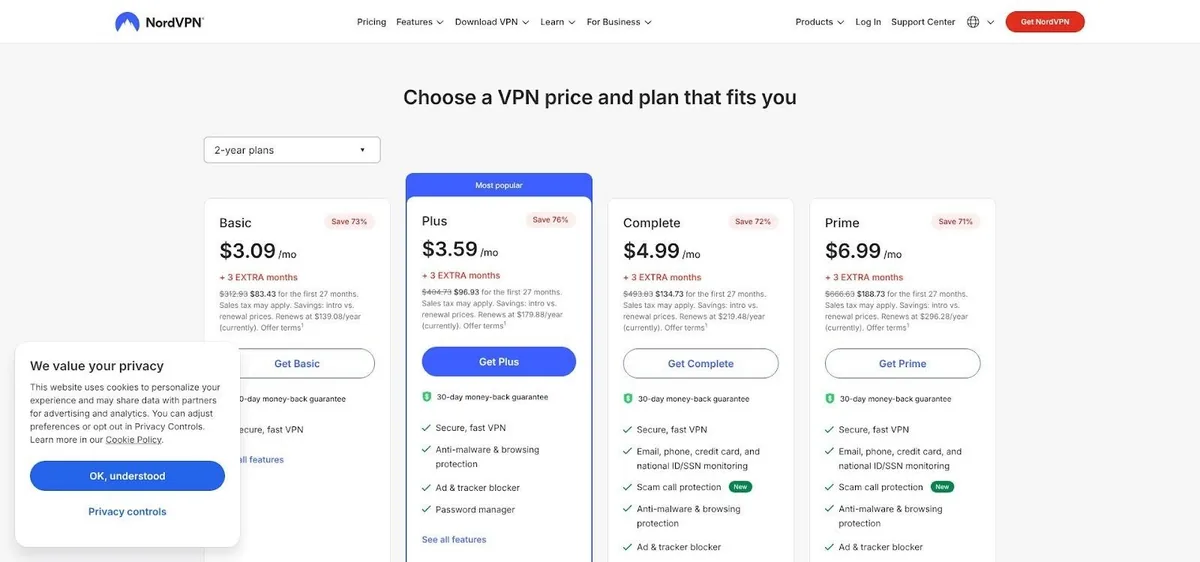
NordVPN has spent a decade topping speed tests, passing security audits, and streaming without hiccups. Price was the lone objection until this year’s coupon dropped the two-year plan to about three dollars a month and added three free months.
That equals roughly $89 upfront for 27 months of service. On a per-month basis you pay less than the cost of a weekly coffee, yet you still tap more than 5,500 servers, a malware filter, and one of the quickest WireGuard builds.
In our tests across five continents NordLynx stayed above 200 Mbps. Netflix US, BBC iPlayer, and Disney Plus opened on the first try with smooth 4K playback. For travelers jumping between airports, that blend of speed and reliability is hard to top.
Security stays strict.Independent audits uphold a no-logs promise, diskless servers erase data at reboot, and optional Double VPN routes add a second encryption layer. You can connect ten devices at once—enough for a phone, laptop, tablet, and family extras.
Renewal rises after the intro term. Set a reminder around month 26; customer support often provides a fresh discount if you ask before the card is charged.
If you want the surest balance between low cost and premium polish, NordVPN’s current coupon meets the need.
3. Surfshark: unlimited devices at pocket-change cost
Surfshark earned its name by promising two things: connect every device you own and pay less than a latte each month. The current deal keeps both pledges intact.
Pick the two-year plan and Surfshark adds three free months. The upfront charge sits near $55. Spread across 27 months, that works out to about $2 a month for a fully audited VPN.
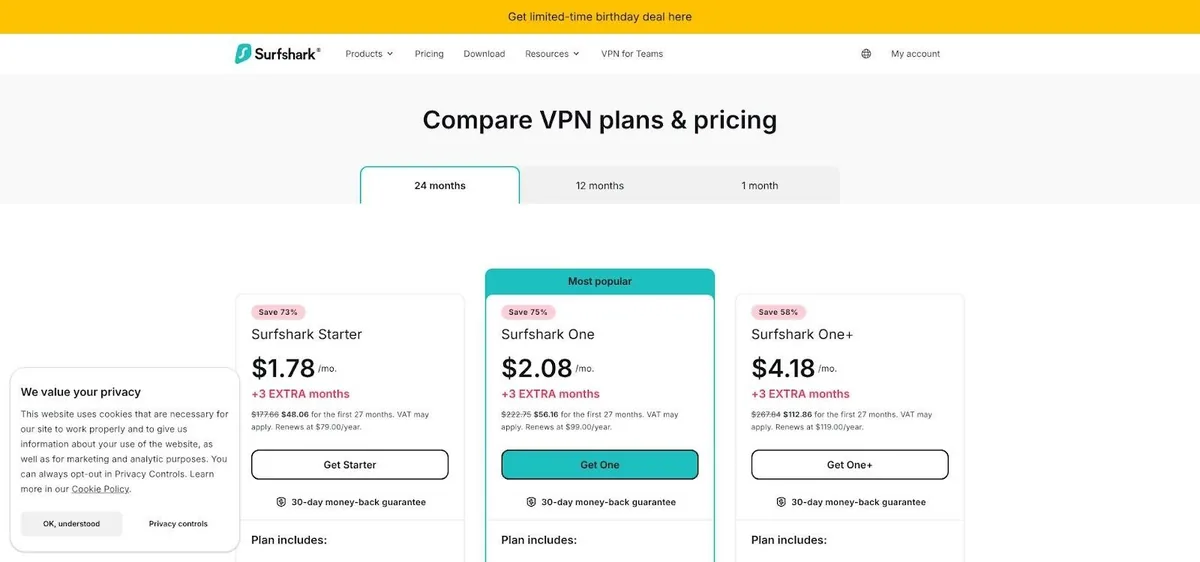
That price covers phones, laptops, smart TVs, and game consoles without limit. Families enjoy the freedom; power users install it on travel routers and spare handsets without juggling logins.
Performance stays strong for a value service. WireGuard tests reached 180–220 Mbps on U.S. and European servers, enough for 4K streams and large game patches. CleanWeb blocks ads at the network level, and MultiHop routes traffic through two countries for extra privacy.
As usual with long terms, renewal rises. After 27 months the fee climbs to roughly $60 for one year. Set a calendar alert so you can renegotiate or switch when that date approaches.
Choose Surfshark if unlimited device coverage and a rock-bottom effective cost matter more than brand prestige. For gadget-heavy households, few rivals stretch a dollar further.
4. ExpressVPN: premium speed, finally priced like a bargain
ExpressVPN long carried a “luxury” label. Lightning-fast Lightway connections, audited RAM-only servers, and consistent firewall bypass earned that status, but the price kept many away.
That shifted in late 2025 when the company introduced tiered plans and a two-year Basic subscription at about two dollars and change per month. You can now secure 28 months of top-tier performance for less than $70 upfront, roughly 73 percent below the old rate.
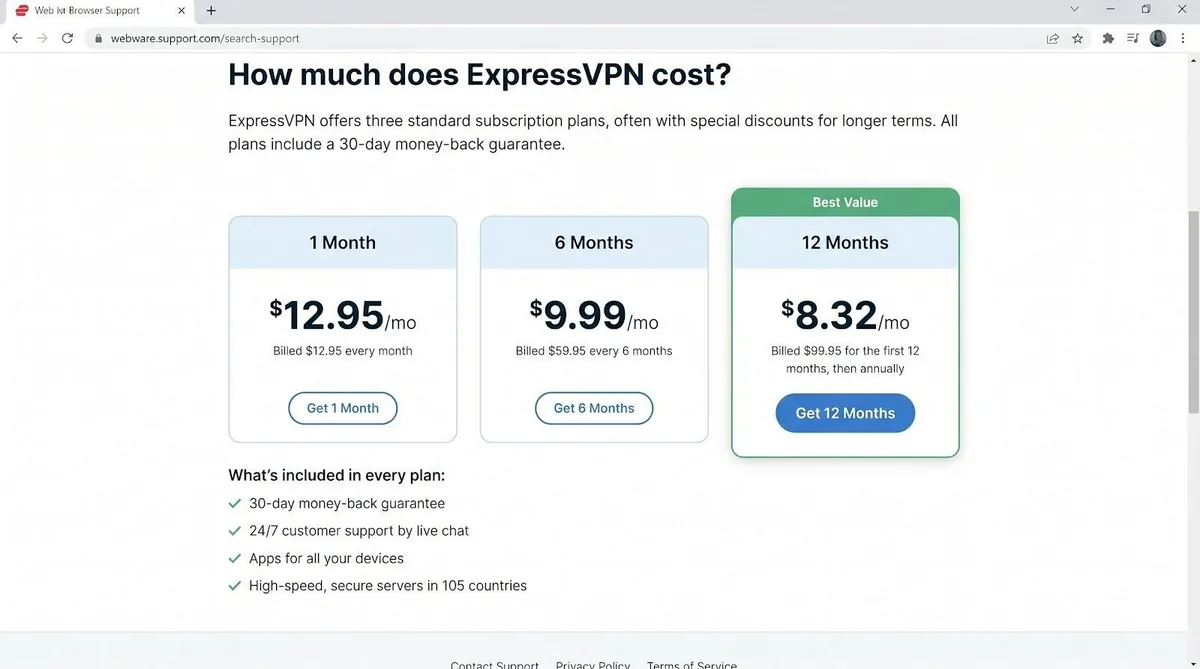
Speed remains the star. On a mid-tier U.S. fiber line we streamed 4K Netflix through a Tokyo exit with no buffering, then switched to Frankfurt and pushed a 6 GB game patch at 250 Mbps. Those figures keep Express ahead of Nord and well above budget services.
Security touches finish the package. TrustedServer wipes each machine on reboot, Lightway reconnects in milliseconds after a phone sleeps, and ten simultaneous connections cover a household. The Basic tier omits the ExpressVPN Keys password manager, which is reserved for the Advanced plan, yet it still strengthens your core network safety.
Limits exist. Express lacks a built-in ad blocker, and renewal returns to the standard rate at term’s end. Add a calendar alert, and customer support often offers a loyalty discount if you ask.
Pick ExpressVPN if raw speed and set-and-forget reliability outweigh every other factor. At this price you no longer need to stretch the weekly coffee fund to buy premium performance.
5. Proton VPN: privacy first, still 70 percent off
If privacy tops your checklist, Proton VPN belongs on your short list. Built by the Swiss team behind Proton Mail, the service keeps everything open-source, independently audited, and protected by strict Swiss laws.
Today the two-year Plus plan sits about 70 percent below its usual rate, landing near $2.99 a month. That is roughly a dollar above the cheapest options here, yet it brings extras those rivals skip.
Secure Core servers first route traffic through hardened data centers in Switzerland, Iceland, or Sweden before sending it to the wider internet. The double-hop design frustrates correlation attacks without extra setup. WireGuard keeps speeds lively; our nearest node hit 200 Mbps, enough for 4K streams and large game downloads.
You can run ten devices at once, generous for most households. The apps are clean and map-based, and the GitHub-hosted source code plus per-release audits offer rare transparency.
Drawbacks exist. NetShield blocks ads only at the DNS layer, so in-video ads may slip through. Support arrives by email, not live chat, so replies take hours, not minutes. If fast help is critical, note that gap.
Choose Proton VPN if you are a privacy purist, journalist, or activist who wants proof over marketing claims. With the current 70 percent coupon and a 30-day refund window, you can test every promise without risk.
Quick-glance deal table
We just covered the stories behind each coupon. If you prefer the raw numbers, the table below lines up the five winners so you can see which one matches your budget and feature list in seconds.
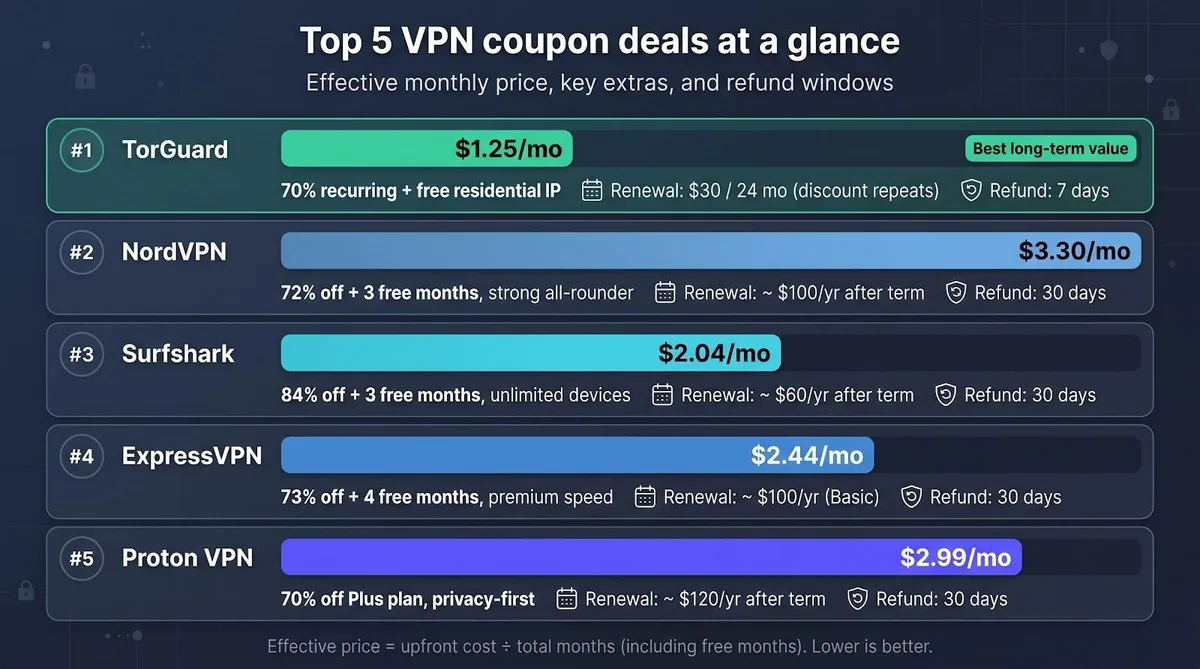
|
VPN |
% off / extras |
Up-front cost & term |
Effective price (per month) |
Renewal price (indicative) |
Refund window |
|
TorGuard |
70 % recurring + free residential IP |
$30 for 24 mo |
$1.25 |
$30 (discount repeats) |
7 days |
|
NordVPN |
72 % + 3 free months |
$89 for 27 mo |
$3.30 |
about $100 yr after term |
30 days |
|
Surfshark |
84 % + 3 free months |
$55 for 27 mo |
$2.04 |
about $60 yr after term |
30 days |
|
ExpressVPN |
73 % + 4 free months |
$68 for 28 mo |
$2.44 |
about $100 yr (Basic) |
30 days |
|
Proton VPN |
70 % off Plus plan |
$72 for 24 mo |
$2.99 |
about $120 yr after term |
30 days |
Conclusion
A few quick takeaways:
- TorGuard’s lifetime discount stands alone; no renewal cliff keeps the long-term total lowest.
- Surfshark slips under two dollars when the extra months are counted, perfect for gadget-heavy families.
- ExpressVPN has closed the historic price gap. At $2.44, premium speed now sits inside budget territory.
Countdown timers on provider sites often reset daily. TechRadar lists that as one of the seven common VPN sales tricks to watch for.
Use this table as a cheat sheet, but rely on the earlier deep dives when details such as TorGuard’s U.S. jurisdiction or Proton’s open-source code influence your final call.