Varaha’s $20M Raise Signals Shift in Carbon Removal Economics
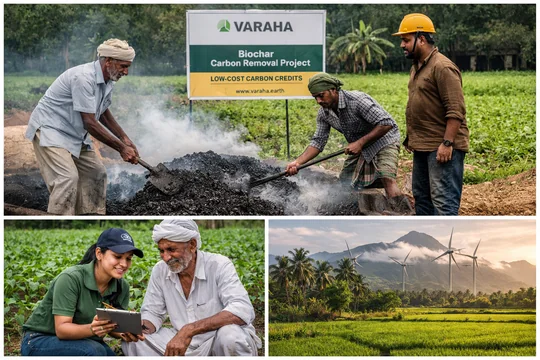
Carbon Removal Startup Varaha’s $20M Raise Signals a Shift in Climate Economics
Indian climate-tech company Varaha has raised $20 million in new funding. But the real story isn’t just about capital—it’s about how carbon removal is increasingly shifting toward the Global South, where scale, cost efficiency, and execution may determine the future of climate markets.
This funding round underscores a deeper transformation: carbon removal is no longer a niche sustainability effort. It’s becoming a cost-driven, infrastructure-grade industry where geography, operations, and credibility matter as much as technology.
Key Facts at a Glance
Varaha, founded in 2022 and headquartered in India, secured $20 million as the first close of a planned $45 million Series B round. The round is led by WestBridge Capital, with participation from existing investors RTP Global and Omnivore.
The carbon removal startup works across Asia and Africa, developing projects in regenerative agriculture, agroforestry, biochar, and enhanced rock weathering. To date, Varaha reports removing over 2 million tons of CO₂ across 14 active projects and generating approximately 150,000 verified carbon removal credits.
Major corporate buyers include Google, Microsoft, Lufthansa, Swiss Re, and Capgemini. The company remains profitable and expects revenue to nearly double this year.
Why Global South Carbon Removal Is Gaining Momentum
The rise of Global South carbon removal isn’t accidental—it’s economic.
India and neighboring regions offer lower operating costs, established agricultural supply chains, and a growing pool of technical talent. As corporate demand for verified removals grows—driven by AI workloads, data centers, and stricter climate targets—buyers are increasingly sensitive to price.
Varaha’s CEO, Madhur Jain, captured this shift succinctly: “Carbon credits are a cost on the balance sheet, not a CSR expense.” When credits become too expensive, demand slows. That’s why lower-cost regions with strong verification standards are gaining attention.
This signals a broader industry trend: carbon removal is maturing from experimentation to procurement.
Execution Over Breakthrough Tech
Unlike many climate startups chasing proprietary breakthroughs, Varaha is betting on execution.
The company works with smallholder farmers and industrial partners, focusing on measurement, reporting, and verification (MRV) systems that meet global standards such as Verra, Gold Standard, and Puro.earth. Its value proposition isn’t radical new tech—it’s reliable delivery at scale.
This approach may prove resilient as carbon markets tighten. High-cost developers in Europe and North America could face margin pressure, while execution-focused players in emerging markets gain ground.
In short, climate credibility plus cost discipline is becoming the winning formula.
Practical Implications for Businesses and Investors
For corporates buying verified carbon credits, the takeaway is clear:
-
Expect more long-term offtake agreements rather than spot purchases
-
Demand transparency and registry-backed verification
-
Look beyond geography and focus on delivery track record
For investors, Varaha’s growth highlights where climate capital may flow next—toward platforms that combine integrity, profitability, and scale rather than speculative tech alone.
For policymakers and climate practitioners, it reinforces the role emerging markets can play in global climate infrastructure when paired with strong standards.
What Comes Next for Low-Cost Carbon Removal
Varaha plans to expand further into South and Southeast Asia, including Vietnam and Indonesia, while deepening operations in existing markets. It’s also rolling out an Industrial Partners Program, enabling industrial operators to generate biochar-based credits using Varaha’s MRV systems.
This partnership-led model could accelerate deployment without heavy asset ownership—an approach that mirrors how other infrastructure sectors have scaled globally.
The bigger picture? Carbon removal is becoming less about who invents first and more about who executes best.
Conclusion: A New Center of Gravity for Carbon Markets
Varaha’s $20 million raise is more than a funding milestone. It’s a signal that the center of gravity in carbon removal is shifting toward the Global South, where cost, scale, and execution can unlock global climate impact.
As carbon removal becomes a core part of corporate climate strategy, platforms built for durability—not hype—are likely to define the next decade.
FAQ SECTION
Q: What does Varaha do as a carbon removal startup?
A: Varaha develops and manages carbon removal projects like biochar, agroforestry, and regenerative agriculture, generating verified credits sold to global corporations through international registries.
[FAQ SCHEMA RECOMMENDED]
Q: Why is carbon removal moving to the Global South?
A: Lower operating costs, strong agricultural ecosystems, and scalable labor make the Global South ideal for delivering cost-effective, verified carbon removal at scale.
Q: Are Varaha’s carbon credits internationally verified?
A: Yes. Varaha issues credits through globally recognized registries such as Verra, Gold Standard, and Puro.earth, ensuring independent validation.