US AI Chip Export Controls Undermined by BIS Staff Attrition, Licensing Bottlenecks, and Policy Confusion
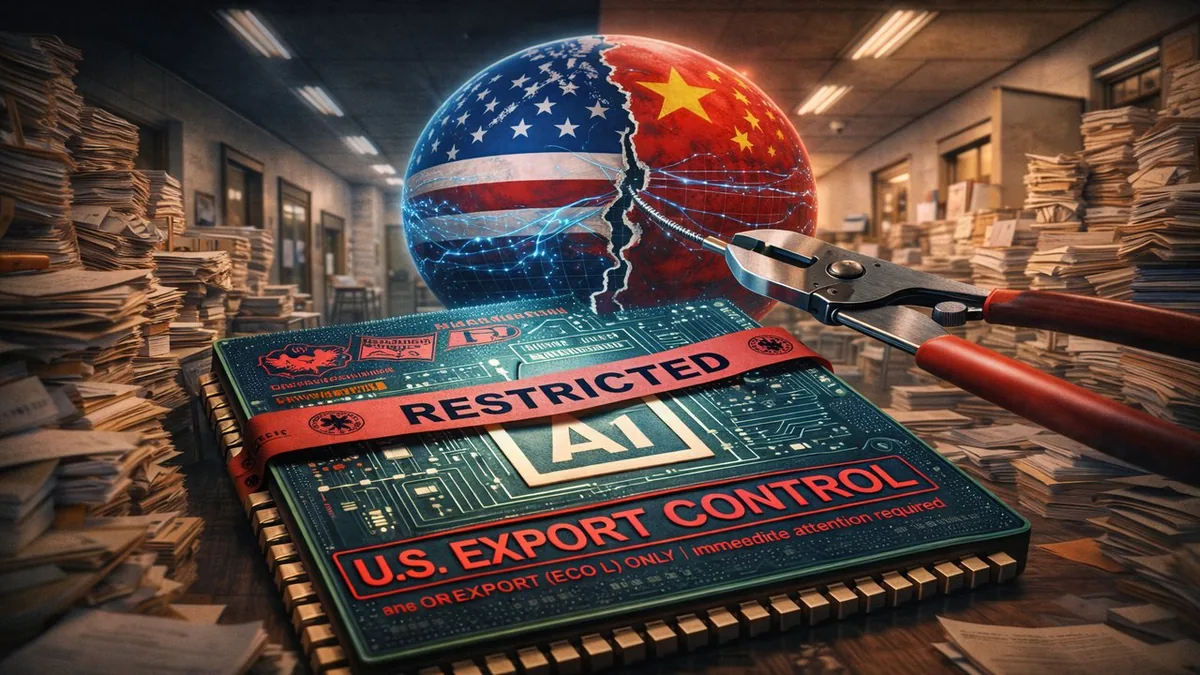
The United States government's push to control the export of AI chips to China and other restricted countries risks being undermined by a combination of licensing bottlenecks, staff attrition at the Bureau of Industry and Security (BIS), and unclear policy direction from the Trump administration, The Washington Post reported. The export control regime — which restricts the sale of Nvidia's most advanced AI chips and related technology to China — is widely considered the most consequential technology policy tool in the US-China AI competition. But the administrative infrastructure required to enforce it effectively is showing signs of strain at precisely the moment when circumvention attempts and policy complexity are both increasing.
The BIS Capacity Problem
The Bureau of Industry and Security, which sits within the Department of Commerce, is the agency responsible for reviewing export license applications and investigating violations of export control regulations. The BIS has faced significant staff attrition under DOGE-driven federal workforce reductions, reducing its capacity to process license applications and conduct the investigations needed to identify circumvention schemes. Export control experts have warned that a smaller, less experienced BIS workforce will result in slower license reviews, reduced enforcement capacity, and increased vulnerability to sophisticated circumvention through third-country transshipment networks — routes through countries like the UAE, Singapore, or Malaysia that then re-export chips to China.
The licensing bottleneck has a direct economic cost: US chip companies including Nvidia, whose Blackwell GPU rental costs have surged 48%, face delays in getting legitimate export licenses for sales to allied countries, while the same bureaucratic constraints slow the enforcement actions needed to stop illicit sales to restricted destinations. The result is the worst of both worlds: reduced legitimate exports and reduced enforcement.
Policy Uncertainty as a Structural Problem
Beyond staffing, the AI chip export control regime faces policy uncertainty from shifting administration priorities. The Biden-era framework established a tiered licensing system based on destination country risk assessments. The Trump administration has signaled both a desire to maintain chip controls on China and to ease restrictions for allied countries seeking to build domestic AI infrastructure — a distinction that requires exactly the kind of careful case-by-case review that understaffed BIS offices are struggling to provide. Companies report difficulty predicting licensing outcomes and timelines, which delays investment decisions and drives some legitimate buyers toward alternative chip sources from AMD or domestic Chinese suppliers.
Frequently Asked Questions
What is the Bureau of Industry and Security?
The Bureau of Industry and Security (BIS) is a US Department of Commerce agency responsible for administering export controls on dual-use technology, including advanced AI chips like Nvidia's H100 and Blackwell series. It reviews export license applications and investigates violations.
Why are AI chip export controls hard to enforce?
Enforcement requires tracking chips through complex global supply chains where they can be transshipped through third countries. Staff attrition at BIS has reduced investigation capacity, while policy uncertainty makes consistent license decision-making difficult.
Can China still get restricted AI chips?
China has obtained restricted chips through documented circumvention routes including third-country transshipment. The effectiveness of US export controls depends heavily on BIS enforcement capacity, which has been weakened by staff attrition.
The Bottom Line
AI chip export controls are only as effective as the agency enforcing them. BIS staff attrition, licensing bottlenecks, and policy uncertainty are creating gaps in the most consequential technology policy tool the US has for managing the AI competition with China. The irony is that reducing federal workforce to cut costs may be undermining the enforcement of export controls designed to protect US technological leadership — a strategic own-goal whose costs will compound as China uses the enforcement gap to acquire chips and develop AI capabilities that the policy was designed to prevent. Fixing it requires rebuilding BIS capacity and establishing policy clarity — neither of which is straightforward in the current political environment.