Understanding the AI Talent War: Why Companies Are Paying Millions for a Single Employee
1. The Million-Dollar Question
What if a company paid its employees an average of $1.5 million each—not in cash, but in company stock? That’s exactly what OpenAI, the creator of ChatGPT, is doing. This staggering figure is at the heart of one of the most intense battles in modern business: the AI talent war. This isn't just about high salaries; it's a strategic conflict with profound implications, creating a new, high-stakes playbook for corporate dominance in the age of AI.
This guide will break down what the "AI talent war" is, explore how companies are using massive stock packages as their primary weapon, and explain the high-stakes consequences for the companies, their employees, and the wider economy. The surprising compensation numbers are a symptom of a much larger conflict that has forced companies into a situation they can't easily escape.
2. What Exactly is the "AI Talent War"?
The "AI talent war" is a fierce competition among major tech companies to hire and keep the best artificial intelligence researchers and engineers. This battle for brainpower pits the industry's biggest names against each other, including OpenAI, Meta (formerly Facebook), and Google.
The current intensity of this war was ignited by a major catalyst: Meta's "recruiting blitz." Led by CEO Mark Zuckerberg, Meta began poaching top AI specialists from its rivals by offering salary and stock packages worth hundreds of millions of dollars, and in at least some cases, offers reportedly reached as high as $1 billion. This aggressive move triggered a defensive reaction across Silicon Valley, pushing compensation to unprecedented levels.
This situation has created a classic "prisoner's dilemma" for the companies involved. In simple terms, while collective restraint on salaries would benefit all companies, the individual incentive to defect—that is, to poach a competitor's top researcher with an irresistible offer—is too high. This ensures the bidding war continues, trapping them in a cycle of escalating costs.
The primary weapon wielded in this high-stakes war is not a traditional salary, but a specific and powerful form of payment: stock compensation.
3. The Fuel for the War: Understanding Stock Compensation
To grasp the scale of the talent war, it's essential to understand the financial tool at its center. Companies aren't just paying in cash; they're paying in ownership.
3.1. What is Stock-Based Compensation?
Stock-based compensation, also known as "equity," is a way companies pay employees with ownership in the company (shares) instead of or in addition to a cash salary. For a company, this has a central tradeoff: it is a powerful way to attract and retain top-tier talent without draining immediate cash reserves. However, this benefit comes at the cost of "long-term dilution for investors," meaning each existing share of the company represents a smaller piece of ownership over time. For the employee, this equity represents a potentially massive future payday if the company succeeds and goes public or is acquired, aligning their financial interests with the company's long-term success.
3.2. Just How Extraordinary is OpenAI's Pay?
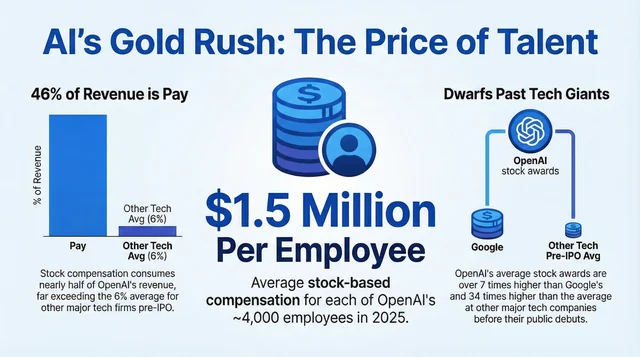
OpenAI's spending on employee equity isn't just high—it shatters historical records set by previous tech giants in the years before they went public (pre-IPO).
|
Company |
Avg. Stock Pay per Employee (Pre-IPO) |
Stock Pay as a % of Revenue (Pre-IPO) |
|
OpenAI |
$1.5 million average |
46% of revenue |
|
|
— |
15% of revenue |
|
|
— |
6% of revenue |
|
Average Major Tech Company |
— |
6% of revenue |
For context, OpenAI's average stock award is more than seven times higher than what Google offered its employees before its 2004 IPO. This spending isn't just an outlier; it's the primary driver of the heavy operating losses and shareholder dilution that define OpenAI's current financial reality, demonstrating a willingness to sacrifice profitability for technical leadership.
3.3. Making Offers Even More Attractive
Beyond the headline figures, OpenAI has further sharpened its competitive edge by altering the structure of its equity awards. The company recently abolished the "six-month vesting cliff."
A "vesting cliff" is a mandatory waiting period an employee must work before they officially start owning the stock they've been granted. By removing this requirement, OpenAI gives its employees faster, more immediate access to their valuable stock awards, making its offers incredibly difficult for rivals to beat.
This aggressive compensation strategy has profound impacts on the companies, the employees who receive these packages, and the economy around them.
4. The High Stakes: What Are the Consequences?
The decision to pay such extraordinary sums is not without significant consequences, creating a series of complex tradeoffs.
4.1. The Impact on Companies
For companies like OpenAI, the talent war forces a high-risk, high-reward strategy that pits short-term dominance against long-term financial stability.
- Benefit: The primary advantage is the ability to retain top talent, which is essential for maintaining a position of "technical leadership" in the fiercely competitive AI race.
- Drawback: This strategy leads to heavy operating losses. The immense payroll requires enormous and continuous infusions of capital from investors just to fund operations.
- Investor Risk: It causes rapid dilution for shareholders. As more and more stock is granted to employees, the ownership stake of existing investors is steadily reduced.
4.2. The Impact on Employees and the Economy
Beyond corporate balance sheets, these massive pay packages have a noticeable effect on the wider world.
- First, it creates a "winner-take-all" dynamic, concentrating immense wealth among a relatively small group of elite AI engineers and researchers. This economic ripple effect is a direct result of using equity as the primary weapon in the talent war, turning a few thousand employees into major financial stakeholders in one of the world's most valuable private companies.
- In a tech hub like San Francisco, this influx of wealth can "supercharge demand for high-end housing and services," driving up prices and creating economic pressure in the local community.
These consequences highlight that the AI talent war is not just an internal business issue but a powerful economic force.
5. A New Era for Tech Pay
The battle for the brightest minds in artificial intelligence has escalated into a full-blown economic conflict, fundamentally altering the landscape of tech compensation.
Here are the three most important takeaways:
- The "AI talent war," sparked by intense competition from companies like Meta, has forced AI leaders like OpenAI into an inescapable bidding war for talent, creating a classic prisoner's dilemma.
- The primary weapon is unprecedented stock compensation, with OpenAI paying an average of $1.5 million per employee—a figure that dwarfs historical norms set by giants like Google and Facebook before they went public.
- This strategy has significant consequences, forcing companies to trade off securing essential talent against high costs, financial losses, and notable impacts on the wider economy.
Ultimately, this intense and costly competition for a small pool of elite researchers and engineers has rewritten the rules for hiring in Silicon Valley, setting a new, precarious, and potentially unsustainable precedent for the entire technology sector.