Ultrahuman Ring PRO Wants $479 to Track Your Social Jetlag and Tell You When to Stop Drinking Coffee
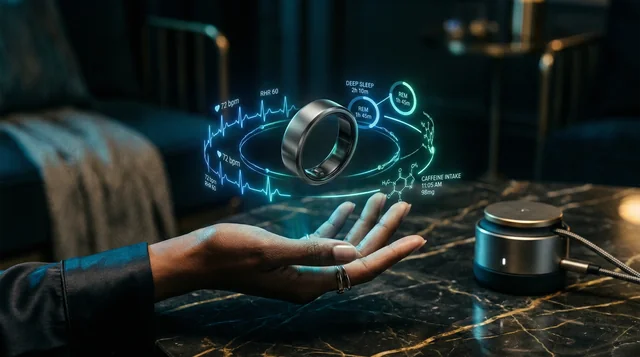
Ultrahuman just launched the Ring PRO, its third-generation smart ring, and it wants $479 for the privilege of knowing when you should stop drinking coffee. The Indian wearable company is also rolling out "Jade," which it calls the world's first "real-time biointelligence AI." That is a lot of syllables for something that basically reads your sleep data and tells you to go to bed earlier.
The Hardware Sounds Genuinely Impressive
Credit where it is due — the Ring PRO specs are strong. Ultrahuman claims up to 15 days of battery life, which would be a significant lead over the Oura Ring 4's roughly 8-day battery. The titanium unibody comes in four finishes (Bionic Gold, Space Silver, Aster Black, Raw Titanium) and sizes 5 through 14.
The ring packs enhanced memory capable of storing up to 250 days of data, a dual-core processor with on-chip machine learning, and a redesigned heart-rate sensor for better sleep and recovery tracking. There is even a "ProRelease Technology" that makes the ring easier to cut off if your finger swells — a genuinely thoughtful safety feature that other ring makers should copy.
The PRO Charging Case Is Overkill in the Best Way
The charging case stores a full year of ring data and has its own 45-day battery life. It uses "UltraSnap" magnetic charging that generates less heat than conventional wireless charging and supports Qi. You get haptic confirmations and LED battery indicators. It is, frankly, more impressive than the case most earbuds ship with.
But "Biointelligence AI" Is Where Things Get Buzzy
Jade is Ultrahuman's new AI layer, and the feature list reads like every health-tech startup's pitch deck rolled into one. AFib detection (a first for smart rings, they claim), caffeine window optimization, respiratory health monitoring, GLP-1 journey tracking, ovulation prediction at "90%+ accuracy," migraine insights based on FDA-approved tech, vitamin D tracking, shift work adaptation, and "social jetlag" detection.
Some of these are genuinely useful. AFib detection on a ring is meaningful. Ovulation tracking at that accuracy level, if validated, could be a real differentiator. But "social jetlag" detection and "circadian alignment" scoring feel like they are solving problems most people did not know they had — or do not actually have.
The Catch: No US Availability
Here is the odd part — the Ring PRO is launching globally except in the United States. Ultrahuman says international pre-orders are first-come-first-served with shipments starting in March. You can trade in an old Ultrahuman Ring AIR or other smart rings for up to $115 off, but even with the discount, $364 is still steep for a ring.
The Bottom Line
The Ultrahuman Ring PRO has legitimately impressive hardware — the battery life alone makes it worth watching. But calling your health insights AI "biointelligence" and promising it will eventually order food and change your room temperature feels like the company is writing checks its ring has not cashed yet. The smart ring market is heating up, and Ultrahuman clearly wants to be taken seriously. Whether a $479 ring that tracks your "social jetlag" is the way to get there remains an open question.