Uber Robotaxi Revealed: Why Lucid and Nuro Change the Game
Uber’s Robotaxi Is More Than a New Car—It’s a Strategic Bet on Premium Autonomy
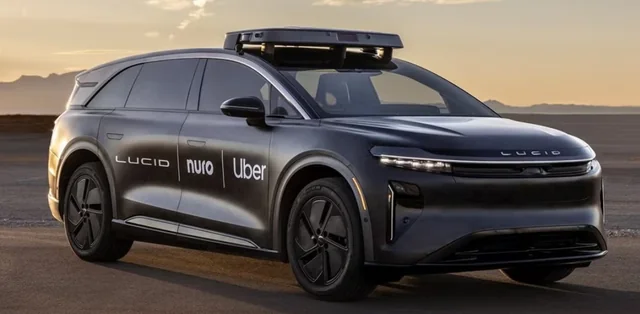
Uber has unveiled a production-intent robotaxi developed with Lucid Motors and Nuro. At first glance, it’s another self-driving vehicle announcement. Look closer, and it becomes clear this launch signals a major strategic shift: Uber isn’t just chasing autonomy—it’s redefining what a robotaxi experience should feel like.
Instead of a utilitarian pod, Uber is betting on comfort, brand trust, and manufacturing efficiency to win the next phase of autonomous ride-hailing.
Key Facts: What Was Announced
Uber’s new robotaxi is built on the Lucid Gravity SUV platform and powered by Nuro’s autonomous driving system. The vehicle integrates cameras, solid-state lidar, radars, and Nvidia’s Drive AGX Thor computer directly into the car during manufacturing at Lucid’s Arizona factory.
Key details include:
-
Public road testing already underway
-
Commercial launch planned for the San Francisco Bay Area
-
Uber committed to purchasing 20,000 Lucid EVs
-
A “halo” roof system with sensors and LED rider-identification lights
-
Uber-designed in-car user interface for riders
Unlike retrofitted vehicles, this robotaxi is designed for autonomy from day one.
Why the Uber Robotaxi Matters
1. Premium Is the New Differentiator
Most robotaxi programs focus on efficiency and scale. Uber is aiming higher. The Gravity SUV offers expansive interior space, large curved OLED displays, and a smoother ride—features that matter when passengers are expected to trust a car without a driver.
This positions the Uber robotaxi as a premium alternative, not just a cheaper one.
2. Manufacturing Integration Solves a Hidden Problem
By integrating autonomy hardware directly on Lucid’s assembly line, Uber and its partners avoid costly retrofitting. This contrasts sharply with competitors that must disassemble vehicles to add sensors and compute systems.
The result:
-
Faster deployment
-
Lower long-term costs
-
Fewer points of failure
This efficiency could quietly become Uber’s biggest advantage.
3. Software Is the Real Risk—and Opportunity
Lucid previously struggled with software issues during the Gravity’s rollout. While those problems appear to be stabilizing, autonomy raises the stakes. As one executive noted, early Gravity owners experienced “frustrations,” a reminder that software reliability will define success more than hardware specs.
For Uber, owning the rider interface is crucial. Control of the screen means control of trust, support, and ultimately, loyalty.
How This Compares to Existing Robotaxis
Uber vs. Waymo: Two Different Philosophies
| Feature | Uber Robotaxi (Lucid + Nuro) | Waymo Robotaxi |
|---|---|---|
| Vehicle Type | Luxury SUV (Lucid Gravity) | Jaguar I-Pace |
| Manufacturing | Built with autonomy tech | Retrofitted after delivery |
| Rider Experience | Premium, spacious, OLED UI | Functional, familiar UI |
| Deployment Model | Uber app integration | Standalone Waymo app |
| Positioning | Premium robotaxi service | Mass-market autonomy |
Bottom Line: Waymo leads in operational maturity, but Uber’s robotaxi could win on comfort, scalability, and platform reach if execution holds.
What Happens Next: Practical Predictions
-
Bay Area launch will be a litmus test. Rider feedback will shape expansion plans.
-
Premium tiers may emerge. Autonomous rides could follow airline logic: standard vs. premium cabins.
-
Partnerships will matter more than ownership. Uber’s asset-light model lets it scale without manufacturing risk.
-
UI trust signals will become standard. Visuals showing what the car “sees” help passengers feel safe.
For riders, the practical takeaway is simple: autonomous rides are moving from novelty to normal—and quality will soon matter as much as price.
The Bigger Picture for Autonomous Mobility
The Uber robotaxi isn’t just about removing drivers. It’s about reframing autonomy as a service experience, not a science project. If successful, this approach could pressure competitors to upgrade vehicle quality, not just algorithms.
The long-term winners in autonomy may not be those who arrive first—but those who make riders feel most comfortable staying.
FAQ SECTION
Q: What is the Uber robotaxi?
A: The Uber robotaxi is a self-driving vehicle built on the Lucid Gravity SUV and powered by Nuro’s autonomous technology. It’s designed for Uber’s ride-hailing platform and focuses on premium comfort, safety, and integrated manufacturing.
Q: When will the Uber robotaxi be available?
A: Uber plans to launch commercial robotaxi service in the San Francisco Bay Area after final validation, expected later this year. Broader expansion will depend on testing results and regulatory approvals.
Q: How is this different from Waymo’s robotaxis?
A: Unlike Waymo’s retrofitted vehicles, Uber’s robotaxi is built with autonomy hardware during manufacturing. It also emphasizes a premium interior experience and seamless integration with the Uber app.
Q: Will Uber robotaxis cost more than regular rides?
A: Pricing hasn’t been announced, but Uber has described the service as “premium,” suggesting higher fares—at least initially—compared to standard rides.
Q: Is the Uber robotaxi fully driverless?
A: Yes, the goal is fully autonomous operation without a human driver, once testing and regulatory requirements are complete.