The New US Dietary Guidelines Are Here—And They've Upended Decades of Nutrition Advice
If you've ever felt confused by conflicting dietary advice, you're not alone. For years, Americans have been told to avoid saturated fat, choose low-fat dairy, and build their diet on a foundation of grains. Now, that long-standing advice has been turned on its head.
The Trump administration, led by Health Secretary Robert F. Kennedy Jr. and Agriculture Secretary Brooke Rollins, has released new dietary guidelines that represent what Kennedy calls the "most significant re-set on nutrition policy in history." Challenging decades of conventional wisdom, this new guidance shifts the focus from fat to food processing and dramatically reshapes how Americans are advised to eat. In a move that mirrors its simple core message—"eat real food"—the new guidance is streamlined to just a few pages, a stark contrast to the nearly 150-page document it replaces.
This article breaks down the most surprising and impactful takeaways from this major policy shift, explaining what has changed and why it matters.
1. The "War on Saturated Fat" is Officially Over
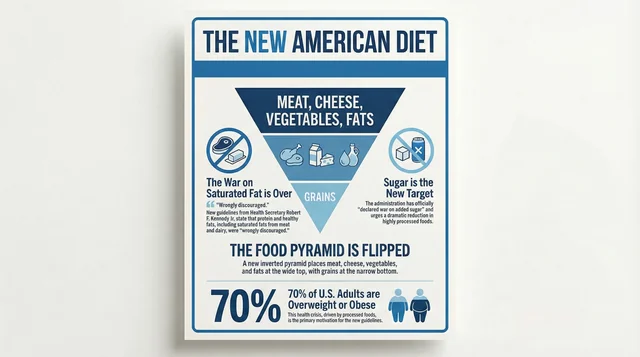
The administration has formally called for an end to the "war on saturated fats," a move that directly contradicts the advice that has dominated public health for a generation. This policy reversal is visually represented in the new food pyramid, which now prioritizes red meat and cheese.
This change marks a landmark moment in U.S. nutrition policy. This shift directly confronts the public health messaging that has shaped consumer choices, food manufacturing, and even medical advice for over 40 years, signaling a fundamental rethinking of the role that different types of fats play in a healthy diet.
"Protein and healthy fats are essential and were wrongly discouraged in prior dietary guidelines. We are ending the war on saturated fats." — Health Secretary Robert F. Kennedy Jr.
2. The Food Pyramid Has Been Flipped Upside Down
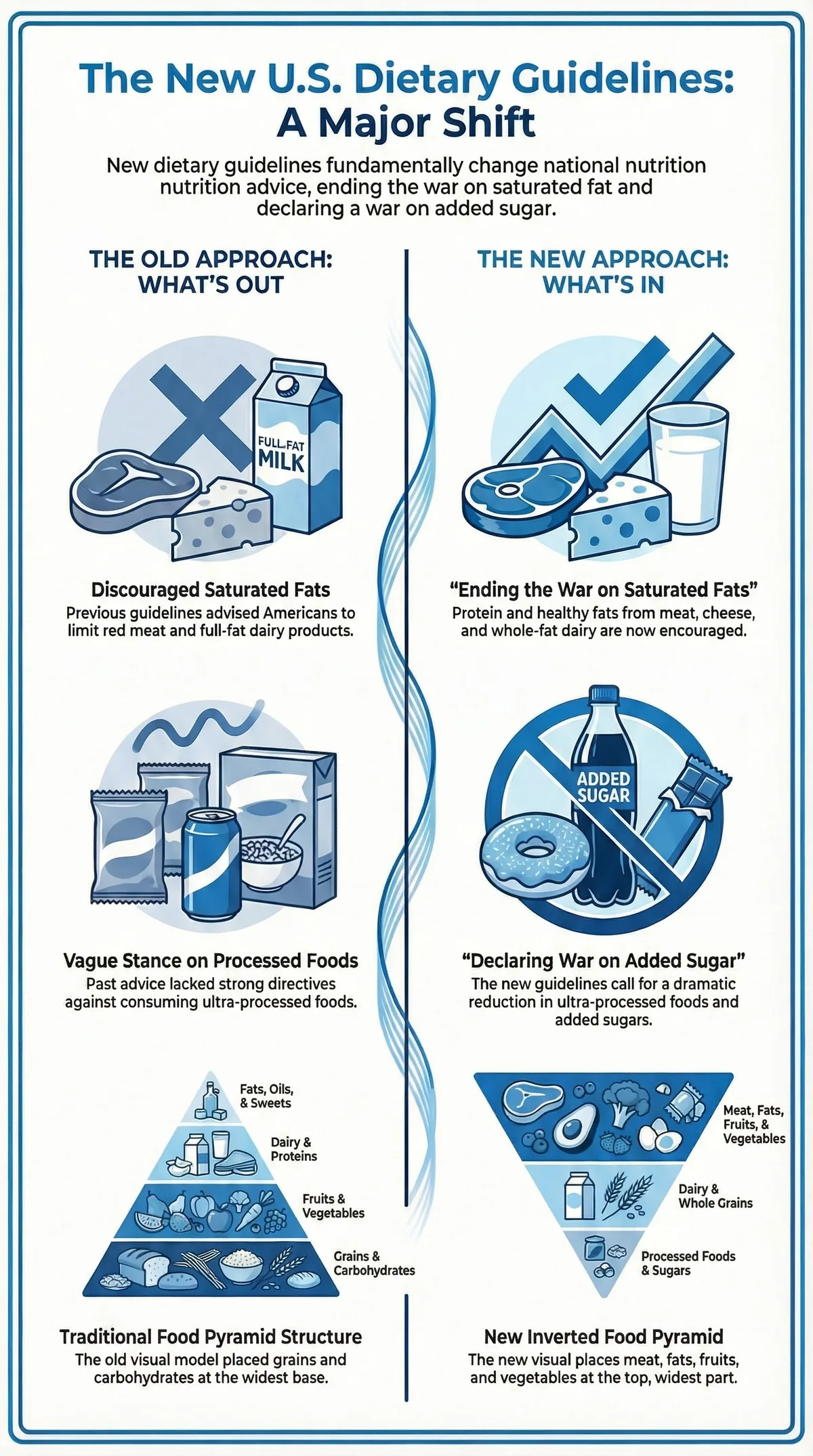
Instead of the classic pyramid with a wide base of grains, the administration has introduced an inverted pyramid. In this new visual framework, the widest part is at the top, built on a foundation of meat, fats, fruits, and vegetables. In a stark reversal, whole grains are now located at the narrow bottom of the pyramid.
This dramatic visual overhaul is a powerful communication tool. By visually demoting grains, which formed the foundation of the American diet for a generation, the new pyramid communicates a radical, non-verbal rejection of the previous nutritional paradigm before the reader consumes a single word of text.
3. Full-Fat Dairy Is Back on the Table
The guidelines elevate cheese and other dairy products to a place of prominence, a move that paves the way for the reintroduction of full-fat milk and dairy products in school meals. This recommendation is supported by a growing body of scientific evidence suggesting the benefits of dairy foods, regardless of their fat content.
As Dr. Dariush Mozaffarian of Tufts University notes, "It's pretty clear that overall milk and cheese and yogurt can be part of a healthy diet."
"What's quite interesting is that the fat content doesn't seem to make a big difference. So both low fat and whole fat dairy versions of milk, cheese and yogurt have been linked to lower cardiovascular risk." — Dr. Dariush Mozaffarian, Tufts University
4. The New Enemy: "Ultra-Processed Food" and Sugar
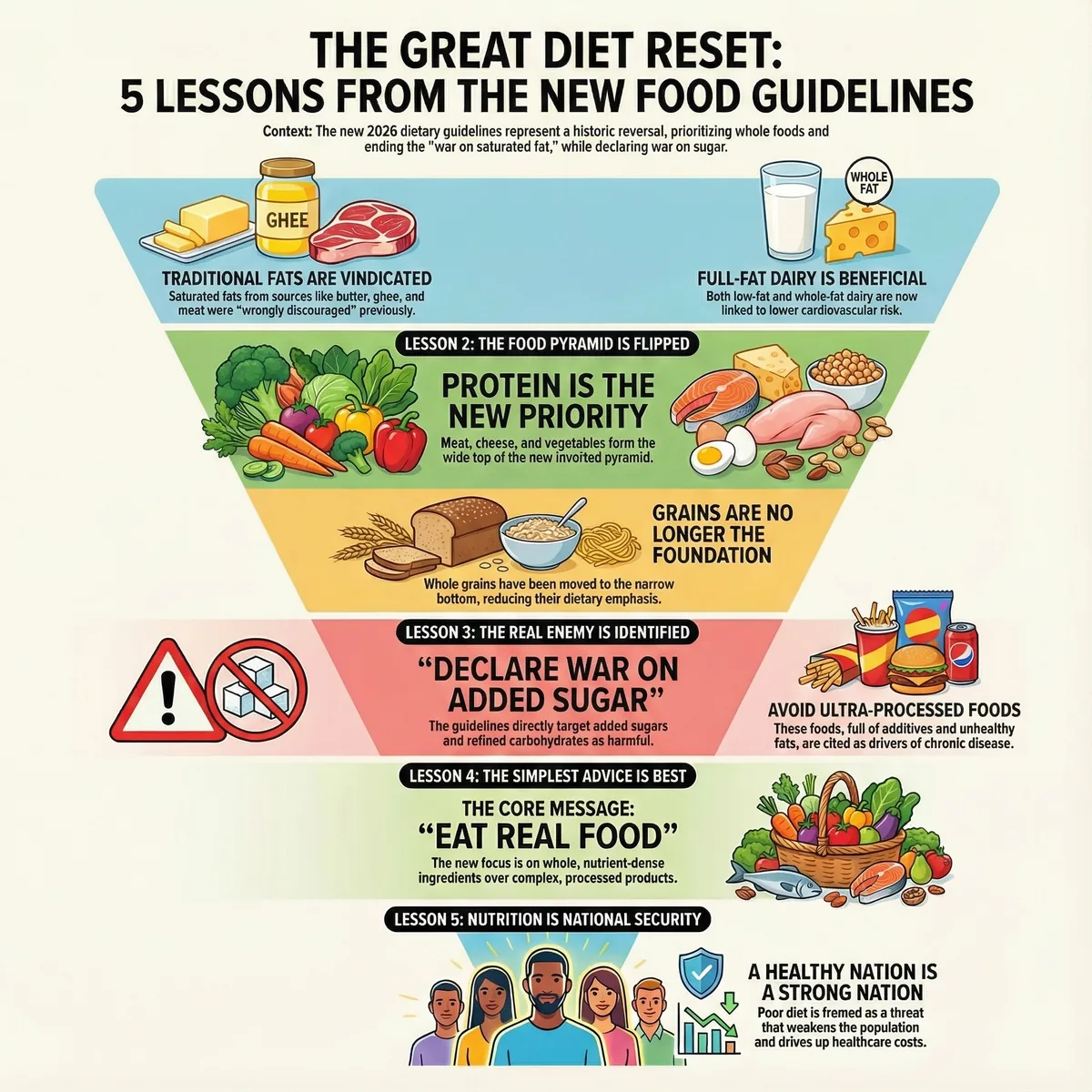
The central target of the new guidelines is not a single nutrient, but the industrial processing of food itself. The administration has not only called for a "dramatic reduction" in ultra-processed foods but has also, in Kennedy's words, "declared war on added sugar." This new philosophy argues that the real problem was never naturally occurring fat, but rather the processing that created low-fat, high-sugar products to replace it.
These ultra-processed foods are described as being laden with refined carbohydrates, added sugars, excess sodium, unhealthy fats, and chemical additives. Health Secretary Kennedy's core message to the public is simple and direct: "eat real food." This shift is being praised by experts like Dr. Dariush Mozaffarian, who called it a "big deal" and a "very positive move for public health."
5. Poor Nutrition Is Now Framed as a National Security Threat
Perhaps the most surprising shift is the administration's framing of diet as a matter of national importance. Health Secretary Kennedy has directly connected the nutrition of Americans to the security and strength of the nation, elevating the issue from a private health concern to a public crisis with economic and security implications.
This rhetorical strategy reframes diet from a matter of personal responsibility to one of collective, patriotic urgency, potentially creating a much broader mandate for policy changes.
"If a foreign adversary sought to destroy the health of our children, cripple our economy, to weaken our national security, there would be no better strategy than to addict us to ultra-processed foods." — Health Secretary Robert F. Kennedy Jr.
A New Era for American Diets?
The latest U.S. dietary guidelines represent a radical departure from the past. The end of the war on fat, the new focus on whole foods over ultra-processed ones, and the dramatic inversion of the food pyramid signal a new chapter in American nutrition policy.
This pivot is not without its critics, however. Nutrition experts like Christopher Gardner of Stanford University have expressed disappointment, stating that the new pyramid "does go against decades and decades of evidence and research." As the government rewrites the rules on what it means to eat healthy, the debate is far from over. How will this historic shift change the food on your plate?