The Future of Language Learning: Why the AI Translator Is Becoming Essential
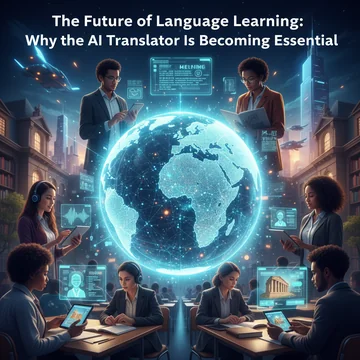
The advent of artificial intelligence has signified a new beginning in the language learning process. Textbooks and conventional class settings are no longer the only way in which learners engage in the language learning process. Modern learners now translate using AI in order to understand new languages, practice, and receive instantaneous feedback on their ability to pronounce and contextualize various words. The use of artificial intelligence in language learning enables learners to approach the multi-faceted task of learning a new language with greater ease. Similarly, the accessibility of these tools helps streamline the learning of new languages.
How AI Translation Has Evolved
AI translation systems are not limited to direct one-to -one mapping of words. Advanced AI systems now implement neural networks and deep learning systems to analyze and understand grammar, tone, and contextual information in order to perform more human-like translations.
Recent advances in translation systems include:
- Context sensitive translation of sentences
- Greater control over translation for idioms and expressions
- Support for various dialect and pronunciation accents
- Improved performance through self learning based on user interactions
These capabilities demonstrate how valuable translation systems have become in education.
Why Is Traditional Language Learning No Longer Enough?
The traditional learning process and systems focus on rote learning, memorization, and regurgitation, while these methods are effective to a certain degree, they tend to fall short when applied in real world situations. This is where many learners suffer as they have no real opportunities to practice conversational languages.
There are several obstacles such as:
- Little exposure to how language is actually used
- Feedback comes too late to be effective
- Tutors and language immersion programs are too expensive
- No customization to meet learners individual needs
AI translators help learners overcome these challenges because they offer customized, on-demand support.
AI Translators as Personal Language Tutors
The ease and convenience of AI language software are unmatched, and they offer just as much personalization as any other educational tool. AI language software can meet students where they are and adjust to their learning pace, skill level, and learning objectives, setting them on the fastest possible path.
Some of the benefits of AI tools include:
- Automated and immediate response to grammatical and syntactical errors
- Pronunciation and enunciation assistance via voice controls
- Usage-based vocabulary refinement suggestions
- Relevant clarifications and meaning of words with contextual explanations
This kind of tailored personal instruction passes along the benefits of true individualized instruction, and builds student confidence.
Real-Time Learning Through Daily Conversations
While theory can be useful, the best way to learn a language is to use it. Even utter beginners can engage in authentic language use thanks to AI translators.
Helpful practical applications of the technology include:
- Real time translation of chats and emails
- Language comprehension during audiovisual presentations
- Simulated conversation with a program designed to mimic a native speaker
- Real world travel scenarios to help students engage and use their learned language effectively
AI translators help students learn languages in a way that is seamless, integrating language use into their everyday life.
Breaking Barriers For Global Education
AI translation is changing the global reach of education. Students studying the content of different languages can now access the learning materials. This is allowing knowledge to flow freely across dissimilar languages. Educational access because of the barriers of the language is eliminated.
Education benefits include:
- Obtaining foreign courses, global research papers
- Greater comprehension of learning materials
- Support for multilingual classrooms
- Equal access to education for all
The education field will become more internationalized, and with the use of AI translation the barriers of languages will no longer exist.
Supporting Lifelong and Self-Directed Learning
Flexibility is a must for modern learners. AI translators in self-directed learning empowers learners to study anytime and anywhere. There are no set schedules or reliance on physical resources.
Benefits to lifelong learners include:
- On demand translation for writing and reading
- Multi-language support
- Continuous learning in a relaxed environment
- Seamless use in daily work and life
Long term, this allows sustainable long term use of an AI translator and flexible approach to learning a language.
Cultural Understanding Beyond Words
Learning a language is more than just learning the words and phrases. Learning a language is understanding the skills and the social understanding of the language. Advanced AI translation tools are more and more able to incorporate the nuances of different cultures.They assist learners in:
- Recognition of formal and informal types of communication
- Understanding culturally embedded references
- Miscommunication avoidance
- Cultivating cross-cultural consciousness
These are vital in a connected world.
The Future of AI Translation
The perfection of AI will result in highly accurate and responsive translation tools. The ideal AI translator of the future will be able to provide real-time voice, written, and visual learning.
The AI translator of the future will:
- Translate with near-human accuracy
- Recognize and adjust for emotional tone
- Integrate fluidly with online learning environments
- Augment support for under-resourced languages
AI translators will be indispensable to the learning process.
Conclusion: The Easiest Way to Learn a Language
AI will help design the language learning experience of the future which will be integrated into the learning process. AI-supported translation will not only be real time, but contextual and adaptive to the learner, transforming language learning and use for students of all levels. AI-supported translation will serve to build the capability to communicate globally.