The EV Crown Has Changed Hands: What BYD's Rise Tells Us About Tesla's Identity Crisis
The Upset That Wasn't Really an Upset
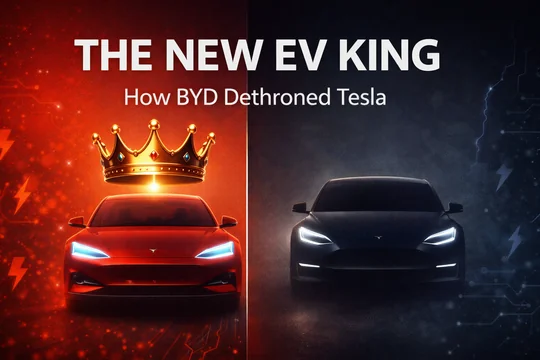
The numbers released this week confirmed what industry watchers had been anticipating for months: BYD has officially dethroned Tesla as the world's largest seller of electric vehicles. The Chinese automaker sold 2.26 million EVs in 2025, a 28% increase from the previous year. Tesla, meanwhile, delivered just 1.6 million vehicles—an 8.6% decline and the largest annual drop in the company's history.
What makes this shift remarkable isn't just the outcome, but the circumstances surrounding it. BYD achieved this milestone without selling a single vehicle in America, while China remains Tesla's second-largest market. The incumbent lost on its challenger's home turf while the challenger won without ever stepping onto the incumbent's.
This isn't just a story about sales figures. It's a story about strategic identity, market dynamics, and the cost of distraction at the highest levels of corporate leadership.
The Divergent Paths: Cars vs. Everything Else
The contrast between BYD and Tesla's strategic directions couldn't be more pronounced. BYD, under founder Wang Chuanfu, has remained laser-focused on its core mission: building and selling vehicles. The company has aggressively expanded its lineup, pushed into hybrid technology, and pursued international markets with single-minded determination.
Tesla, under Elon Musk, has drifted. The company that once defined the EV category now seems more interested in robotaxis, humanoid robots, and the cultural influence of its CEO than in the unglamorous work of maintaining market leadership in electric vehicles.
This strategic divergence has consequences. While BYD was iterating on pricing, expanding production capacity, and penetrating new markets, Tesla was promising a fleet of autonomous vehicles that, by year's end, operates only in Austin and San Francisco—a far cry from Musk's prediction that it would serve half of the US population.
The market, it seems, has noticed. Tesla's stock rose 18.6% in 2025, but that growth was driven almost entirely by investor speculation about robotaxis and robots—not by confidence in the company's automotive business. This creates a peculiar situation: a car company valued for everything except its cars.
The Musk Factor: Asset or Liability?
Perhaps the most uncomfortable conversation Tesla investors and executives must have is about the role of Elon Musk himself. In the first half of 2025, Tesla's sales fell sharply, and a significant portion of that decline can be attributed directly to consumer backlash against Musk's political activities.
When Musk took a prominent role in the Trump administration's Department of Government Efficiency, the reaction was swift and visceral. Protests erupted outside Tesla showrooms in Europe and the United States. Reports of vandalism against Tesla vehicles and facilities surfaced regularly. For many potential buyers—particularly in the environmental and progressive demographics that formed Tesla's early adopter base—purchasing a Tesla became ideologically untenable.
This represents an unprecedented situation in automotive history: a car company's sales declining not because of product quality, pricing, or competition, but because of its CEO's extracurricular activities. The man who once made Tesla synonymous with innovation and sustainability had, for a substantial segment of the market, made it synonymous with political controversy.
The third-quarter sales spike—driven by consumers rushing to take advantage of the expiring $7,500 tax credit—temporarily masked the damage. But when the credit disappeared on October 1st, so did the artificial demand, and fourth-quarter sales plummeted 15.6% year-over-year.
BYD's Victory Comes With Asterisks
Before we crown BYD the undisputed champion of the EV era, we should acknowledge the complexity of its position. The company's triumph is not without its own challenges.
In China—where BYD sells the bulk of its vehicles—the competitive landscape is brutal. Over 150 car brands and more than 50 EV makers are fighting for market share in a space that has seen relentless price wars and razor-thin margins. BYD's domestic market share has fallen from a peak of 35% in 2023 to 29% in the first eleven months of 2025.
The company reported profit declines in both the second and third quarters of 2025. Rivals like Geely, Leapmotor, and the smartphone-maker-turned-automaker Xiaomi have steadily eroded BYD's dominance. Wang Chuanfu himself has acknowledged that the company's technological lead has narrowed and product differentiation has become insufficient.
Meanwhile, BYD's aggressive pricing strategy—while effective at driving volume—has drawn regulatory scrutiny and triggered new tariffs in several international markets. The same low-cost approach that fueled its rise may limit its ability to compete at the premium end of the market where margins are healthier.
The Lessons for the Industry
What can the broader automotive industry learn from this changing of the guard?
Focus matters. BYD's success is fundamentally a story about strategic discipline. While competitors diversified into adjacent technologies and moonshot projects, BYD remained committed to its core competency: building vehicles that consumers want to buy at prices they're willing to pay. This isn't glamorous, but it works.
Leadership carries risk. The cult of the celebrity CEO has always been a double-edged sword. When the figurehead is beloved, the halo effect benefits the brand. When the figurehead becomes polarizing, the brand absorbs the damage. Tesla's experience in 2025 should serve as a cautionary tale for any company that allows its identity to become inseparable from a single individual.
Markets evolve faster than narratives. For years, the story of EVs was the story of Tesla. That narrative was so dominant that many observers failed to notice the rapid maturation of Chinese competitors. BYD's ascent wasn't sudden—it was the culmination of years of investment, iteration, and expansion that happened largely outside the spotlight of Western media.
The tax credit dependency was always fragile. Tesla's reliance on government incentives to drive sales was a known vulnerability that the October 2025 deadline exposed mercilessly. Any company building its business model around political variables is building on sand.
What Happens Next?
The EV landscape in 2026 and beyond will be shaped by several converging forces.
Tesla faces a pivotal year. The company has rolled out cheaper versions of its Model 3 and Model Y to compensate for the lost tax credit, but these stripped-down variants offer less range and fewer features—a compromise that may alienate the brand's quality-conscious customer base. Whether the robotaxi and humanoid robot initiatives will ever deliver meaningful revenue remains speculative at best.
BYD must navigate international expansion while defending its home market from increasingly capable domestic rivals. The company's ability to establish a foothold in Europe will be critical, particularly as it faces regulatory headwinds and protectionist sentiment.
And legacy automakers—the Fords, GMs, Volkswagens, and Toyotas of the world—are watching carefully. The lesson they're drawing from 2025 may not be encouraging for either Tesla or BYD: the EV market is more contested, more price-sensitive, and more difficult to dominate than anyone predicted.
The Bigger Picture
What we're witnessing is not simply one company overtaking another. We're witnessing the normalization of electric vehicles as a category—a transition from a market defined by a single pioneer to one shaped by global competition.
In this new landscape, the advantages that once made Tesla exceptional—first-mover status, Supercharger network exclusivity, and the mystique of disruption—are diminishing. Electric vehicles are no longer exotic; they're expected. And in a commoditizing market, execution matters more than vision.
BYD understood this earlier than Tesla did. Whether Tesla can recalibrate in time—and whether Musk is willing to focus on cars rather than robots, rockets, and political appointments—will determine whether the company remains a major player or becomes a cautionary tale about the perils of losing focus.
The EV crown has changed hands. The more interesting question is whether it will stay with its new owner—or whether the era of clear market leadership in electric vehicles is ending altogether.