Bill Gates’ TerraPower Gets Approval to Build Next-Gen Nuclear Reactor as AI Demands Surge
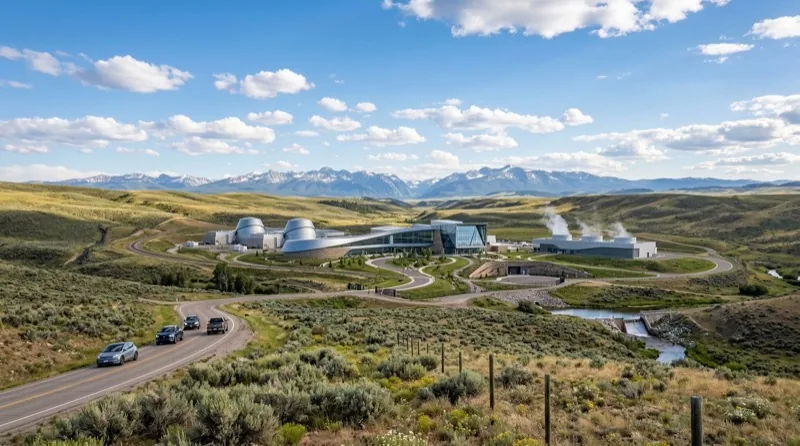
Bill Gates’ nuclear energy company TerraPower has received regulatory approval to build an advanced nuclear reactor — a milestone that’s been two decades in the making. The reactor will be built in Kemmerer, Wyoming, a former coal town that’s about to become ground zero for the next generation of nuclear power.
Gates has been evangelizing nuclear energy since he founded TerraPower in 2006, long before it was fashionable. Now, with AI data centers consuming more electricity than some small countries and renewable energy struggling to keep up, the world is finally catching up to what Gates has been saying all along: you can’t power the future without nuclear.
The Natrium Reactor
TerraPower’s Natrium reactor isn’t your grandfather’s nuclear plant. It’s a sodium-cooled fast reactor — a fundamentally different design from the pressurized water reactors that dominate today’s nuclear fleet:
- Sodium coolant instead of water — Liquid sodium operates at atmospheric pressure, eliminating the risk of pressure-related accidents that plagued older designs
- Higher operating temperatures — Allows for greater thermal efficiency and the ability to store energy as heat
- Integrated molten salt energy storage — The reactor can ramp power output up and down to complement intermittent renewable energy sources
- Smaller footprint — The 345-megawatt plant is much smaller than conventional nuclear plants but can boost output to 500 MW using stored energy
- Passive safety systems — The reactor can shut itself down safely without operator intervention or external power
The design addresses virtually every criticism that has stalled nuclear power for the past 40 years: safety, cost, waste, and flexibility.
Why Kemmerer, Wyoming?
Kemmerer is a town of about 2,600 people that has historically depended on coal mining and a coal-fired power plant for its economic lifeblood. The coal plant is scheduled to close, and TerraPower’s reactor is positioned as both its energy replacement and economic lifeline.
The location is strategic for several reasons:
- Existing grid infrastructure — The coal plant’s transmission lines can be repurposed for the nuclear facility
- Community support — Unlike many nuclear projects that face local opposition, Kemmerer has enthusiastically welcomed TerraPower
- Workforce transition — Former coal workers can be retrained for nuclear plant operations
- Proximity to data center demand — The Western U.S. is seeing explosive growth in AI data center construction
AI’s Insatiable Energy Appetite
The timing of TerraPower’s approval isn’t coincidental. AI data centers are creating an energy crisis that nobody fully anticipated:
- A single large AI training run can consume as much electricity as a small city for months
- ChatGPT alone uses roughly 10x the energy of a Google search per query
- Data center energy demand is projected to double or triple by 2030
- Renewable energy can’t scale fast enough — solar and wind require vast land areas and still need backup for when the sun doesn’t shine and wind doesn’t blow
Nuclear is the only carbon-free energy source that can provide the consistent, high-density baseload power that AI data centers require. Microsoft, Google, and Amazon have all signed nuclear power agreements in the past year, recognizing that their AI ambitions are incompatible with a renewables-only energy strategy.
Gates’ 20-Year Bet
Bill Gates founded TerraPower in 2006 — back when nuclear energy was deeply unfashionable, climate tech investing was nearly nonexistent, and the idea that computing would need nuclear-scale power was considered absurd.
Two decades later, every major tech company is scrambling to secure nuclear power for their data centers, and Gates’ “eccentric side project” looks like one of the most prescient bets in tech history. TerraPower has raised over $1 billion in funding, with the U.S. Department of Energy providing significant support.
The irony is thick: the tech industry spent years dismissing nuclear while building AI systems that now require it. Gates was warning about this exact scenario while his peers were installing solar panels on their office roofs.
The Road Ahead
Regulatory approval is a massive milestone, but building the reactor will take several more years. Construction is expected to take approximately 4-5 years, with the plant potentially coming online around 2030. If successful, TerraPower plans to build additional Natrium reactors, potentially creating a new standard for nuclear energy deployment.
The challenges aren’t trivial. Nuclear construction has a history of cost overruns and delays. The Natrium design, while promising, has never been built at commercial scale. And the regulatory environment, while improving, still moves at a glacial pace compared to the speed at which AI data center demand is growing.
The Bottom Line
Bill Gates spent 20 years telling everyone that nuclear energy was essential for the future. Everyone nodded politely and went back to debating solar panel subsidies. Now the AI industry needs more power than renewables can provide, and Gates’ “crazy nuclear bet” is the only answer that actually scales.
TerraPower’s regulatory approval doesn’t just validate a reactor design — it validates two decades of conviction from a man who saw the energy problem before the energy problem existed. The former coal town of Kemmerer, Wyoming, is about to become the unlikely birthplace of AI’s power grid.